Coffee cupping explained — how professionals taste coffee
The slurp is not rude — it is the most precise way to taste coffee that exists.
A professional cupper in Amsterdam tastes the same coffee in exactly the same way as a buyer in Tokyo and a farmer in Mexico. Coffee cupping is the standardised method the specialty coffee industry uses to evaluate, compare and source coffee. Without cupping there would be no objective way to determine what specialty coffee actually is.
What cupping actually is
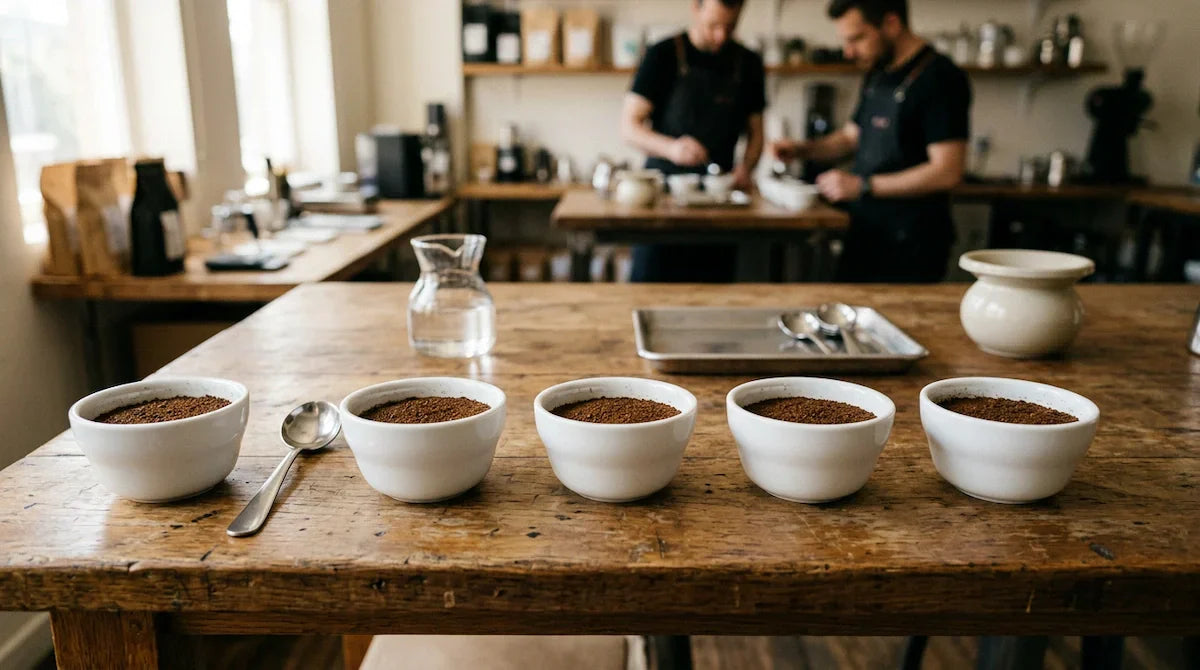
Cupping is a controlled tasting method in which all variables are fixed: grind size, the ratio of coffee to water, water temperature and steeping time. The Specialty Coffee Association (SCA) has formalised this protocol so that results are comparable anywhere in the world. The ratio is 8.25 grams of coffee to 150 millilitres of water, brewed at 93 degrees Celsius, steeped for four minutes without a filter.
No filter is crucial. The coffee oils and fine particles remain in the liquid and give the cupper an unprocessed view of the coffee flavour profile. Filter methods like pourover remove part of that information. With cupping you taste the bean without interference from the brewing method.

How a cupping session unfolds
The cupper starts with the dry grounds. Before water is added they smell the fragrance: the dry aroma the bean already releases. Then the water is poured. After four minutes a crust of floating grounds forms on top of the bowl. The cupper leans over it, breaks the crust gently with the back of their spoon and smells the explosion of aromas released. That is the moment when the wet aromas are most intense.
The surface is then skimmed clean and tasting begins. The technique is striking: the cupper loudly slurps the coffee from a spoon. That sounds impolite but is essential. By atomising the coffee across the entire palate, the flavour compounds reach all taste receptors at once and the volatile aroma compounds rise through the nasal cavity. Tasting coffee this way gives a far more complete picture than simply drinking it.
The session repeats as the coffee cools. Hot, warm, lukewarm: the perception of acidity, sweetness and body changes at every temperature. A coffee that tastes bitter when hot can be complex and pleasant when lukewarm. The cupper records their findings at each temperature.

What a cupper evaluates
The SCA protocol evaluates ten aspects: fragrance and aroma, flavour, aftertaste, acidity, body, balance, uniformity, clean cup, sweetness and an overall final score. Each aspect receives a score on a scale from six to ten, in increments of 0.25. The scores are added together and any defects are subtracted. The maximum score is 100.
For specialty coffee evaluation, the threshold is 80 points. Coffee scoring lower is classified as commercial grade, regardless of origin. Coffee scoring 90 or above belongs to the absolute top and is extremely rare. The vast majority of specialty coffee scores between 80 and 87.
Why cupping matters for single origin coffee
Cupping is the reason the coffee flavour profile of a specific origin can be described and compared objectively. A buyer in Europe can know exactly what they are purchasing based on a cupping report, before the coffee has even been shipped. Two lots from the same farm from different harvest years can be placed side by side and compared objectively.
That also makes cupping relevant for the consumer. When a roaster sells single origin coffee with tasting notes like "red fruit, caramel and light acidity", those notes are based on a cupping session. They are not marketing terms but observations from a standardised tasting process.
Anyone who has seen or done coffee cupping once understands why specialty coffee demands the attention it receives. The method reveals what is truly inside a bean.

Drink the coffee behind the writing
Freshly roasted, delivered to your door, with a fair deal behind every bag.