Coffee oxidation explained — why beans go stale so fast
Freshly roasted coffee is not at its best on day one — and it is already declining by week four.
A freshly opened bag of coffee beans smells different from the same bag two weeks later. That is not imagination. Coffee oxidation is a chemical process that breaks down the volatile aroma compounds in the bean, precisely the compounds responsible for the complexity, sweetness and fruitiness that characterises a good specialty coffee taste. The longer coffee is exposed to oxygen, the flatter the profile becomes.
What oxidation actually does
Coffee beans contain hundreds of volatile aroma compounds formed during roasting. Those compounds are unstable. As soon as they come into contact with oxygen, they begin to break down. Fatty compounds in the bean turn rancid, aldehyde compounds evaporate and the fresh, bright notes disappear first. What remains is a flat, sometimes slightly cardboard-like taste that no longer says anything about the origin or flavour profile of the bean.
Coffee oxidation does not proceed in a straight line. The first few days after roasting the bean is actually not yet optimal for consumption. Freshly roasted coffee beans release CO2, a gas produced during the roasting process. That CO2 forms a temporary buffer that keeps oxygen at bay and protects the bean. That is also why freshly roasted coffee sometimes tastes bitter or sharp: the CO2 interferes with extraction. After three to seven days most of the CO2 has dissipated and the ideal consumption window begins.

The ideal window for consumption
For most specialty coffees the optimal consumption window falls between seven and thirty days after roasting. In that period the CO2 has largely dissipated, the bean has fully settled and the coffee aroma is at its peak. After four to six weeks quality begins to decline noticeably, even if the beans have been stored dry and dark.
Ground coffee oxidises exponentially faster than whole beans. Grinding increases the surface area by a factor of a hundred or more, dramatically increasing exposure to oxygen. Anyone wanting to taste coffee at its freshest always grinds just before brewing, never in advance.
The five enemies of fresh coffee
Coffee oxidation is the primary enemy but not the only one. Moisture is the second: water activates chemical reactions in the bean and accelerates degradation. Heat is the third: higher temperatures speed up all chemical breakdown processes. Light is the fourth: UV radiation damages the chemical structure of aroma compounds. Smell is the fifth and most underestimated: coffee is porous and absorbs ambient odours from the cupboard or fridge more easily than most people think.
Anyone who follows research into coffee freshness sees the same pattern repeatedly: the combination of oxygen and moisture is by far the most destructive. An airtight, dry environment at room temperature is the most effective storage environment for most home brewers.

Why specialty coffee is more sensitive
Cheap bulk coffee has typically already lost most of its aroma compounds before reaching the consumer, through long storage, blending and industrial roasting. There is little left to lose. Specialty coffee taste is built on a layered, nuanced profile that depends on precisely those volatile compounds that oxidation breaks down first.
For storing coffee beans that makes a significant difference. A bag of specialty coffee that has spent three months in a kitchen cupboard has already lost its most interesting characteristics, even if the beans still look and smell fine. Coffee aroma fades quietly and gradually, without visible signals.
What you can do yourself
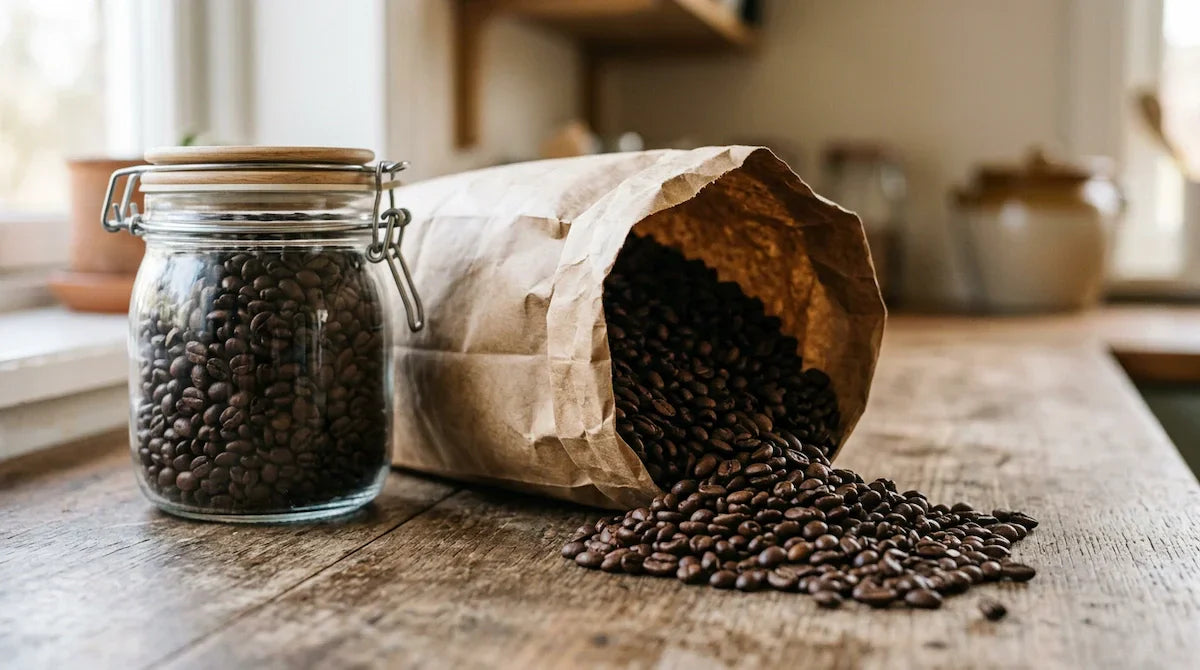
The simplest measure is an airtight storage container. Vacuum containers are even more effective but not strictly necessary for most home brewers. Buy coffee preferably in small quantities that you finish within three weeks. Store the beans in a dry, dark spot at room temperature. The fridge is not a good idea: condensation when opening introduces moisture and the coffee absorbs fridge odours.
Coffee oxidation is inevitable. But anyone who understands how it works can slow it down and gets more out of every bag of beans.

Taste our coffee from Mexico
Freshly roasted, delivered to your door.