
The Soconusco: The Forgotten Region Where Mexican Coffee Began
Mexican coffee started in a narrow strip of Chiapas called the Soconusco in the 1880s. The story of a region almost no one talks about today.
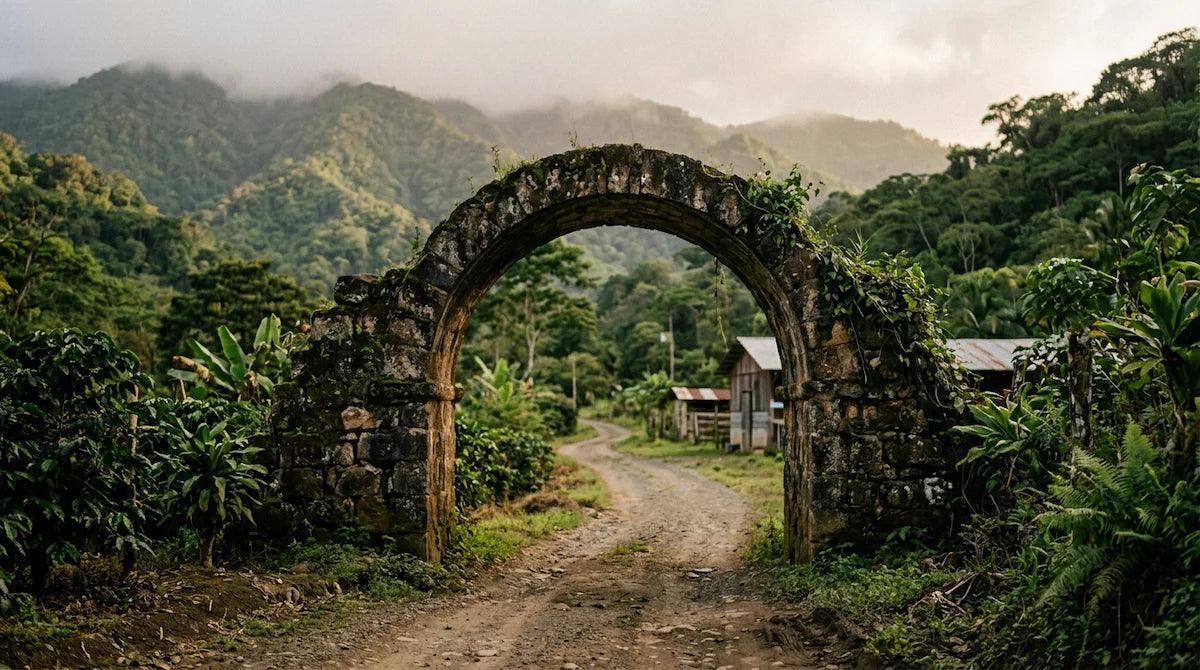
On a back road outside Tapachula stands a stone gate with a German family name carved into the lintel. The paint is gone. The mortar is patchy. The farm behind it still ships coffee every harvest, 140 years after the gate was built.
This is the Soconusco coffee region, the narrow strip of southern Chiapas where coffee in Mexico actually began. Most coffee drinkers, even ones who buy single-origin from Mexico, have never heard the name. The story of how it got built, fell apart, and quietly came back is one of the strangest chapters in Mexican coffee history.
What the Soconusco actually is
The Soconusco sits at the Pacific edge of Chiapas, pressed between the Sierra Madre de Chiapas and the ocean. It runs roughly 600 to 1,800 meters in elevation, with volcanic soils, heavy rainfall on the slopes, and a microclimate that swings between humid lowland heat and cool mountain air over short distances. Pacific slope coffee from this corridor has a particular cup profile because of that compression.
Politically, the Soconusco was its own thing for most of its history. It was annexed by Mexico from Guatemala in 1842 and treated as a frontier region for decades. Mexico City was far away. Local politics were shaped by landowners, foreign investors, and indigenous communities the federal government barely knew how to govern.

How Germans ended up planting coffee here in the 1880s
In the 1870s the Mexican government under Porfirio Díaz wanted the southern frontier productive. Land was offered cheaply to foreign settlers willing to clear, plant, and export. German immigrants answered. They had capital, technical training, and connections to the European green coffee buyers in Hamburg and Bremen.
The first commercial Mexican coffee farms in the Soconusco were planted around 1875 to 1880. Names like Argovia, Hamburgo, and Irlanda go back to that wave. They still operate today. The early German coffee planters built finca compounds with drying patios, washing stations, and water-powered processing equipment imported from Europe, often using shade systems and processing methods they had picked up in Guatemala and Costa Rica.
Mexico exported its first coffee at scale from this region in the 1880s. By the late 19th century the Soconusco had become the most productive coffee zone in the country, supplying European roasters who never advertised the origin on the bag.
The peak years and the long decline
By 1910 the Soconusco produced about 60% of all Mexican coffee. The fincas were running at industrial scale by the standards of the day, with hundreds of workers each harvest, narrow-gauge rail to move parchment to the coast, and direct shipping lines to Hamburg.
Then the Mexican Revolution. Then the 1930s land reforms under Lázaro Cárdenas, which broke up many of the large German-owned estates and redistributed land to ejidos and smallholders. Some German families held onto core farms by adjusting ownership structures. Many lost most of their land. World War II added another layer: Germans in Mexico were placed on US blacklists and several Soconusco estates were seized or forced into Mexican management.
The cooperative model that emerged from the reforms produced a lot of coffee but not always good coffee. Through the second half of the 20th century the Soconusco became a volume origin, not a quality one. Green from Chiapas coffee origins moved into blends, unnamed.

Why the region is producing serious specialty coffee again
The renewal started slowly, with a small group of producers in the 2000s who decided to chase cup quality instead of yield. Some were descendants of the original German coffee planters working with farms that had stayed in the family. Others were ejido coffee farms with younger producers who had trained in cupping and processing in Veracruz, Guatemala, or Honduras.
Specialty Mexican coffee from the Soconusco started cupping 86 and above at international competitions in the late 2010s. Perfect Daily Grind has documented several producers in the region now experimenting with anaerobic and natural processing on lots that previously would have been washed and sold by the kilo.
Today the Soconusco produces roughly 30% of Mexican coffee output by volume, less than its peak share but a far higher proportion of the country's top lots. Mexican coffee farms here are smaller on average than they were in 1910, often 5 to 20 hectares, but the cup scores are higher than they have been in a century.
Want to taste what this region is making now?
The Soconusco story is not over. Producers there are building a second wave of quality, this time aimed at specialty buyers in Europe and Japan rather than commodity green importers in Hamburg.
Santo Café roasts single-origin coffee from Mexico in small batches, the kind of coffee that carries this longer history forward in the cup.

Taste our coffee from Mexico
Freshly roasted, delivered to your door.


