
Transparent coffee supply chain: why most brands hide it
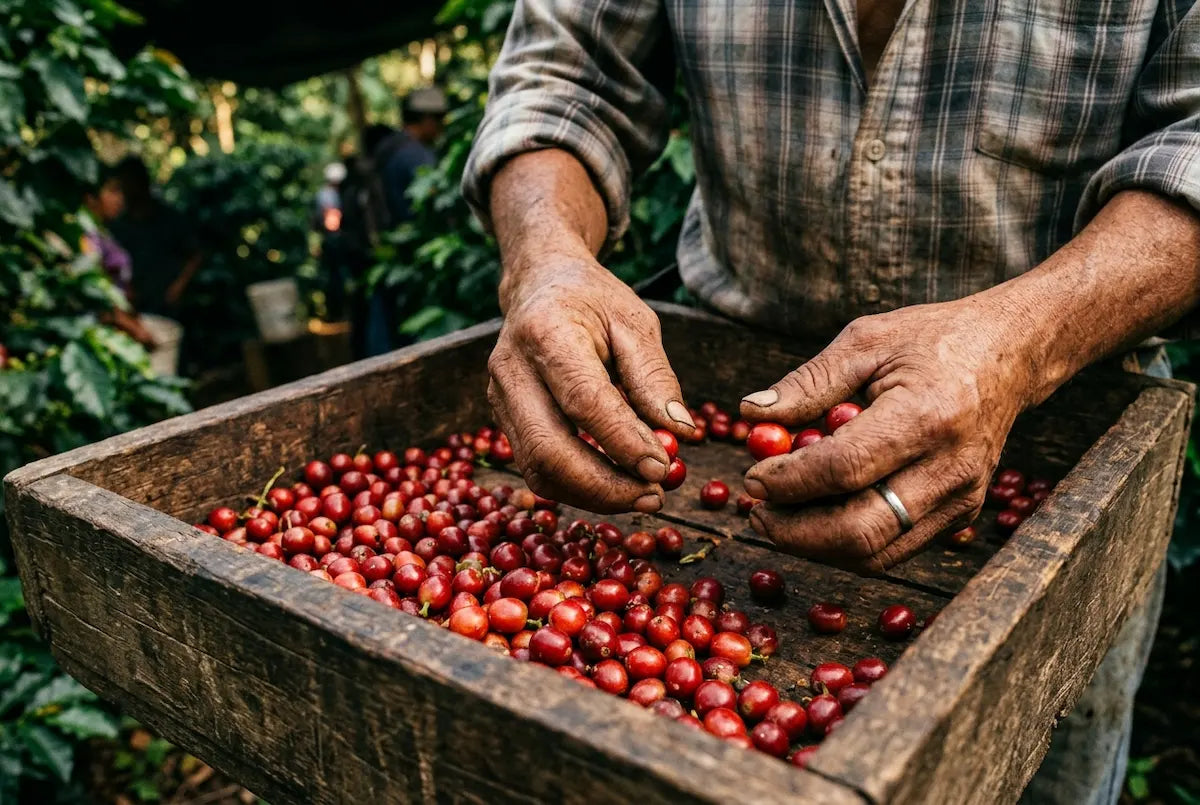
Between the farmer and your cup there can be five parties. None of them are required to tell you that.
The packaging shows a photo of a farmer. A name. Maybe a country of origin. It feels transparent. But what really sits between that farmer and your cup is rarely what it appears.
The coffee supply chain is one of the most fragmented chains in the world. That has consequences for the farmer, for the quality and for what you as a consumer actually know.
How many steps sit normally in the coffee chain
An average coffee transaction has at least five parties. The farmer sells to an exporter. The exporter works with an importer. The importer delivers to a roaster. The roaster sells to a shop or hospitality. And somewhere in between sit traders, cooperatives and intermediaries who all take a margin.

Every link has a reason to reveal as little as possible about the previous link. The margin sits in the information asymmetry. The farmer does not know what the consumer pays. The consumer does not know what the farmer received. That is not coincidence but a structural feature of how bulk trade in coffee works. And in that world a transparent coffee supply chain is not the norm but the exception.
Why coffee supply chain transparency is so rare
Brands that claim to buy fairly are rarely asked to prove it. A Fairtrade label guarantees a minimum price but tells you nothing about which specific farmer grew the beans, at what altitude, with what processing method. The coffee supply chain transparency stops at the country. Sometimes at the region.

Specialty coffee goes further. What sets specialty coffee apart is precisely that traceability: a specific farm, a harvest year, a processing method. Not as a marketing story but as verifiable information. The coffee supply chain is complex but transparency is genuinely possible when a brand consciously chooses it.
What you as a consumer can do
Ask about the country of origin. Ask about the region. Ask about the farmer or cooperative. If a brand cannot go beyond the country, you know enough. Good fair coffee can answer those questions.
Also look at the price. Coffee that is structurally cheaper than the market price for specialty simply cannot pay that price to the farmer. The chain does not work differently. A fair price for a quality bean has a floor, and that floor sits higher than most supermarket consumers are willing to pay. That is not a judgement but a calculation. And why Mexican coffee is getting more expensive is directly connected to what fair payment in the chain actually means.

Taste our coffee from Mexico
Freshly roasted, delivered to your door.


