Coffee blooming explained — why pre-wetting makes a difference
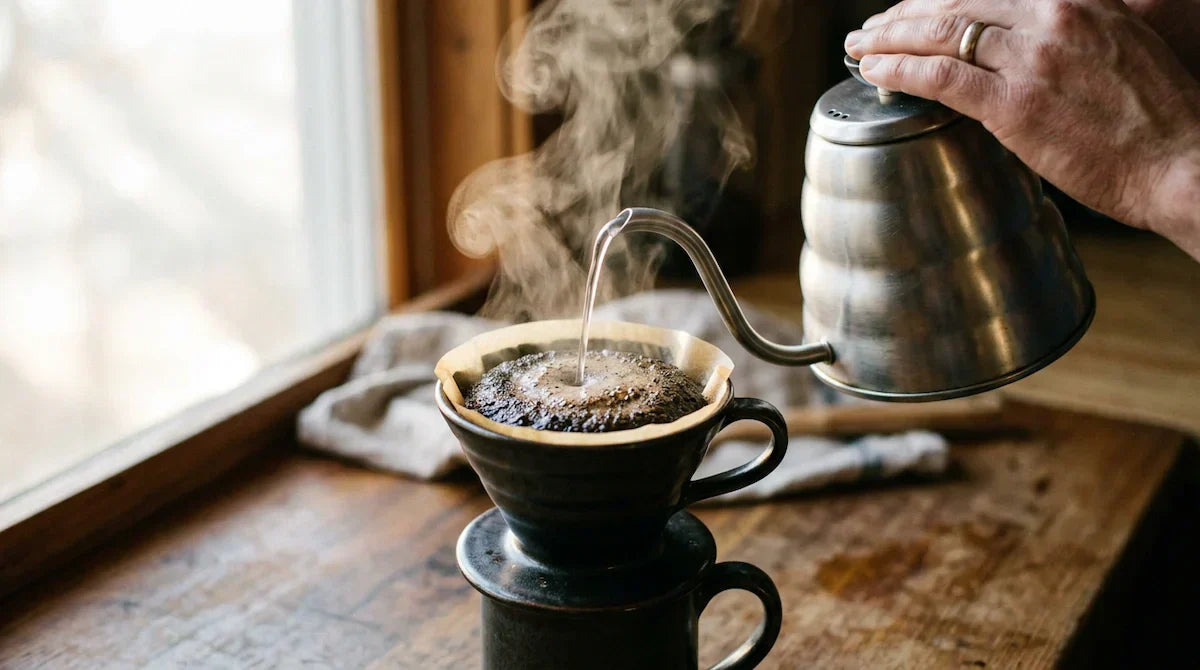
If your coffee grounds do not bubble when water hits them, your beans are telling you something.
With freshly roasted coffee you see it the moment water hits the grounds: the grounds begin to swell, bubble and expand. Sometimes it almost looks like breathing. That is coffee blooming, and it is one of the most visible signals of freshness in a bag of beans.
What happens chemically
During roasting, chemical reactions inside the coffee bean produce a large amount of CO2 coffee gas. That gas is partially stored in the cellular structure of the bean. Directly after roasting the concentration is so high that the bean even needs a brief rest before consumption. That is also why freshly roasted coffee has a slightly sharper, less balanced flavour profile in the first few days.
As soon as hot water comes into contact with the ground coffee, that stored CO2 begins to escape. The bubbles you see during coffee blooming are literally gas escaping. The grounds swell, burst open and release the gas that was driven into them during roasting.

Why blooming improves extraction
CO2 coffee gas and water mix poorly. If a lot of CO2 is still present in the grounds when you start pouring, the gas forms a barrier between the water and the flavour compounds in the bean. The water is essentially pushed away from where the extraction work needs to happen.
By first pouring a small amount of water over the grounds, twice the weight of the coffee is a common rule of thumb, and waiting 30 to 45 seconds, you give the CO2 a chance to escape. Only then do you start the actual pour. The extraction then proceeds more evenly, the water reaches the flavour compounds without a gas barrier, and the result in the cup is clearer and more complete. That is precisely why coffee blooming is a standard step in every pourover coffee protocol.
Blooming as a freshness test
An interesting by-product of the blooming step is that it gives you direct information about the freshness of your beans. Freshly roasted coffee, from the past two to three weeks, blooms vigorously. The grounds visibly rise, the bubbles are active and it takes the full 30 to 45 seconds for the activity to subside.
With coffee that is four to six weeks old or older, the CO2 coffee content drops significantly. The blooming is barely visible or entirely absent. The grounds do not move, no bubbles form. That is not a sign something went wrong with the brewing. It is a sign that the beans have largely exhaled. Perfect Daily Grind describes how the extent of blooming directly correlates with the amount of CO2 still present in the bean after roasting.

When blooming is less relevant
Not every brewing method calls for an explicit blooming step. With a French press, where the coffee sits in the water for four to five minutes, the CO2 dissolves on its own during the steeping time. The same applies to an AeroPress. Blooming is most relevant with pourover coffee, where water is actively guided through the grounds and the contact time per drop is short. Here the CO2 content makes the most difference for the evenness of extraction.
When brewing specialty coffee with freshly roasted beans, the blooming step is not optional. It is the step that starts the rest of the extraction in the way it was intended.
How to do it in practice
Pour twice the weight of the coffee in hot water over the grounds. With 15 grams of coffee that is 30 grams of water. Make sure all the coffee gets wet. Then wait 30 to 45 seconds and observe what happens. If the coffee is fresh, you will see the grounds actively expand. After the waiting time, begin slowly pouring the rest of the water in circular movements.
The more exuberant the coffee blooming, the fresher the bean. And the fresher the bean, the more there is to taste in a good pourover coffee.

Taste our coffee from Mexico
Freshly roasted, delivered to your door.