Coffee grind size explained — why it determines everything
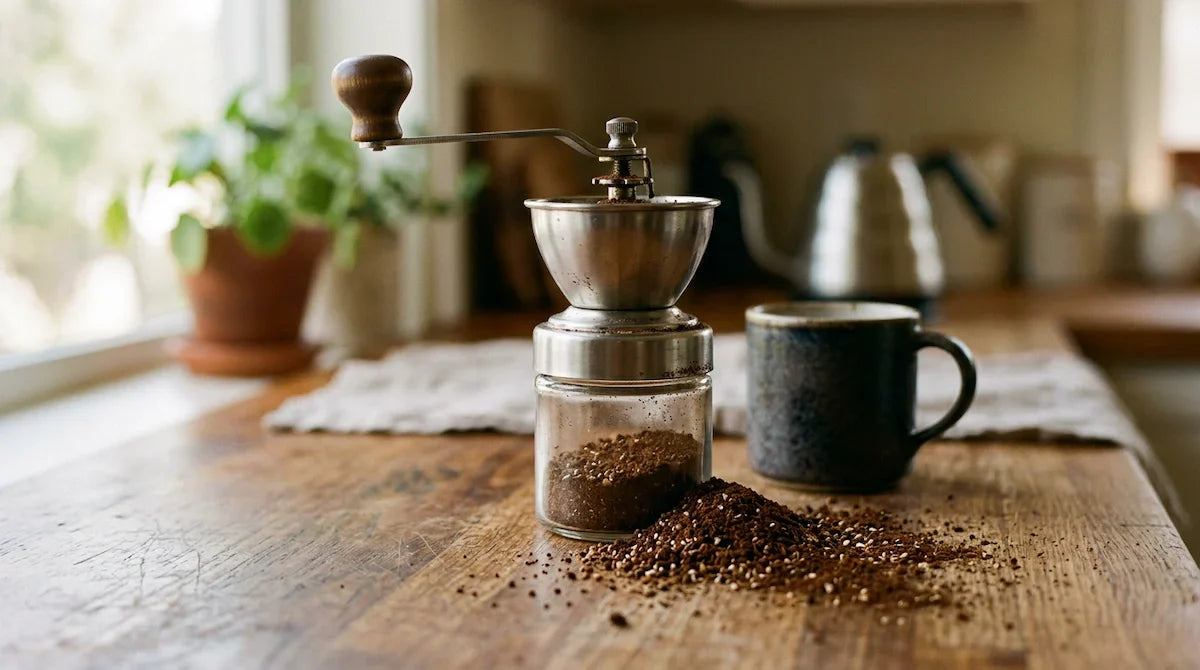
Same beans, different grind size — completely different result in your cup.
Take the same beans. Grind them fine for one cup, coarse for another. The result is so different you would swear it was two different types of coffee. Coffee grind size is, after the beans themselves, the variable that determines most what ends up in your cup.
How grind size controls extraction
When water flows through ground coffee, it dissolves flavour compounds from the bean. That process is called coffee extraction. The grind size determines how much surface area is available for the water and how quickly the water flows through. Finely ground coffee has more surface area, meaning water stays in longer and more intensive contact with the bean. Coarsely ground coffee has less surface area and lets water pass through faster.
Extraction always follows the same sequence: acids come first, then sweetness, then bitterness. Grind size determines where on that spectrum you end up. Grinding too fine pulls out too many bitter compounds. Grinding too coarse stops extraction too early, leaving the coffee flavour flat and sour. Both are immediately noticeable in the cup.

Which grind size suits which method
Every brewing technique calls for its own grind size, because the contact time between water and coffee varies greatly per method. A short, fast method needs finely ground coffee to extract enough flavour. A slow method needs coarsely ground coffee to avoid over-extraction.
Espresso is the fastest method: hot water flows through the coffee in twenty to thirty seconds under high pressure. That calls for a very fine grind, comparable to fine sand. AeroPress works well with medium-fine: a little more space than espresso, but still compact enough for a full cup in a short time. Pourover needs a medium grind that lets water flow steadily and produces a clear flavour profile. French press keeps the coffee in contact with water for four to five minutes, so coarse grinding prevents bitterness. Cold brew steeps for up to twelve hours and therefore needs the coarsest grind of all.
Anyone who wants to taste specialty coffee Netherlands at its best at home cannot avoid matching the grind size to the brewing method. The wrong grind size hides exactly the notes that make the coffee interesting.
Burr or blade: the type of grinder also matters
Not only the setting but also the grinder itself makes a difference. A blade grinder chops beans randomly, resulting in a mix of fine and coarse particles. Those particles all extract at a different pace in the same cup, making the coffee flavour restless and unbalanced. A burr grinder grinds the beans between two grinding discs to a consistent particle size. Perfect Daily Grind describes consistency of grind size as one of the most determining factors for balanced coffee extraction.

For anyone who regularly brews at home with single origin beans, a burr grinder is not a luxury. It is the tool that allows the flavour profile of the bean to actually come through.
What to do when the coffee tastes off
If your coffee tastes sour or flat, grind finer. If it tastes bitter or dry, grind coarser. Those two cues are enough to fix most problems without touching other variables. Small adjustments already have a noticeable effect quickly, especially with single origin coffee with a pronounced flavour profile.
A good grinder and a deliberate grind size are together the shortest route to a cup that actually tastes like what is inside the bean.

Taste our coffee from Mexico
Freshly roasted, delivered to your door.