How altitude shapes the taste of your coffee
That number on the packaging tells you more about the taste of your coffee than you think.
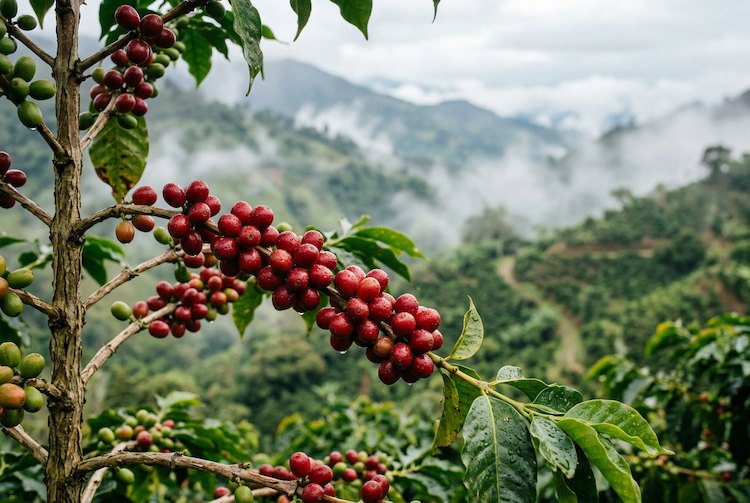
At high altitude it is colder. That lower temperature slows the growth of the coffee plant. A cherry that normally takes four months to ripen might take six or seven months at 1600 metres. That extra time is not a loss, it is exactly where the flavour comes from.
The longer a cherry hangs on the tree, the more sugars and flavour compounds can develop. Scientific research confirms this: arabica coffee grown at higher altitudes has measurably more complex flavour profiles, more acidity and more pronounced aroma than coffee from lower plots. That is not marketing, that is chemistry.

Arabica coffee altitude and density
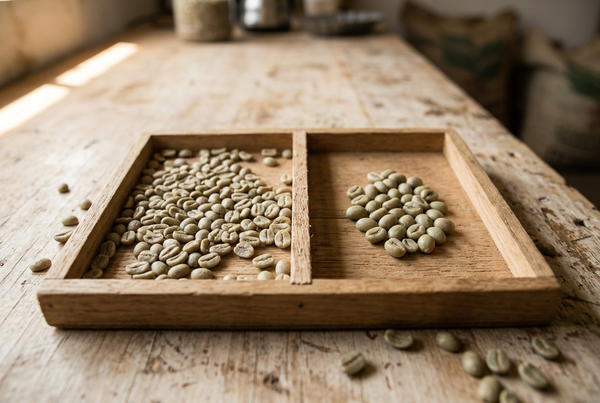
Altitude also affects the physical properties of the coffee bean itself. Beans from high altitude are more compact and denser. If you place them next to a lowland robusta, you see the difference. That density means more flavour compounds per bean. You notice this not only when tasting but also when roasting, the bean has more to give.
Robusta typically grows between 200 and 800 metres. Arabica prefers higher, ideally between 1200 and 2000 metres above sea level. Chiapas, one of the highest coffee regions in Mexico, falls exactly in that optimal range. Many plots there sit at 1200 to 1800 metres. That is also why coffee from Chiapas so consistently has a pronounced flavour profile.

What you taste in high altitude coffee
Coffee from high altitude typically has more acidity. Not the unpleasant, sharp sourness of bad coffee, but a clear, fruity brightness that lifts the flavour. Notes of citrus, red fruit or flowers are typical of well-grown highland coffee.
Lowland coffee tastes different. Earthier, heavier, less complex. Not necessarily bad, but different. You miss the layering you find in a good mountain coffee. That is also why specialty coffee almost always comes from high altitude.
Altitude as a quality indicator
In Central America a classification system exists that acknowledges this. Coffee grown above 1350 metres is called SHG, Strictly High Grown. The name says enough. Altitude is so decisive for quality that it has become an official criterion.
If you want to understand why specialty coffee costs more than supermarket coffee, altitude is a large part of the answer. Higher plots are harder to reach, the harvest is more labour-intensive and the yield per tree is lower. But the flavour you get back is of a different order. Want to know more about what specialty coffee actually means? Read this article on the difference with regular coffee. And for those who want to understand the science behind altitude, this overview from Perfect Daily Grind explains it well.

Taste our coffee from Mexico
Freshly roasted, delivered to your door.