Hand coffee grinder or electric — which suits your brewing
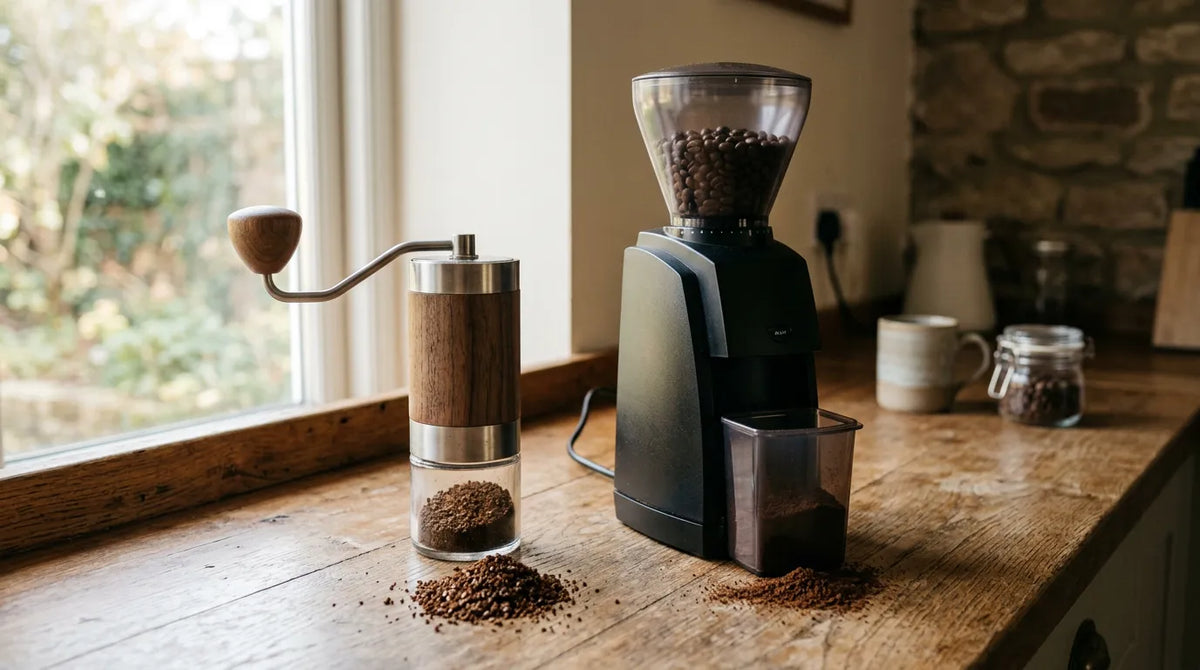
A fifty-euro hand grinder often outperforms a hundred-euro electric one — here is why.
Anyone who wants to brew specialty coffee seriously cannot avoid it: the beans must be freshly ground. But which grinder you use makes a big difference in practice. The hand coffee grinder and the electric coffee grinder are both capable, but they suit different types of home brewer.
How both grinders work
Both types use a burr set: two grinding discs that reduce the bean to a consistent particle size. That is the first thing that matters. A blade grinder, where a blade chops the beans randomly, produces an uneven coffee grind size that leads to unbalanced extraction. Anyone serious about grinding coffee at home always needs a burr grinder, whether that is a hand or electric model.
The difference lies in the drive. With a hand grinder you turn the handle yourself. With an electric grinder a motor does the work. That sounds simple, but it has consequences for speed, noise, price and the quality you get for your money.

The hand grinder: quiet precision for little money
A good hand coffee grinder in the mid-range costs between fifty and a hundred euros. For that budget you get a grind quality that you only encounter in an electric grinder from twice as much. There is a reason for this: with hand grinders the budget goes entirely to the burr set and mechanism. There is no motor, no housing, no display.
Popular models such as the Timemore C2, the 1Zpresso JX and the Hario Skerton Pro are known for their consistent coffee grind size in the mid-range. They are compact, quiet and work without electricity. That also makes them ideal for travel or camping.
The disadvantage is clear: grinding takes time and effort. For one pourover or AeroPress you spend twenty to thirty seconds. Two cups of French press: a minute or longer. Anyone in a hurry every morning or brewing multiple cups in a row will find that the hand grinder requires a deliberate choice.
The electric grinder: speed and consistency at scale
An electric coffee grinder grinds a portion in five to fifteen seconds. For households with multiple coffee moments per day or people who regularly brew for others, that is a practical advantage that quickly offsets the higher purchase price.
The entry-level models in the electric segment, such as the Baratza Encore or the Wilfa Svart, start around a hundred to a hundred and fifty euros. For comparable grind quality to a fifty-euro hand grinder you pay more. But those willing to spend more, around two to three hundred euros, get an electric grinder that surpasses manual models in consistency.
For anyone wanting to brew specialty coffee Netherlands daily without fuss, an electric grinder at that higher budget is the most comfortable choice.

Grind quality: what it actually comes down to
The goal of every grinder is a uniform particle size. The more uniform the coffee grind size, the more even the extraction, the clearer the flavour profile in the cup. With single origin coffee with a nuanced flavour profile, that distinction is noticeable: a good grinder reveals the fruity notes that a poor grinder buries under bitterness and noise.
In the mid-range, good hand grinders and electric grinders perform comparably. At the higher end, electric grinders win on consistency, particularly at finer grind sizes for espresso or AeroPress. For pourover and French press the difference is smaller.
Which suits you
Choose a hand coffee grinder if you brew one or two cups each morning, want to be deliberate about your morning ritual, and want high performance on a limited budget. The Timemore C2 or 1Zpresso JX are solid starting points.
Choose an electric coffee grinder if you grind multiple cups per day, brew for others, or simply do not want the physical effort of grinding coffee at home. In that case go for a burr grinder above a hundred euros. Everything below that sits close to the quality of a good hand grinder, but without the benefit of a low purchase price.
Both paths lead to a better cup, as long as you choose a burr grinder over a blade grinder. That is the only hard rule.

Drink the coffee behind the writing
Freshly roasted, delivered to your door, with a fair deal behind every bag.