Pourover coffee or French press — which suits your taste
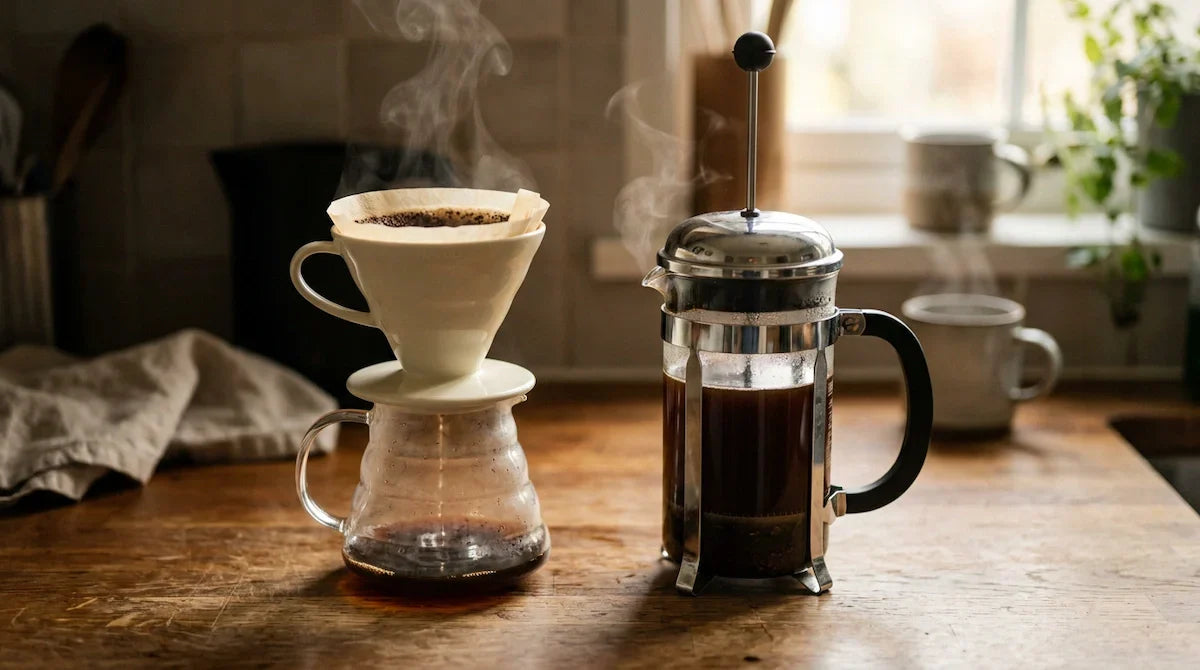
Pourover reveals what is in the bean. French press amplifies how it feels in your mouth.
Two of the most popular ways to brew specialty coffee at home are polar opposites. Pourover coffee gives clarity. French press coffee gives body. Which you choose depends on what you want to taste in your cup and how much attention you are willing to give the brewing process.
How pourover works
With a pourover, you slowly and deliberately pour hot water over coffee grounds in a filter. The water draws through the coffee and drips into a carafe or cup below. Brew time typically runs between two and four minutes, depending on grind size and pour speed.
The paper or metal filter holds back virtually all coffee oils and fine particles. That gives pourover coffee its characteristic clarity: a clean, transparent liquid in which the flavour notes of the bean are clearly distinguishable. Fruity acidity, floral tones, a delicate finish. Anyone wanting to taste a specialty coffee flavour profile in all its nuance will find pourover the most direct method.

The downside is that pourover demands more. You need a gooseneck kettle for control over the water flow, a scale for the right ratio and the focus to distribute the water evenly. A good pourover is not something you make in passing. It is a deliberate ritual.
How French press works
With a French press you add coarsely ground coffee directly to the carafe, pour hot water over it and let it steep for four to five minutes. Then you slowly press the plunger down, which pushes the grounds to the bottom. Then you pour.
Because there is no paper filter, the coffee oils and some fine particles remain in the liquid. That gives French press coffee its full, robust character: more body, a silky texture and a rich, round flavour. More subtle notes are less clearly conveyed as a result, but the overall mouthfeel is more impressive than with pourover.
French press is also simpler. You do not need a special kettle and the method forgives small deviations in grind size or pour sequence more easily. For brewing coffee at home without much fuss, it is a logical choice.
Flavour compared
The difference lies in the filtration. Pourover filters strictly and delivers a clear, light cup with pronounced flavour details. French press barely filters and delivers a full, heavy cup with more body and less transparency in the coffee flavour profile.

For single origin coffee from high-altitude regions with a nuanced flavour profile of fruit and flowers, pourover coffee is the better choice. The method shows exactly those notes the farmer and roaster developed. French press suits coffees with a pronounced body and earthy or chocolate tones better, where texture is just as important as flavour.
What equipment do you need
For pourover you need at minimum: a pourover dripper (Hario V60, Chemex or Kalita Wave are the most common), paper or reusable filters, a gooseneck kettle and a kitchen scale. The investment sits between fifty and one hundred euros for a solid starter kit.
For French press you only need the press itself. A good glass or stainless steel French press costs between twenty and fifty euros. No filters, no special kettle. For anyone wanting to start brewing specialty coffee Netherlands at home without a major investment, the French press is the lowest-threshold first step.
Which suits you
Choose pourover coffee if you like clarity, want to taste the nuances of a single origin and are willing to spend a few focused minutes brewing. The result rewards the attention you put in.
Choose French press coffee if you like a full, rich cup, want less fuss and want brewing coffee at home to be as accessible as possible. The method is forgiving and consistently delivers a satisfying result.
Both methods show what specialty coffee can do when you take the time. They just do it in a completely different way.

Drink the coffee behind the writing
Freshly roasted, delivered to your door, with a fair deal behind every bag.