Why a good coffee grinder matters more than your machine
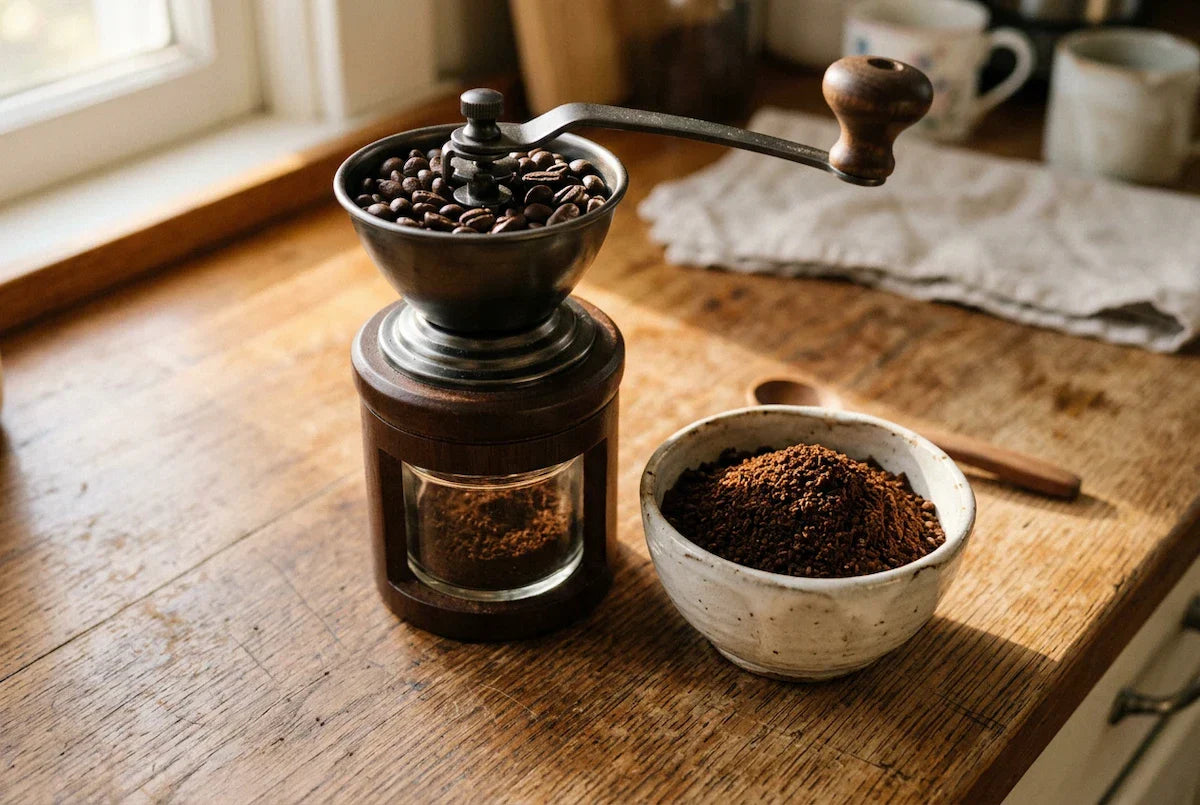
You can buy the most expensive espresso machine. Without a good coffee grinder you will brew mediocre coffee with it.
Most home coffee brewers invest hundreds of euros in an espresso machine or a good filter coffee maker. And then buy a twenty euro blade grinder to go with it. That is the wrong order. Of all the equipment that affects your home setup, the coffee grinder is the most decisive factor for what ends up in your cup.
Here is why that is and what you can do about it.
What the coffee grinder does to the taste
Brewing coffee is extraction: hot water dissolves flavour compounds from ground coffee. How evenly that extraction proceeds depends entirely on the size and consistency of the ground particles. Small particles extract faster than large ones. If your grind is uneven, you have simultaneous over-extraction and under-extraction in the same cup. You taste that as a combination of bitterness and sourness that does not work.
Buying a good coffee grinder solves this. Specialty coffee has subtle flavour profiles that only come through properly when extraction is balanced. An uneven grind masks precisely those nuances that make the bean valuable.

Blade grinder vs burr grinder coffee: the difference
A blade grinder chops coffee beans with a rotating blade, similar to a small blender. The result is a mix of coarse and fine: part of the beans is ground to dust while large chunks remain. You have no control over grind size and every grind produces a different distribution.
A burr grinder coffee machine works differently. Two discs or cones with sharp edges grind the beans into particles of a uniform size. The distance between the discs determines the grind size. You set it coarse for a french press and fine for espresso, and you get the same result every time. That is the foundation of consistent grinding coffee at home.
Grind size also determines extraction time. French press and espresso require completely different grind sizes. Without a good grinder you cannot reliably make that difference.
Why a good grinder does more than an expensive machine
A mid-range espresso machine at 400 euros with a good coffee grinder produces better coffee than an 800 euro machine with a poor grinder. That sounds contradictory but it is correct. The machine brings water to temperature and pressure. What the machine meets with that pressure, the ground coffee, determines everything. If the grind is inconsistent, no machine can compensate for that.

Professional baristas confirm this without exception: when purchasing home equipment the budget is better spent on a good grinder than a more expensive machine. Perfect Daily Grind describes extensively how the coffee grinder guide for home use always starts with choosing burr over blade.
What the minimum investment is for a good burr grinder
For filter coffee and french press an electric conical burr grinder between 80 and 150 euros is already a significant improvement over a blade grinder. Models like the Baratza Encore or comparable entry-level models from Timemore fall in this range and deliver reliable results for most brewing methods.
For espresso the threshold is higher. The grind for espresso is critical and requires fine adjustment steps that cheap grinders do not offer. Here you realistically start at 150 to 250 euros for a solid entry-level option. Those who want to invest less but still grind fresh are better served by a manual burr grinder, which in the range of 50 to 100 euros can already deliver excellent results for filter coffee and french press.
The rule of thumb is simple: buy the best grinder you can afford and choose your machine afterwards.
Curious which coffee a good grinder brings out the most?
Santo Café sources its coffee from Mexico, where farmers receive a fair price for their harvest. Single origin Arabica with a pronounced flavour profile that only comes through properly with a consistent grind.

If you want to taste what a good grinder and good beans deliver together, this is where to begin.

Drink the coffee behind the writing
Freshly roasted, delivered to your door, with a fair deal behind every bag.