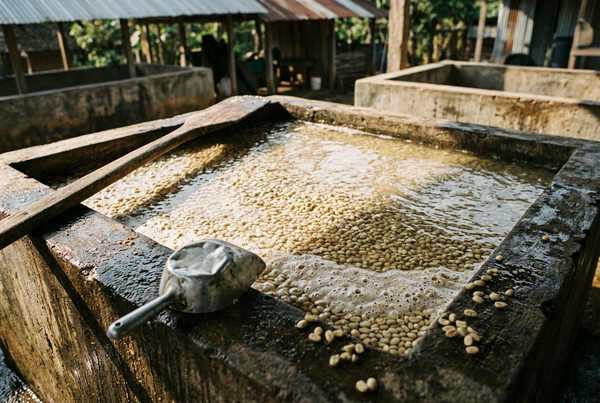
Caffeine in coffee plants does more than keep the insects away
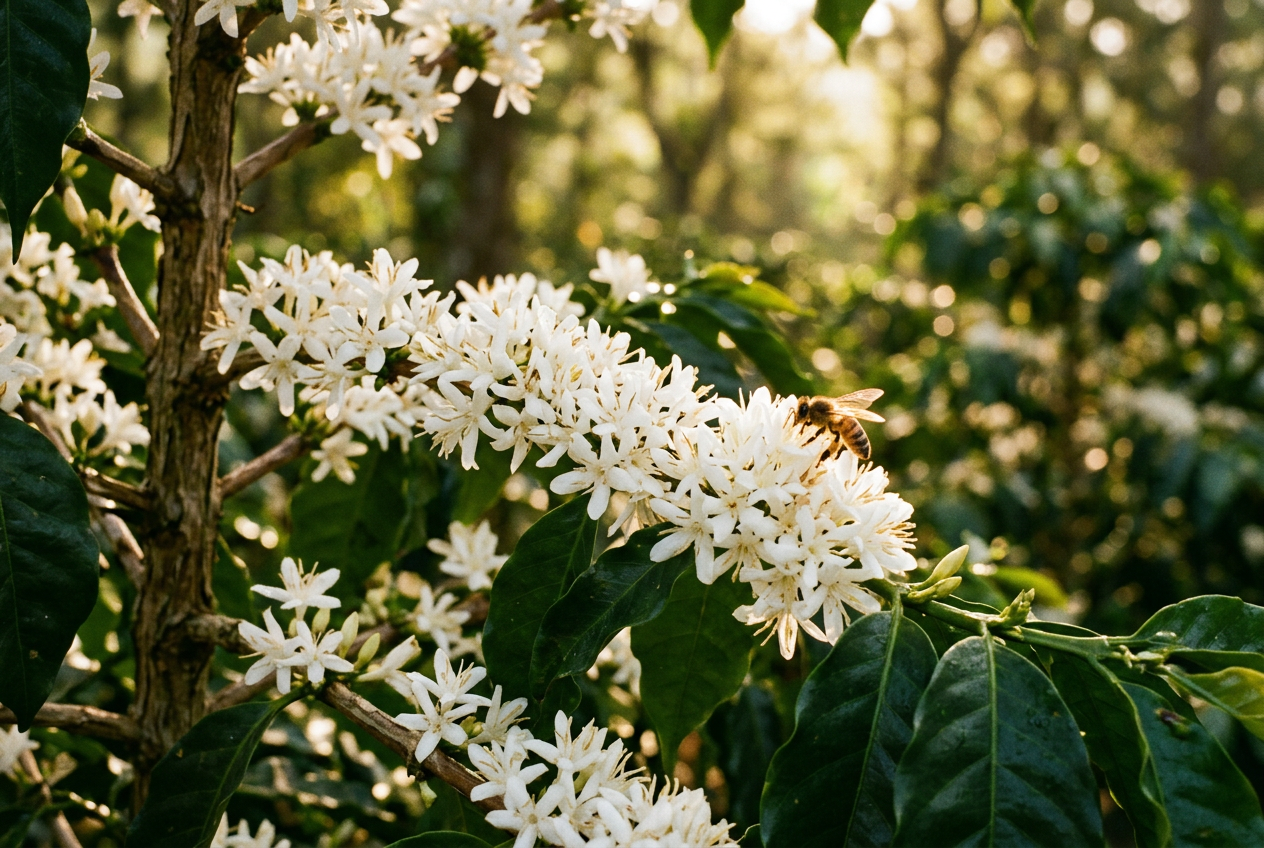
The coffee tree puts caffeine in its nectar at a dose too small to taste and large enough to change what a bee remembers.
A coffee flower holds only a few microlitres of nectar, and some of that nectar is drugged. Caffeine turns up in it at concentrations between 0.003 and 0.253 mM, far below anything a person could taste, and enough to leave a mark on the insect that drinks it. Next to what sits in the leaves, the caffeine content of a flower is a rounding error. It is also the part that has been shown to do something.
Most writing about caffeine starts at the cup. The plant got there first, and its reasons have nothing to do with anyone's morning.
What coffee flower nectar actually carries
A group at Newcastle University sampled the nectar of three Coffea species, C. canephora, C. arabica and C. liberica, alongside three Citrus species, and published the result in Science in 2013. Where caffeine was present, its concentration ran from 0.003 to 0.253 mM. Total sugar in the same nectar ranged from 0.338 to 0.843 M, which is the part a bee is actually after.
Caffeine showed up more often in the nectar of Coffea canephora than in either of the other two, and that species held the highest mean concentration of everything sampled. Same genus, different chemistry, and the gap runs in the same direction as the one in the beans.
Three times as many bees remembered the scent
The nectar survey was only the setup. The same group conditioned honeybees to link a floral scent with a sugar reward. Some rewards were plain sucrose, some carried 0.1 mM caffeine, a dose sitting inside the range they had just measured in real flowers. During training the two groups learned at nearly the same rate. The difference came later.
Three times as many bees remembered the conditioned scent 24 hours afterwards and responded as though it predicted food. At 72 hours, twice as many still did. Honeybee memory is not something a flower is usually thought to improve, and the effect was not a matter of the bees simply smelling better.
The mechanism is the one caffeine uses elsewhere. It blocks adenosine receptors, and that antagonism potentiates the mushroom body neurons a bee uses for olfactory learning. Cells that would have answered weakly answer harder, and the trace left behind holds.

A dose that stops just short of bitter
Bees can taste caffeine. They carry neurons that detect it in sensilla on their mouthparts, and they refuse sucrose solutions once the caffeine climbs above 1 mM. That is a ceiling the nectar never touches. Across every flower sampled, concentrations did not exceed 0.3 mM, which works out at 0.058 mg/ml.
Set that against the rest of the plant, where levels in vegetative and seed tissue have been reported as high as 24 mg/ml. The flower is not a diluted version of the leaf. It is a different dose doing a different job, and the same molecule reads as a deterrent at one concentration and a reward at another. A cup runs on the same logic, which is why caffeine gets blamed for a bitterness it barely causes.
Where caffeine in coffee plants is actually made
Caffeine biosynthesis runs as three methylation steps on a xanthosine backbone, at positions 7-N, 3-N and 1-N. The intermediates are worth knowing by name: 7-methylxanthosine first, then theobromine, the alkaloid that carries chocolate, and only then caffeine.
Where it happens is not the bean. Tracking both species through leaf and grain development, researchers found that young coffee leaves hold the highest concentrations anywhere in the plant, at 3 percent of dry weight in Robusta against 1.6 percent in Arabica. In mature leaves the figure falls to 70 percent of the young-leaf level.
Tender growth is what a tree cannot afford to lose. That is where the chemistry sits.

What that leaves in the bean
By the time the seed is ripe the gap has narrowed without closing. In the mature bean the caffeine content is 50 percent higher in Robusta than in Arabica, a difference settled long before harvest and untouched by anything a roaster does afterwards. Which species a farm plants is a decision about disease pressure and altitude as much as flavour, which is why the varieties that replaced Mexico's rusted trees read as chemistry as much as agronomy.
So the line on a bag worth reading is the species, not the roast. Robusta beans were never a stronger version of the same plant. They came off a tree that spent more of its budget on one molecule, starting in leaves that never reached anybody's cup.

Taste our coffee from Mexico
Freshly roasted, delivered to your door.