
Mexican coffee varieties: what replaced the trees rust killed
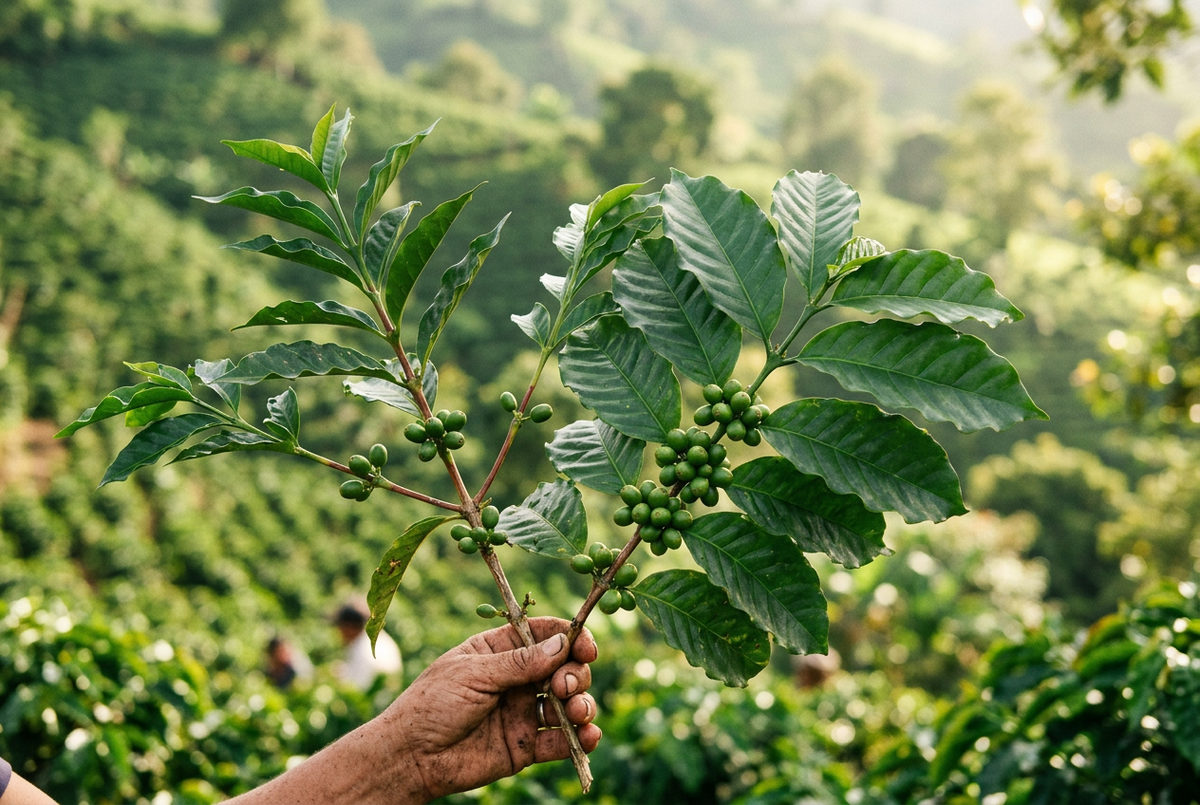
The trees that went back into the ground were bred to survive, and survival is a different brief from flavour.
A farm that lost its coffee to leaf rust did not replant what it had. It replanted what would live. That decision, taken across hundreds of thousands of hillside plots, is why the Mexican coffee varieties standing in the ground today are not the ones that were there fifteen years ago.
Species first, then variety
Arabica and robusta are two different species of plant, and the gap between them is the one most people already know. Typica, Bourbon, Caturra and Catimor sit one level below that. They are all arabica, the way a Cox and a Granny Smith are both apples, and the differences between them are just as real on the tongue.
A coffee cultivar behaves like an apple cultivar in the ways that matter to a farmer too. It sets how much fruit a plant carries, how tall it grows, what altitude it tolerates, and which diseases can take it down. That last one turned out to be the whole story.
What Mexico was growing before
Typica came first. It is the lineage that travelled from Yemen through Java and the Caribbean into the Americas, tall and slow and low-yielding, and for a long stretch it was most of what Mexico had. Bourbon, its close relative, filled in much of the rest.
Both are prized in the cup and both are close to defenceless against Hemileia vastatrix, the fungus that causes leaf rust. Under an intact shade canopy on cool high ground they held on for a century and a half. When the weather shifted, they stopped holding.

What the rust changed
The epidemic that cut Mexico's crop by 40 percent in 2013 and 2014 emptied whole plots, and the nurseries that answered it were not stocked with Typica. They were stocked with the Catimor family.
Catimor came out of the Coffee Rusts Research Centre in Portugal around 1959: the Timor Hybrid crossed with Caturra. It is highly productive, resistant to disease, and content on lower ground than the heirlooms will accept. Costa Rica 95, a cross of Caturra and Timor Hybrid 823/1, holds off both leaf rust and ojo de gallo and keeps producing at altitudes where Bourbon sulks.
A nursery choice is not made on flavour notes. It is made on whether the seedling handed to a grower will still be alive in four years, which is how long a replanted tree takes to bear anything. Everything else is a question for later, and later arrived only recently.
Oro Azteca, bred in Mexico
One of those replacements is Mexican by birth. INIFAP, the national agricultural research institute, spent roughly fifteen years developing Oro Azteca, the first coffee variety bred in the country. It runs on a Catimor line, meaning Timor Hybrid stock crossed with Red Caturra: the Timor side supplies the rust resistance, the Caturra side supplies the yield, the cup and the compact plant height.
The numbers explain its spread. The variety catalogue puts it at roughly 32 to 45 quintals per hectare, around 37 percent more than Red Caturra manages alone, on a plant that does not die when the rust arrives. For a smallholder carrying four barren years, that is not a preference. That is the difference between farming and stopping.

Does a rust resistant coffee taste worse?
Not automatically, but the question is fair and the honest answer has two halves. Every one of these lines carries the Timor Hybrid, and the Timor Hybrid carries robusta ancestry. That is exactly where the resistance comes from, and it is also why Catimor types earned a reputation among buyers for a flatter, less articulate cup than Typica or Bourbon.
The other half is that breeding did not stop. Marsellesa, another rust resistant coffee in wide use, performs best up to about 1300 metres and shows a fruity, floral aroma with balanced medium acidity and a body close to Caturra but sweeter. And in a finished cup, altitude, picking and processing still move more than the variety name does. A carelessly picked Bourbon loses to a carefully picked Catimor every time.
Look for a variety on the next bag you buy. Most do not print one, and a specialty coffee roaster who does is telling you they know the lot well enough to name it.
Does the name on the bag earn its place?

A variety name only means something when the rest of the lot is known as well, which is the part most bags leave blank. Santo Café roasts a single-origin Mexican arabica in small batches, with the origin on the bag rather than a marketing word. One origin, one profile, and no blending to smooth over what is missing.

Taste our coffee from Mexico
Freshly roasted, delivered to your door.


