Coffee sweetness survives a roast that destroys 97% of the sugar

Roasting destroys almost all the sugar in a coffee bean, and the cup still tastes sweet, because most of that sweetness is aroma.
Ask a roaster to describe a good filter coffee and the word sweet turns up almost immediately. Ask an analytical chemist how much sugar in coffee survives the roast and the answer is close to none. Both are right, and the gap between them is the most useful thing a home brewer can learn this month, because sweetness in the cup is something a brew protects or ruins. It is not a property sealed into the bag at the roastery.
How much sugar in coffee there is before the roast
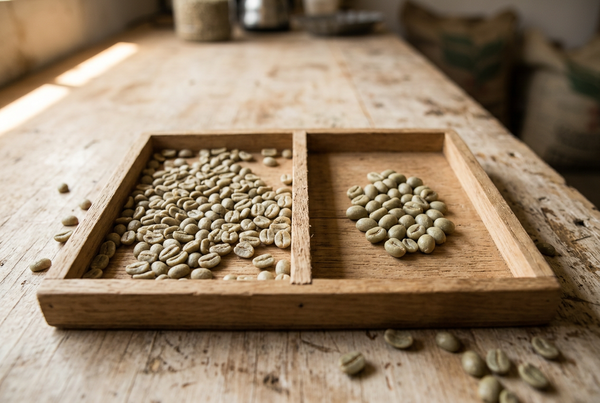
Sucrose is the main sugar in a raw coffee seed, and there is a real quantity of it. Green coffee beans of the Arabica species carry between 6.25% and 8.45% sucrose by dry weight. Robusta runs much lower, from 0.9% to 4.85%. Those figures come from hyperspectral measurements of individual beans rather than bulk averages, which is why the ranges are tight enough to be worth quoting.
Eight percent is not a rounding error. A raw seed holds enough sucrose to taste, if anyone wanted to drink it, and nobody does. The roast is the thing standing between that seed and the cup, and it is not a gentle process.
What the roast does to it
Heat does not caramelise the sucrose into a sweeter bean. It takes it apart. Sucrose hydrolyses into glucose and fructose, and those simpler sugars are consumed almost at once by caramelisation and by the Maillard reaction between reducing sugars and amino acids. Work published in Frontiers in Nutrition puts the scale of it plainly: on roasting, sucrose content falls by about 97%.
What survives is not sugar but the things sugar became. Hundreds of aroma compounds, a great many of which smell sweet. That is the bargain the roast strikes. It spends the sugar to buy the smell.

Where coffee sweetness actually comes from
Most of what a taster calls sweetness never touches a sweet receptor on the tongue. It arrives through the nose, by the retronasal route: compounds released in the mouth during swallowing travel up to the olfactory epithelium, and the brain folds what it reads there back into something that feels like taste.
The effect has been measured. In a sensory and EEG study of 16 adults, a moderate level of ethyl maltol aroma over a 6% sucrose solution raised perceived sweetness by 14.7%. Ten times more of the same aroma reversed it, cutting sweetness by 5.4%. That was a model solution and not a cup of coffee, but the mechanism is the one at work in the cup. Furfural, phenylacetaldehyde and 2,3-butanedione all raise the sweetness of sugar solutions without tasting sweet themselves, and furfural and 2,3-butanedione are ordinary roast volatiles. None of this makes a coffee sweeter. It makes the drinker read it as sweeter.
Bitterness sets the level sweetness is judged against
Sweetness is also a subtraction problem. One brew reads as sweet and the next reads as flat and harsh, from the same beans and the same water, because the bitter compounds that mask it scaled differently. Push water too far through the bed and the late, harsh fractions arrive, which is the mechanism behind why coffee tastes bitter and the most common way a home brewer buries sweetness that was already there.
Which is why the repair is usually a grind setting rather than a different bag of beans. Bringing the extraction yield back inside its working window adds no sugar to anything. It removes the competition.

A test that takes one morning
Brew a cup the usual way and taste it hot. Then pinch the nose shut, take one sip, hold it, and let go. The step up when the nose opens is the aroma contribution, and in most roasted coffee it is bigger than people expect. Let the same cup drop to room temperature and taste it again. More of the volatile fraction has left by then, and the sweetness goes with it. The liquid has not lost a gram of sugar between the two sips.
Sweetness in roasted coffee is not a claim printed on a label. It is something the grinder and the kettle either keep or throw away.

Taste our coffee from Mexico
Freshly roasted, delivered to your door.