Peaberry coffee beans dry faster and cup the same as the rest
Peaberry beans are 5 to 7% of every harvest, screened out as a defect and then sold back on taste, and the study that cupped them found the same score.
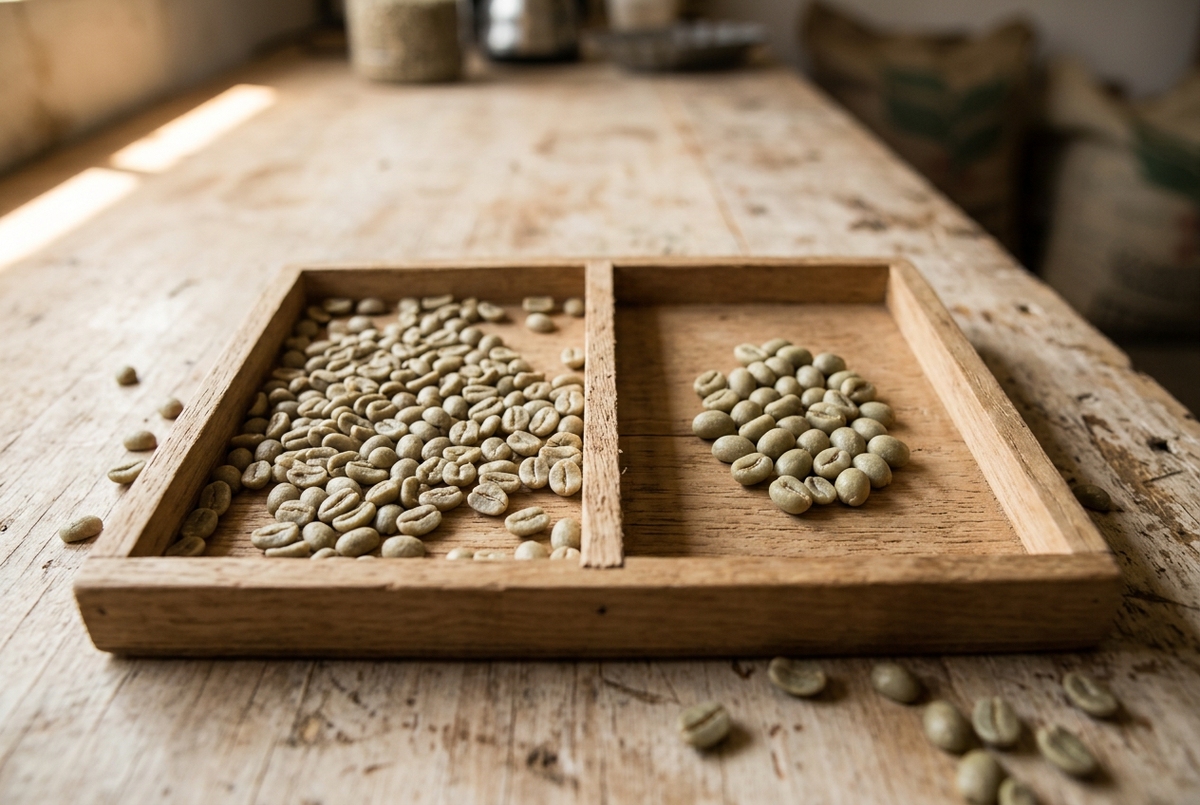
On a sorting table in any producing country, one bean in a handful comes up wrong. Rounded on every side, no flat face, no crease, and it rolls instead of lying flat. Graders pull it out. Peaberry beans are not a separate species, a separate variety or a separate farm. They are an accident of pollination: a defect to screen off at one end of the chain, the most expensive thing in the lot at the other.
What happens inside the coffee cherry
A coffee cherry normally carries two seeds, grown pressed flat against one another. That contact is the whole reason a coffee bean has one domed side, one flat side and a seam. Sometimes it fails. Failing to fertilise both ovules of one of the seeds, or a failure in endosperm development, leaves a single seed to grow alone. With nothing pressing back, it fills the cavity alone and comes out smaller, denser and far more domed.
The rate holds across both commercial species. Work out of Cenicafe in Colombia puts peaberries at 5% to 7% of the total harvested crop for Coffea arabica L. and Coffea canephora alike, and brewing chemists report the same band independently. That is somewhere between one bean in 20 and one in 14, in every lot, every season. How much fruit it takes to make a kilo of green coffee does not shift either way.
Labelled a defect, then sold on flavour
In most producing countries the round bean is simply a fault. The Cenicafe team put it in those terms: peaberries are often labelled a defect for their shape and reduced size, against a market that wants large, uniform, standard beans. Mills sort on screens, and a seed that will not lie flat is awkward for anyone paid on consistency.
Then the lot crosses the water and the story inverts. Producers market peaberry coffee as flavourful, with a complex aroma and a sweeter taste, and the reason offered is that the single seed took everything the coffee cherry had to give. That is a sales argument with an intuitive mechanism behind it, not a measurement. The same authors who recorded the claim wrote that the bean's chemical character is not well understood.

The shape does change how the bean behaves
Coffee bean shape does turn out to matter, just not where the marketing points. Peaberry beans behave differently in a mill, and that half has been measured. A team ran peaberries and standard beans of Coffea arabica L. var. Cenicafe 1 through the full postharvest chain, weighing rather than tasting: drying, roast colorimetry, inner roasting profiles, and compressive and shear force tests on the grinder.
The round bean came out ahead on every mechanical count. It dried faster. It roasted evenly, avoiding the burnt spots that catch the thin edges of a flat bean. Under load it collapsed at homogeneous forces instead of splitting along a flat face. That shape carries no thin edge to scorch, and what the inside of a bean looks like governs how heat and water travel through it.
The cup score that did not move
Then comes the cupping analysis. Against standard beans of the same variety, the peaberries attained the same high cup scores. Not higher. The same. The peaberry market had grown on the back of exceptional scores for the bean type, and nobody had tested the link to shape until this team did. The shape explained the drying, the roasting and the grinding, and nothing at all about the score.
The brew chemistry leans the same way. Lots from Tanzania, Kenya, Sumatra and Papua New Guinea were taken to a medium roast and ejected at 188 degrees Celsius, ground to a 500 to 710 micrometre fraction, then brewed hot and cold. The published measurements put pH between 5.10 and 5.29 and total caffeoylquinic acid between 1845 and 2294 mg per litre. Caffeine concentration ran from 1108 to 1315 mg per litre, above the 960 to 1250 reported elsewhere for cold brew and the 520 to 1140 for a French press. The authors called that a hint rather than a finding, and they were right to: those numbers come from other studies, not from flat beans on the same bench.

What a bag of round beans asks of you
Tip a handful out before dialling anything in. If every seed is rounded, with no flat face and no seam, it is a peaberry lot. The useful response is not a better cup, because the one controlled comparison says the cup is the same. It is to treat the grinder as unsolved: a bean that collapses at an even force and takes heat more evenly will not sit where the last bag sat. Peaberry beans change the machine setting, not the expectation.

Taste our coffee from Mexico
Freshly roasted, delivered to your door.