Cold brew coffee: what the cold water changes and what it does not
Two chemistry papers measured what a seven hour cold steep actually pulls out of coffee, and it is not a gentler drink.
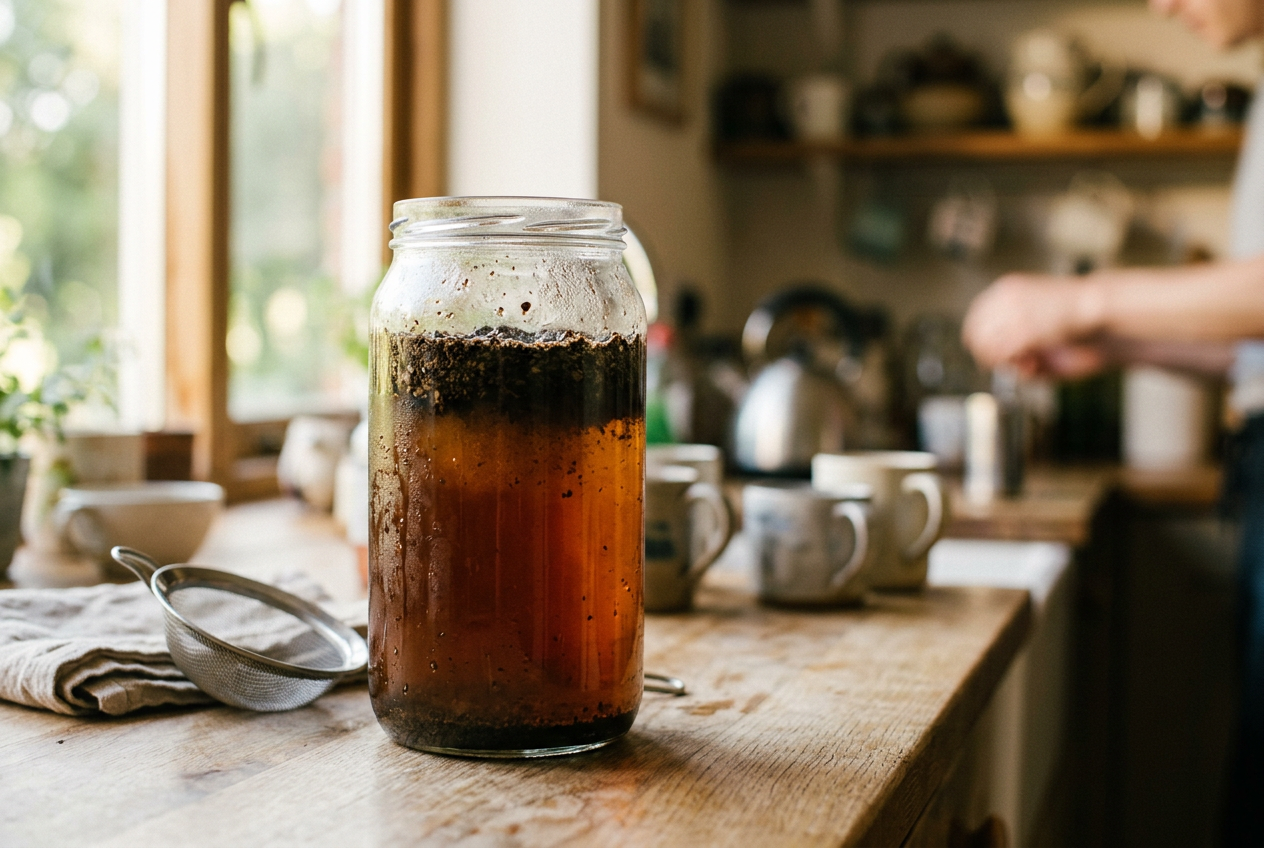
Leave 35.0 g of ground coffee in 350 mL of water on a kitchen counter for seven hours and something happens that most cafe menus describe wrongly. The jar of cold brew coffee that comes off that counter is not a softer drink. It is a slower one. Two chemistry papers out of Thomas Jefferson University measured what actually leaves the grounds when the water never gets hot, and the numbers cut against the copy on most bottles.
What cold brew extraction actually is, in numbers
Both studies ran the same setup. 35.0 g of coffee, 350 mL of water, and then one variable moved: the water itself. The hot control went in at 98 °C and came out after six minutes. The cold batch sat at room temperature, somewhere between 21 °C and 25 °C, for seven hours.
That is the whole difference. No filter change, no ratio change, no different bean. Time replaces heat. Coffee solubles do not read the label on the bottle, they answer to temperature and to steeping time, and the two do not swap cleanly.
Cold brew acidity barely moves the pH
The 2018 paper measured pH across light roast coffees from Brazil, two Ethiopian regions, Colombia, Myanmar and Mexico. The cold samples landed between 4.96 and 5.13. Their hot counterparts landed between 4.85 and 5.10. The two ranges overlap almost end to end.
Where they did separate was total titratable acidity, which counts how much acid sits in the cup rather than how strong it reads on a meter. There the hot extracts carried the larger measures. Cold brew acidity, then, is lower by one count and level by the other, which is worth checking in the published measurements before repeating the line that cold coffee is the gentle option.

The cold does not hold the caffeine back
The 2017 paper tracked caffeine and chlorogenic acid as they came out of the grounds. In the coarse grind samples the deviation between hot and cold was considerable, and it ran the wrong way for anyone expecting a weaker drink: the cold extractions carried the higher caffeine.
That is a result from four samples, not a law that makes every jar stronger than every pot of filter coffee. What it does retire is the idea that cold water is a mild solvent. Given seven hours it reaches roughly where boiling water reaches in six, and in one case past it. The bitterness people report in a long steep has a chemistry behind it, and it is not the chemistry of a scorched hot brew.
Grind size moves less than the clock does
Grinding finer is the standard fix for a thin brew. In cold brew extraction it mostly is not. Between medium and coarse grinds the 2017 study found no significant change in the equilibrium concentrations the samples reached, which puts the rate limiting step somewhere other than surface area.
That is useful at the counter. Once the steep runs long enough for the system to settle, a finer grind buys a cloudier drink and a slower filtration rather than a stronger cup. Caffeine concentration is set by the clock and by what is in the bean, and that is a different question from why a hot brew turns sour when the grind is off.

Roast level is the lever that moved most
The variable that separated the samples hardest was neither the water nor the grinder. It was the roast. Beans roasted at 215 °C to 217 °C gave up more caffeine and more chlorogenic acid than the same beans taken to 223 °C to 225 °C.
So the bag decides more here than the brewer does. A medium roast in a jar of cold brew coffee reads heavier than a dark roast through the same steep, which is the reverse of what the colour suggests. Buy one bag, split it, brew half hot and half cold at the same 35.0 g to 350 mL ratio, and taste them side by side once both have come to the same temperature. The gap shows up in the aroma and in the bitter register, not in the acid.

Taste our coffee from Mexico
Freshly roasted, delivered to your door.