Coffee acidity is not the same as sour, and the numbers show it
Acidity is a number a roaster can titrate, and almost none of it survives the trip to your tongue.
A roaster can hear the moment a batch reaches its most acidic point. It happens at first crack, and it happens whether the profile ran fast or slow. That is the odd thing about coffee acidity: it is a measured quantity with a peak, a decay and a titration endpoint, and almost none of that survives the trip to the tasting table, where the same word gets stretched to cover a cup that simply tastes sharp and wrong.
What a roaster measures, and when it peaks
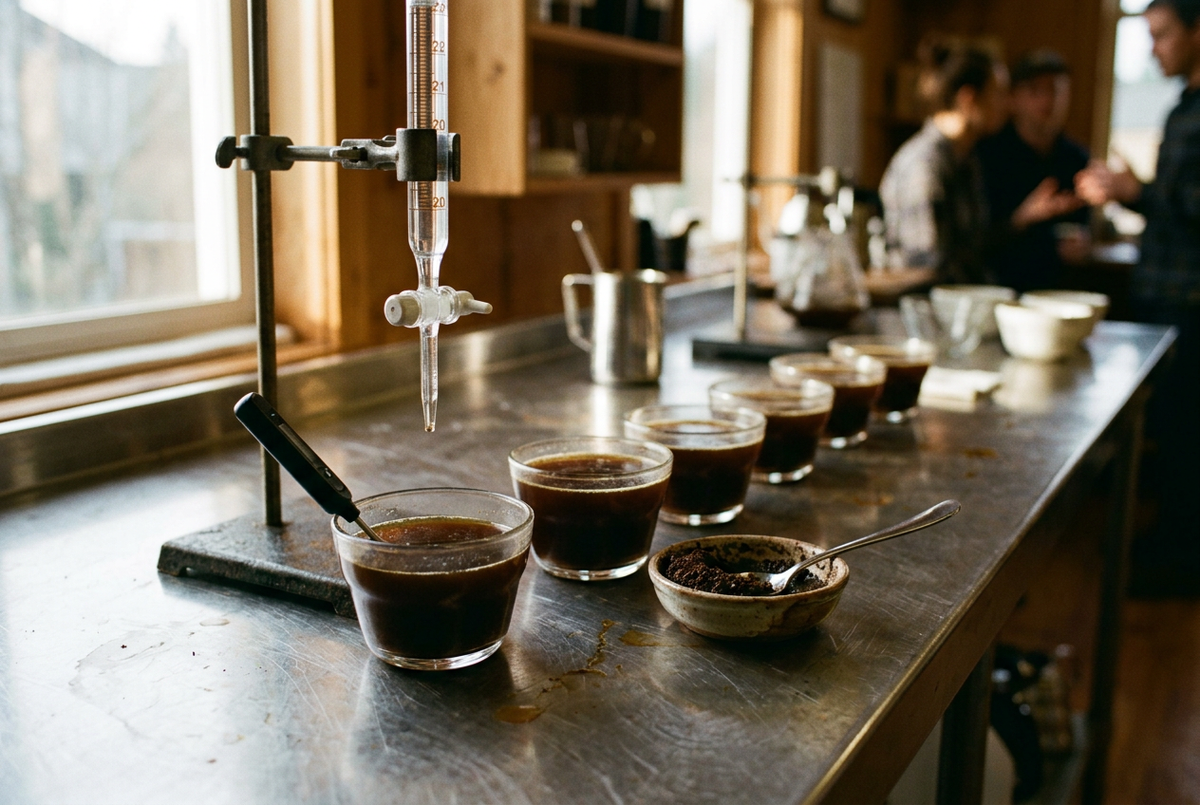
A team at UC Davis roasted the same coffees seven different ways in a 5 kg commercial drum roaster, holding every batch to 16 minutes and changing only the shape of the heat curve. Samples came off the trier throughout, and every brew went under a titrator. The green baseline sat at 2.2 mL of sodium hydroxide per 40 mL sample, at pH 5.9.
Every profile then did the same thing. Titratable acidity climbed to an average peak of 4.9 mL, always during first crack, and fell away after it. By the onset of second crack it had come back to roughly where it began: 2.5, 2.7 and 2.8 mL across three of the profiles. The peak value barely moved between profiles or between the three origins tested. What the profile changed was when it arrived.
Acidity in coffee is not one substance
A Danish group measured nine organic acids in French press brews of five coffees from Brazil, Bolivia and Kenya, all in the light to very light range. Roast degree pulled them in opposite directions. Citric, malic and chlorogenic acids dropped as the roast went darker. Acetic, lactic, phosphoric, quinic and glycolic acids rose. Formic acid alone refused to follow a trend.
That split is why roast level is a blunt instrument for predicting a cup. A light roast coffee is not simply more acidic. It is acidic in a different arrangement, heavier on the acids that heat destroys and lighter on the ones heat creates.

What roasting burns off
Chlorogenic acids are the clearest case. Green beans carry a great deal of them, and one survey of commercial lots put the range at 61.15 to 86.42 mg per gram before any heat. Roasting at 230 degrees for 12 minutes cut total chlorogenic acid to nearly half. Pushed to 250 degrees for 21 minutes, it fell to trace levels. The same paper noted a general correlation between those compounds and pH.
The roast study behind the titration curve is open to read in full, and it repays a look at what it does not claim. It measured a number, not a preference.
Only one acid clears the bar a tongue sets
The Danish study also ran a threshold test, and the result is awkward for the way people talk about tasting. Citric acid was the only acid sitting in the cup above its own detection threshold. That threshold fell below 0.16 g/L, while the brews held 0.23 to 0.60 g/L. Brazilian lots came in at 0.49 g/L and Kenyan lots at 0.30 g/L.
Malic, acetic and lactic acid all sat under the level at which a taster can pick them out alone. The researchers then spiked brews with each acid at its measured average concentration and asked coffee experts to name what had gone in. Nobody got it right.

Why a sharp cup usually is not the bean
Put the findings side by side and sour coffee starts to look like a brewing fault in a chemistry costume. The acids are in every cup, mostly below the level anyone can name individually. What separates a bright cup from a harsh one is how much of the ground coffee the water actually dissolved, which comes down to grind, contact time and how much coffee met how much water.
There is a cheap test for that. Brew the same bag twice in one morning, changing a single variable and nothing else: go finer on the grinder, or give the water longer against the grounds. If the sharpness drops away, the sour coffee was extraction. If it holds steady through both cups, the acidity in coffee that reaches the table is the bean's own.

Taste our coffee from Mexico
Freshly roasted, delivered to your door.