What the decaffeination process actually does to a coffee bean
Three industrial routes lead to the same word on the bag, and they do very different things to the bean.
Decaf coffee is not coffee without caffeine. It is coffee that has had most of its caffeine taken out, and the word most is doing real work in that sentence. A cup of decaf lands somewhere around 3 to 7 mg of caffeine, against roughly 95 mg for a normal cup of filter coffee. Small, but not nothing.
What a decaffeination process has to hit
The target depends on where the coffee is sold, and the two big markets do not measure the same thing. In the United States a coffee may be called decaffeinated once at least 97 percent of the caffeine that was in the bean has been removed. Most European rules come at it from the other end and cap what stays behind, at 0.1 percent of dry weight in roasted coffee. One is a percentage taken out, the other a percentage remaining.
The distinction matters more on paper than in a cup, since both routes end up within a few milligrams of each other. What it does mean is that the caffeine content of the bean going in changes the difficulty of the job. A lot that starts high has to give up more before it clears either threshold, and it has to do that without the rest of the bean leaving alongside it.

Water doing the work
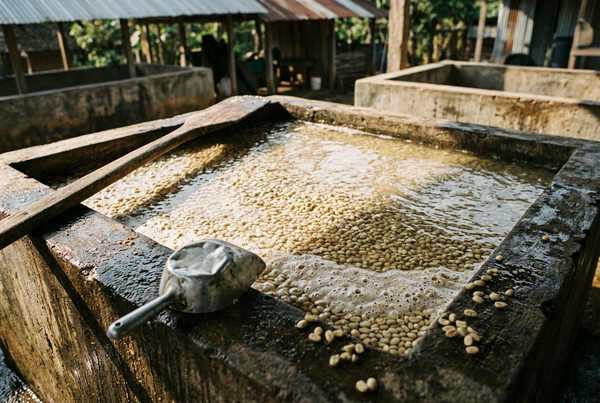
The Swiss Water process adds no solvent at all. Unroasted beans are put in contact with a saturated green coffee extract, a liquid already carrying everything a bean is soluble in except caffeine. Because the liquid is full of everything else, only the caffeine has anywhere to go, and it migrates out along the concentration gradient until the two sides balance.
Run that cycle enough times and the beans come out quoted at 99.9 percent caffeine free. The liquid is then pulled through carbon filters that strip the caffeine back out of it and sent around again, which is the part that takes time. Coffee decaffeinated this way costs more per kilo than the alternatives, and the price is mostly the hours.
Sugarcane, which is a solvent with a friendlier name
The sugarcane method is a solvent process, and the solvent is ethyl acetate. It is made by fermenting sugarcane molasses, which is where the friendly name on the bag comes from, and it binds to caffeine while leaving most other soluble compounds where they are. Moistened beans sit in circulating solvent, batch after batch, until the caffeine has been carried off.
The method removes a minimum of 97 percent of the caffeine and leaves a residue of at most 10 parts per million. The directive covering coffee extracts works at a different scale entirely, allowing 0.3 percent in the instant category, which is three times what roasted beans are held to.

Carbon dioxide under pressure
The third route uses carbon dioxide. Beans are soaked in water first, then held in a vessel with the gas at high pressure, in the region of 1,000 pounds per square inch. Under that pressure the gas stops behaving like a gas and starts acting as a selective solvent, dissolving caffeine and largely ignoring the compounds that carry flavour and aroma.
The equipment is expensive and the vessels are large, so this route runs commodity volumes rather than single lots. The starting material matters here as much as anywhere. Robusta carries roughly twice the caffeine of arabica, and the gap between the two species turns into a difference in how much work a plant does per sack.
Does decaf coffee taste worse?
Not by definition, though the bean has been through something before it ever reaches a roaster. Every one of these routes wets the bean, warms it and changes its cell structure, and a bean in that state browns faster and takes heat differently. Roasters treat decaf as its own profile rather than running it alongside everything else, which is one reason where a roast lands on the scale reads differently on a decaf bag.
The other reason is duller. Decaf sells slowly, so it sits, and a stale bag tastes worse than a fresh one whatever the residual caffeine figure says. The process is usually printed somewhere on the packaging, and a bag that names water, sugarcane or pressure is telling you something that a bag saying only decaf is not.

Taste our coffee from Mexico
Freshly roasted, delivered to your door.