
Brew basket shape changes drip coffee more than the grind does
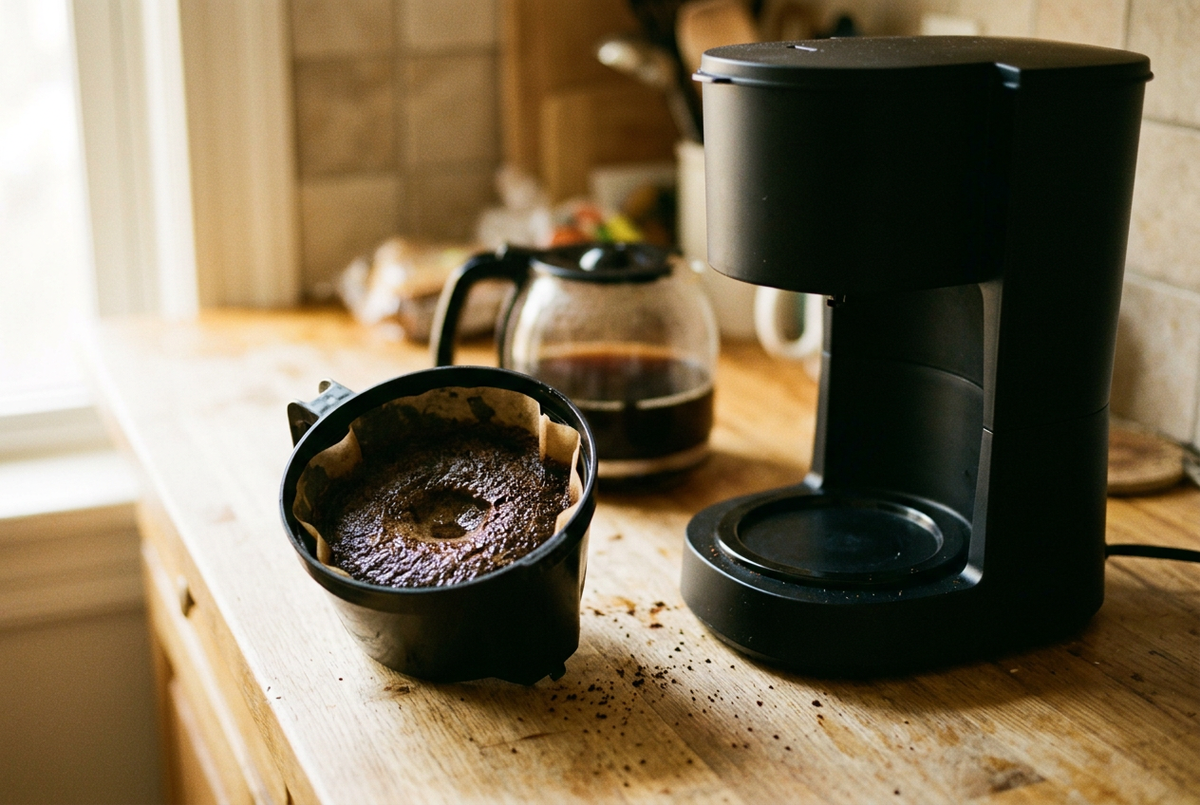
A UC Davis panel could tell a cone basket from a flat one by taste, but could not tell two grinds apart inside either.
The dial on the grinder gets all the attention. The basket underneath it does not, and yet a drip coffee machine arrives with its basket in one of two shapes, a shallow flat tub or a steep cone, and that shape is fixed on the day the machine is bought. A team at the University of California, Davis put both shapes through one brewer with the same dose, water and temperature, then asked a trained panel whether it could taste the difference. It could. What it could not taste was a change of grind inside a single shape.
The same machine, two brew basket shapes
Scott Frost, William Ristenpart and Jean-Xavier Guinard needed a way to change the shape and nothing else. A Breville Precision Brewer gave them one, because its cone insert drops straight into the flat filter basket the brewer ships with. Everything else was pinned down. 66 g of ground coffee, 1,200 g of water, the gold cup setting running at 4 mL/s, water leaving the spray head at 95 °C, and a 2:30 drip out period before anything was poured.
The coffee was ground on a Mahlkönig Guatemala Lab Grinder at three settings, with median particle sizes near 800, 1,000 and 1,200 micrometres, each measured three times on a laser analyser. Two roasts went through as well: a dark blend of Latin American origin at Agtron 32.0, and a lighter Colombian and Ethiopian blend at Agtron 48.8.
The panel could taste the basket, not the grind
Triangle tests came first. Three cups, two of them identical, 45 participants working through six sets in booths lit with red light. Coffees brewed in the two shapes came out significantly different, with a p value under 0.05. The quieter result is worth taping to the machine: a 25% change in median particle size, kept inside one shape, was not discernible at all.
Home advice tends to run the other way round. Thin cup, grind finer. Harsh cup, grind coarser. Across the range this study covered, grind size moved the coffee less than the container did, and the settings a drip machine usually runs at sit inside that quiet zone.

Why the cone runs stronger
Same dose, different container. A flat-bottom basket spreads the coffee into a wide shallow bed. A cone stacks it into a deep column, so water travels further and less of it slips around the edge. The refractometer backed that up: the semi-conical basket produced coffee of significantly higher dissolved solids than the flat one.
The size of the gap makes it useful. The smallest difference the panel could actually detect was 0.24 percentage points of dissolved solids, between the flat basket at the fine grind and the cone at the medium grind, worth a 28% jump in relative terms. Turning the grinder moved much less. A shift of 266.0 micrometres in median particle size bought 0.16 points in the cone and 0.15 in the flat basket, relative gains of 15% and 21%, and neither one crossed the line. The published paper treats that concentration as the driver behind nearly every difference the panel reported, which is the same quantity sitting under the numbers behind an extraction figure.
The same settings, a different cup each morning
One figure is easy to skim past and hard to unsee afterwards. Brewing the same coffee on the same settings, the flat basket at the fine grind gave drinks running from 0.65% to 1.0% dissolved solids. The cone at that grind stayed between 1.2% and 1.3%. The flat one wandered across a wider band than the 0.24 points that made two coffees taste different in the first place.
That is brew strength drifting for reasons nobody is adjusting: how the bed settles, where the water lands, whether a channel opens somewhere in the middle. The authors point at channelling as a likely cause and leave it there, because drip brewing never mixes grounds and water the way immersion does. What sits in the basket holds the bed differently too, which is the separate lever taken apart in the comparison of paper, metal and cloth.

No basket shape won
The trained panel described 26 attributes. Roast shifted 11 of them, grind six, and the basket on its own only three: smoke aroma, sweetness and tobacco flavour. Shape turned up mostly in combination, roast and shape together moving six more attributes, among them bitterness, sourness, citrus flavour and berry flavour.
Then 85 drinkers rated the coffees on a nine point scale, and cluster analysis sorted them into four groups of 16, 25, 25 and 19. Every group disliked something, and never quite the same something: one shape, one roast, or both. No brew basket won outright. The work was funded by the Specialty Coffee Association with underwriting from the Breville Corporation, worth knowing given the brewer it ran on.
So pull the filter basket out and look at the floor of it, flat or sloped. Then brew the same coffee two mornings running, change nothing at all, and notice how far apart the two cups land.
And what goes into the basket?

The shape is fixed and the grind moves less than most people assume, which leaves the coffee itself carrying most of what reaches the cup. Santo Café roasts a single origin Mexican arabica for exactly this kind of brewing, and the pack says plainly what is inside it: Mexican coffee, 100% arabica, freshly roasted. Whichever basket the machine came with, that part is still yours to choose.

Taste our coffee from Mexico
Freshly roasted, delivered to your door.


