
Coffee bean storage: the airtight canister came last of four
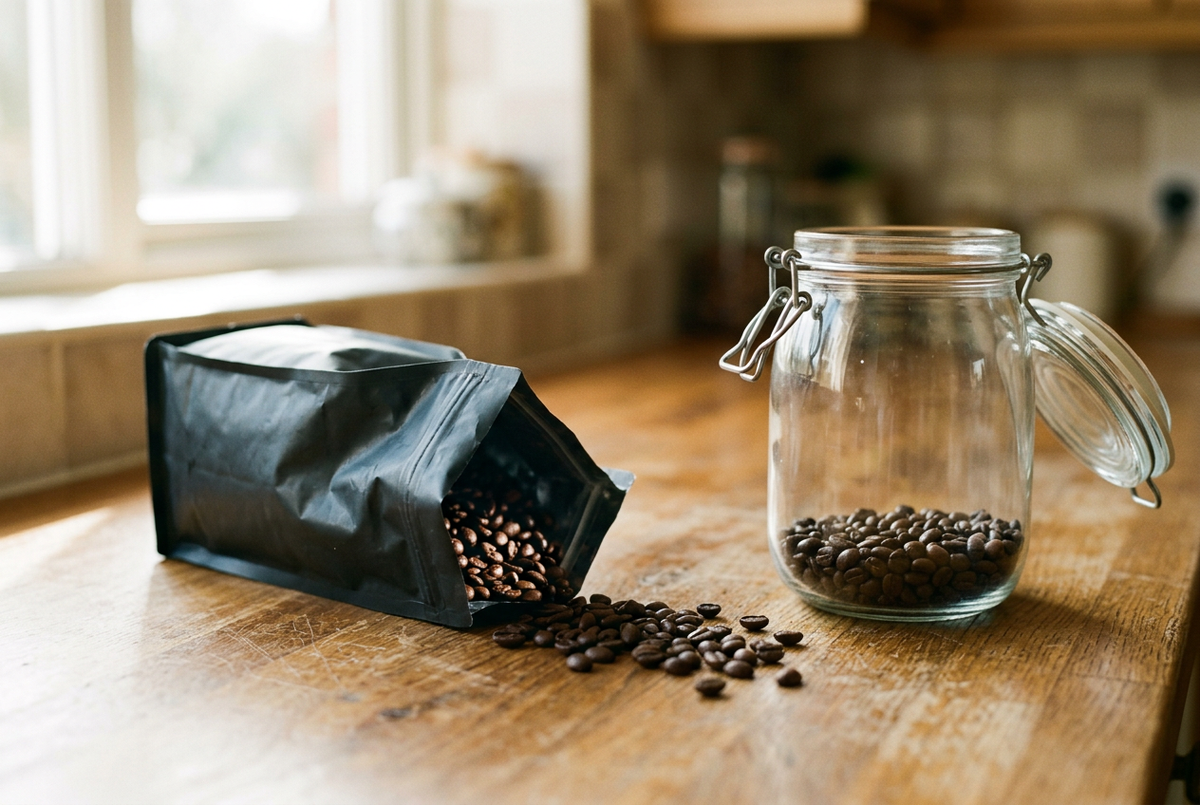
Nine weeks of measurements put the sealed tin last of four ways to keep beans once the bag has been opened.
The grinder arrives first. A scale, maybe, a few weeks later. Then, almost without thinking about it, a coffee storage container: steel or glass, a rubber gasket, a lid that clamps shut with a satisfying click. The bag the beans came in goes out with the recycling that same afternoon.
A group at the Zurich University of Applied Sciences spent nine weeks measuring that habit against three cheaper ones. The beans tipped into the sealed tin lost their most volatile aroma faster than beans left in the bag they arrived in, whatever was used to shut that bag again.
Nine weeks and four ways of shutting a bag
The design is worth describing, because it copies a kitchen rather than a laboratory. Roasted arabica from a single roast batch went into 1 kg foil bags, flushed with nitrogen, each one carrying a one-way valve so the carbon dioxide still leaving the beans could get out without letting air in. The bags then sat for three weeks, which is roughly the trip from roaster to shop to kitchen, and also roughly how long whole beans keep giving off that gas.
Then they were opened and handled the way anyone handles beans. Two scoops a week, 49 g at a time, for nine weeks. Four treatments: the bag's own screw cap, a clip, tape re-applied after every scoop, and the beans transferred into an airtight metal tin. Five replicates of each. Unopened bags served as the reference, a fresh one opened for every measurement.
The coffee storage container came last
Freshness here is not a taste score. It is a ratio between two compounds on a gas chromatogram, 2-butanone and 2-methylfuran, and it works because the second is one of the most volatile things in roasted coffee. As the methylfuran evaporates, the ratio climbs. A steep climb means coffee aroma walking out of the beans. The whole dataset is open access, funded by the roaster Tchibo and the university itself.
Over the nine weeks that ratio climbed with a slope of 0.0667 for the beans in the tin. The taped bag managed 0.0583, the clip 0.0399, and the bag's own screw cap 0.0327, roughly half the rate of the tin. Any two of those slopes differed significantly. The unopened reference never climbed at all: its slope ran slightly backwards, at minus 0.0099.
Which puts the ranking upside down. The most deliberate thing a person can do with a new bag, decanting it into a proper vessel, was the worst of the four for coffee freshness.

The air is back inside within a week
Inside an unopened bag the atmosphere is not air at all. After the three-week rest it held about 70% carbon dioxide and under 0.5% oxygen, and by the end of the trial the carbon dioxide had crept up to 77% while the oxygen stayed near zero. That is the valve doing its work.
Opening the bag ends it, faster than most people would guess. With the beans in the tin, or the bag shut with tape, oxygen was back at the ambient 21% inside a week and the carbon dioxide was gone. The clip and the screw cap slowed that down, but only by degrees: one opening already pushed oxygen past 10%, and after two weeks, four scoops in, every pack sat within 1% of room air. From there, every closure is storing beans in air, which is what the volatile compounds react to.
The falling carbon dioxide also told the researchers how much of the air inside got swapped at each scoop. About 60% with the screw cap. About 75% with the clip. With the tin and the taped bag, effectively all of it, every single time. That is the case against decanting in one line: a tin has no protective atmosphere to keep, and a wide mouth to lose it through.
What that leaves on the counter
None of this keeps coffee fresh. Methanethiol, the compound doing most of the work in the smell of a bag opened on day one, fell to about 15% of its starting signal within eight weeks in every opened pack, however that pack was closed. Even the unopened reference finished at about 33%. Stale coffee is not a storage failure, it is a schedule, and a closure only changes the slope.
The honest limit of the study is that it measured chemistry and not flavour. Nobody tasted the treatments against each other, and the authors say plainly that the sensory work still has to be done. What it does support is a dull piece of advice about coffee freshness. Keep whole bean coffee in the bag it came in, press the air out before closing it, use the cap if the bag has one and a clip if it does not, and buy a size that actually gets finished.
Next time a bag gets opened, look at the top of it. A screw cap or a zip is not packaging theatre. It is the difference between swapping 60% of the air above the beans every morning and swapping the lot.

How long has that bag been open?

Most of the aroma a bag of beans loses goes out through the opening, not through the weeks. Santo Cafe ships its Mexican arabica in a flat pouch with a zip along the top, so the bag the coffee arrives in is also the bag it lives in. Press the air out, close the zip, keep it out of the light, and grind what the next brew needs.

Taste our coffee from Mexico
Freshly roasted, delivered to your door.


