Coffee degassing: why fresh beans need to rest before brewing
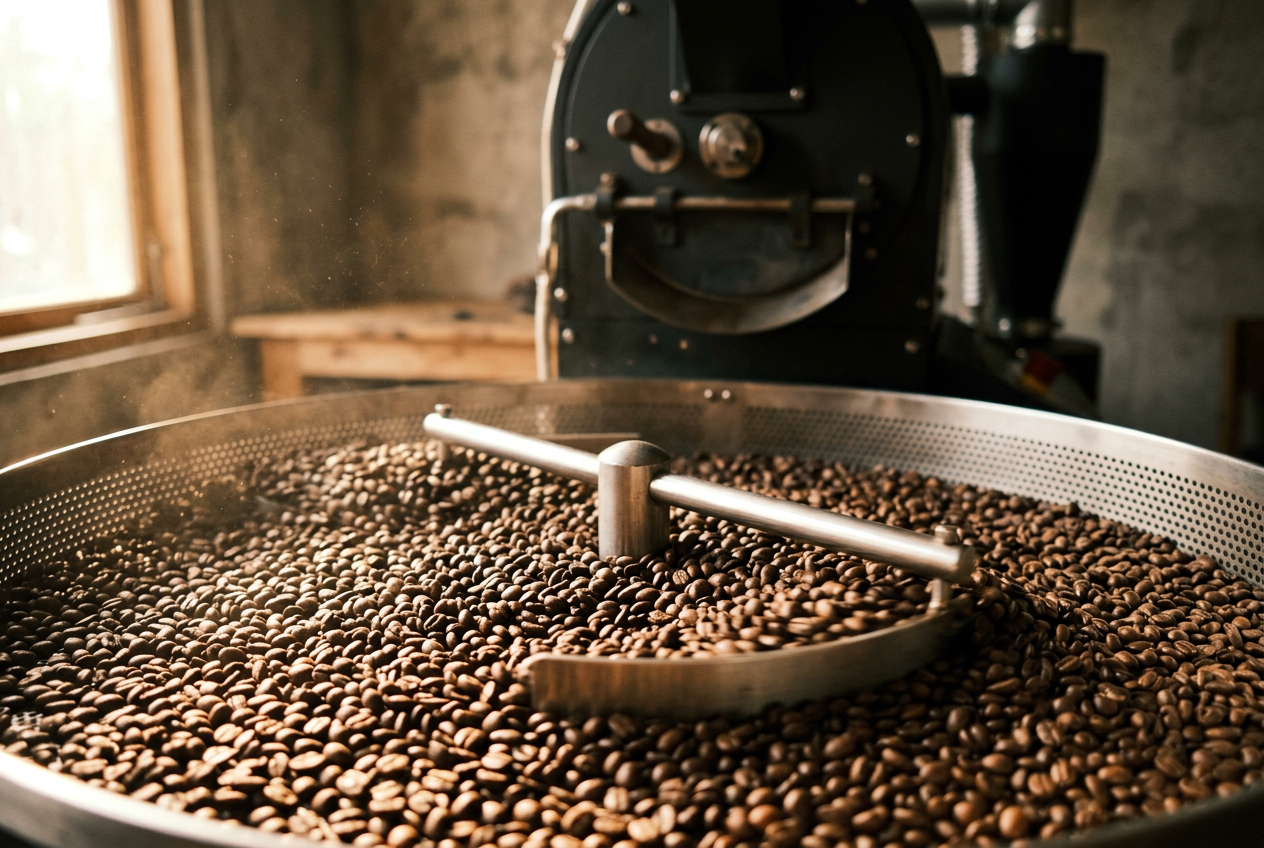
Roasted coffee holds carbon dioxide, and how much it holds and how fast it leaves is set by the roast level and the grinder rather than the calendar.
A bag of beans roasted this morning will pull a worse espresso today than the same beans will pull on Friday. Coffee degassing is the reason, and it is not a figure of speech. Roasting drives thermal reactions that make carbon dioxide inside the bean, and the bean keeps hold of a large share of it. Everything that happens after the cooling tray, in the bag and in the grinder, is that gas finding its way out.
Where the gas in freshly roasted coffee comes from
Green coffee carries almost no free carbon dioxide. The gas is built during the roast, out of thermal reactions across several fractions of the bean, and part of it escapes through the pore structure while the rest stays locked in. What stays is the residual CO2, and it can be weighed. Xiuju Wang did exactly that for a 2014 doctoral thesis in food science at the University of Guelph, and a light roast held between 6.29 and 6.70 mg of gas per gram of coffee.
That reads as a small number. A 250 g bag of light roast is still carrying more than a gram and a half of gas that wants to leave.
Roast level sets the amount, roast heat does not
Take the same beans to a medium roast and the figure climbs to between 11.04 and 11.51 mg per gram. Take them to a dark roast and it lands between 15.36 and 15.62, more than double the light roast. The gap between light, medium and dark roast levels is usually described in the cup, in acidity and body. It also shows up as how much gas the bean is still holding when it reaches a shelf.
Going darker than dark adds nothing. Beans pushed to a very dark roast measured 15.11 to 15.97 mg per gram, which is the same amount within the error of the method. The thesis reads that as precursors running out, and as gas escaping through the fractures the bean opens at second crack.
Roasting temperature turned out not to matter either. Beans roasted at 230 and at 250 degrees to the same colour held the same amount of gas. How dark the bean went is the determinant. How hot it got there is not.

Grinding lets a quarter to half of it go at once
The bean is a container, and breaking it stops the container working. In the same Guelph measurements, a coarse grind gave up 26 to 30 percent of its trapped gas the moment it was ground. A medium grind gave up 33 to 38 percent. A fine grind gave up 45 to 59 percent.
Those losses land in seconds, before any water arrives. That is the real argument against grinding on Sunday for the week ahead. The coffee is not going stale in some vague way by Wednesday, it is arriving at Wednesday with most of its gas already spent.
Whole beans keep going for weeks
Left whole, freshly roasted coffee gives up that gas slowly. Dark roasted beans in the Guelph tests needed more than 800 hours, roughly 33 days, to release about 90 percent of what they held. A fine grind off the same batch flattened out inside 50 hours.
Storage moves the clock too. A warmer room raised the rate, and so did a more humid one, which is the plain reason a cool dry cupboard beats a sunny windowsill. Cold pushes in the same direction, and what freezing does to a coffee bean reaches the grinder as well.

What coffee resting time actually buys you
None of this settles how long a given coffee should sit. The measurements are of gas, not of taste, and the two are related without being the same thing. What the numbers do explain is why the advice keeps shifting with the roast. A dark roast starts with more than double the gas of a light one, so it has more to shed before it brews evenly.
The visible version of all this is the coffee bloom, the dome that rises in a filter when water hits fresh grounds and the trapped gas pushes back. A bag fitted with a one way degassing valve is handling the same pressure, quietly, on a shelf.
So the useful habit is a small one. Look for a roast date on the bag rather than a best before date, and grind at the moment of brewing rather than the night before. Coffee resting time does its work in the bag, and the grinder is where it stops.

Taste our coffee from Mexico
Freshly roasted, delivered to your door.