
Coffee grinder static: what one drop of water actually changes
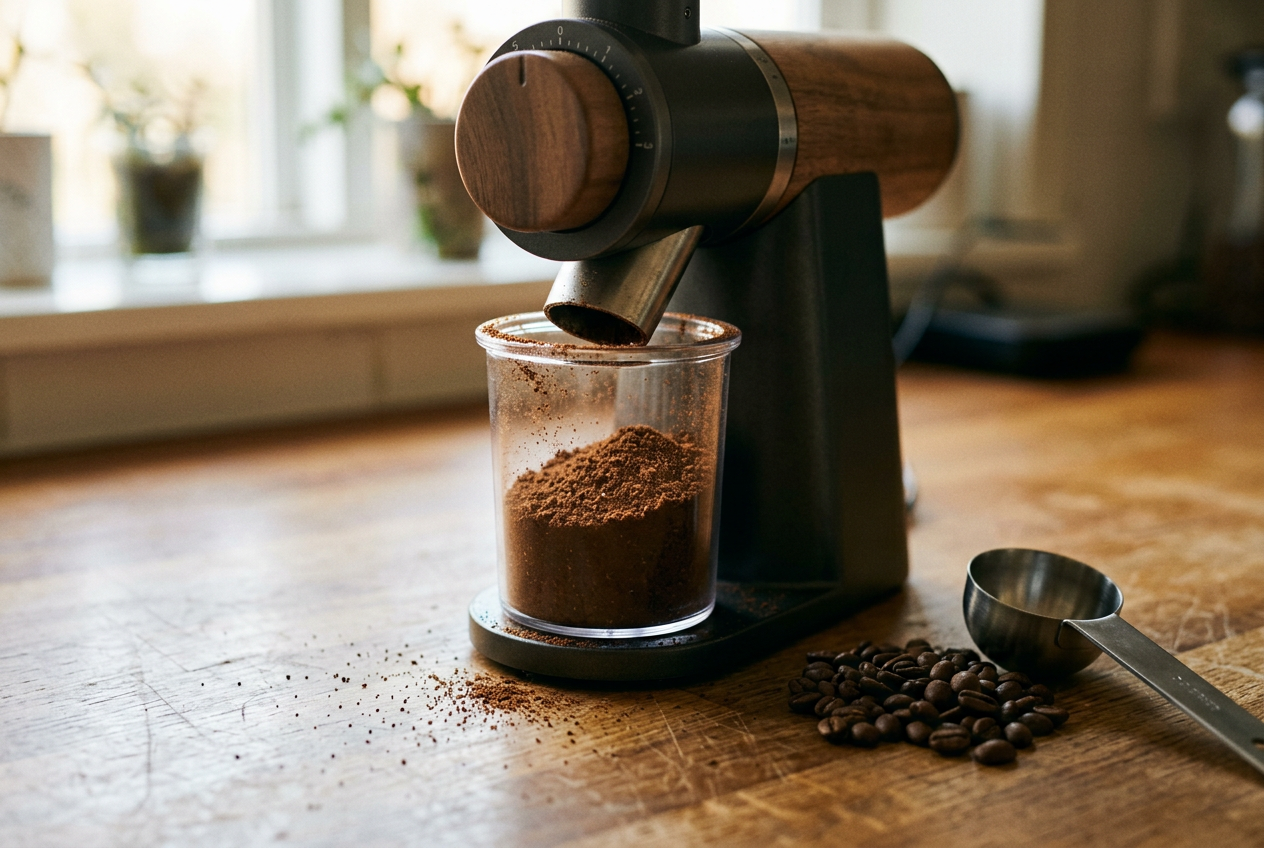
Grinding charges coffee particles to as much as 120 nC per gram, and a study in Matter found that a few microlitres of water on the beans takes that to almost nothing.
Anyone who has ground coffee on a dry winter morning knows the mess. Grounds cling to the chute, jump to the side of the catch cup, and a small cloud of fines lands on the counter instead of in the basket. The usual explanation is that the grinder is cheap. The real explanation is physics, and researchers at the University of Oregon put a number on it: grinding coffee beans charges the particles to as much as 120 nC per gram.
That measurement was published in Matter on 3 January 2024. It is the first study to pin down how much charge a grind produces and what decides it, and the answer has almost nothing to do with the motor or the burrs. It is water.
Where coffee grinder static actually comes from
Two things happen when a bean meets a burr. It fractures, and the fragments rub against each other and against the metal. Both move electrons around, and the effect has a name outside coffee: triboelectrification, the same static electricity that gets you at a car door in January. The Oregon group machined a Faraday cup to fit the chute of a Mahlkonig EK43 and caught the grounds as they fell.
It is not a rounding error. At the top end the particles carried 120 nC per gram, enough for fines and boulders to lock onto each other on the way down. That is what a burr grinder is really doing when the grounds come out in lumps, and the cost runs past the mess on the counter: clumps let water find channels through the bed instead of wetting all of it.
Roast colour decides the sign of the charge
Not every coffee charges the same way, and the pattern is tidier than folklore suggests. Positive charging turned up only in the palest coffees in the set, the ones with an Agtron colour value above 70. Everything darker charged negative, and the magnitude climbed as the roast went further.
Colour was standing in for something else. Roasting drives water out of the bean, and the sign of the charge tracked internal moisture more closely than it tracked colour: the flip happened once water content passed about 2 percent by mass. A darker roast is a drier bean, and a drier bean fights back. If the coffee to water ratio is right and the cup is still uneven, the grind that fed it may have arrived in clumps.

What 20 microlitres of water does
The workaround has been common in cafes for years: wet the beans before they go in. It even has a name, the Ross Droplet Technique, and the paper is refreshingly plain about where it came from, which is an online message board rather than a laboratory.
Water went onto whole bean coffee by pipette, and the beans were shaken in a sealed container to spread it. As the dose approached 20 microlitres per gram, the charge fell to roughly 0 nC per gram, across every coffee tested, whatever the roast or the origin. On an 18 g dose that is well under a millilitre. The team also ran mineralised water against pure reverse osmosis water and found no contribution from the minerals at all.
There was a second effect nobody went looking for. With water added, close to zero grounds stayed behind in the machine, which quietly solves the grind retention problem as well.
The espresso came out slower and stronger
Charge is only interesting if it reaches the cup. Every espresso variable was pinned down on a Victoria Arduino Black Eagle: 18 g of dry coffee to yield 45 g in the cup, tamped at 196 N, brewed at 94 degrees and 7 bar of static pressure behind a 2 second pre-infusion. The single difference between the two sets of shots was whether the beans had been wetted before they went through the espresso grinder.
The wet-ground shots ran nearly 50 percent longer. First drops still reached the cup at about 10 seconds either way, so nothing was blocked. The bed was simply denser, because fines and boulders had stopped shoving each other into a loose, porous cake. Concentration went from 8.2 percent total dissolved solids on the dry grind to 8.9 percent on the wet one. More concentrated is not the same as better, and the study does not pretend otherwise.
It is a familiar shape. A small change upstream, a large change in the timing, and the temperature the machine actually delivers carrying on with its own separate argument.

What to try on the next grind
Wet the beans, never the machine. One drop stirred through, or a light spritz from a mister, is the whole intervention. Then look at two places: the chute of the burr grinder, and the counter around the catch cup. If the fines that normally cling have gone, so has the charge.
Expect the shot to slow down after that. It is the measured outcome rather than a fault, and the sane response is to open the grind up instead of assuming something broke. On filter the effect is gentler, since a paper bed forgives density better than a basket does. Grinding coffee beans on a dry day is where the difference shows up first, so that is the day to test it.
So what goes into the grinder?

All of this is about how evenly water reaches the coffee, and none of it puts anything into the cup that the bean did not already hold. Santo Café says one thing on the front of the pack that matters here: 100% arabica, freshly roasted. The moisture still sitting inside a bean after roasting was the strongest predictor of charge in the whole study, and that is settled long before anything reaches the burrs.

Taste our coffee from Mexico
Freshly roasted, delivered to your door.


