The coffee to water ratio that fixes most bad home brewing
The ratio sets how strong the coffee is. Everything else decides how it tastes.
Most people fix a bad cup by changing something clever. A finer grind, filtered water, a better machine. The coffee to water ratio sits underneath all of it and decides how strong the result will be before any of those get a say, and it usually ends up set by whatever scoop came in the box.
What a ratio actually says
A ratio of 1:16 means one gram of coffee for every sixteen grams of water. Water is weighed rather than poured by volume because a millilitre of water weighs a gram, so one scale reads both sides of the equation in the same unit. Sixty grams of coffee, 960 grams of water, one number to remember.
That is the whole idea. A brew ratio is a fraction rather than a recipe, so it scales from a single cup to a full carafe with no arithmetic beyond multiplication, and it stays true whichever brewer is standing on the counter. Bar staff write it on the machine for the same reason a baker writes down a hydration figure: the fraction survives being scaled, a recipe does not.
The numbers the golden cup standard sets
The Specialty Coffee Association publishes a target range rather than a single figure. Brew strength should land between 1.15 and 1.35 percent dissolved solids, which is 11.5 to 13.5 grams of dissolved coffee per litre of finished drink. Extraction yield, the share of the bean's soluble mass that made it into the water, belongs between 18 and 22 percent.
For drip and filter that works out to a brew ratio of 1:16 to 1:17, or roughly 55 to 62 grams of coffee per litre. Water goes in between 90 and 96 degrees. The published standard is worth reading once and then leaving alone for a month while the numbers turn into habit.

Strength and extraction are not the same thing
This is where home brewing usually goes wrong. The ratio sets strength, meaning how much coffee ended up in the water. Grind size, contact time and temperature set extraction, meaning how much of each ground particle dissolved. A cup can be strong and under-extracted at the same time, which tastes thick and sour at once and satisfies nobody. The two are easy to tell apart once separated: strength is how much is there, extraction is how good what is there tastes.
That combination explains a common mistake. Sour coffee reads as weak, so the instinct is to add more grounds, which raises strength and leaves the sourness exactly where it was. The repair is a finer grind or a longer brew. It also helps to start from beans that have had a few days off the roast, because a very fresh bag gives off gas that pushes water away from the grounds and skews the extraction before the ratio gets a chance.
Where each method sits
Pour over coffee and drip both land in that 1:16 to 1:17 band. A French press usually goes nearer 1:15, since its metal filter leaves the oils in and a slightly heavier dose suits that body. Espresso is not on the same scale at all, running near 1:2, so a number that works for a carafe means nothing at a machine.
Batch brewers deserve a warning of their own. Many of them are sized in cups of 125 millilitres rather than 250, so a jug filled to the ten mark holds well under a litre and a half. Weigh the water once and write down where that lands on the gauge.

Why the scoop lets you down
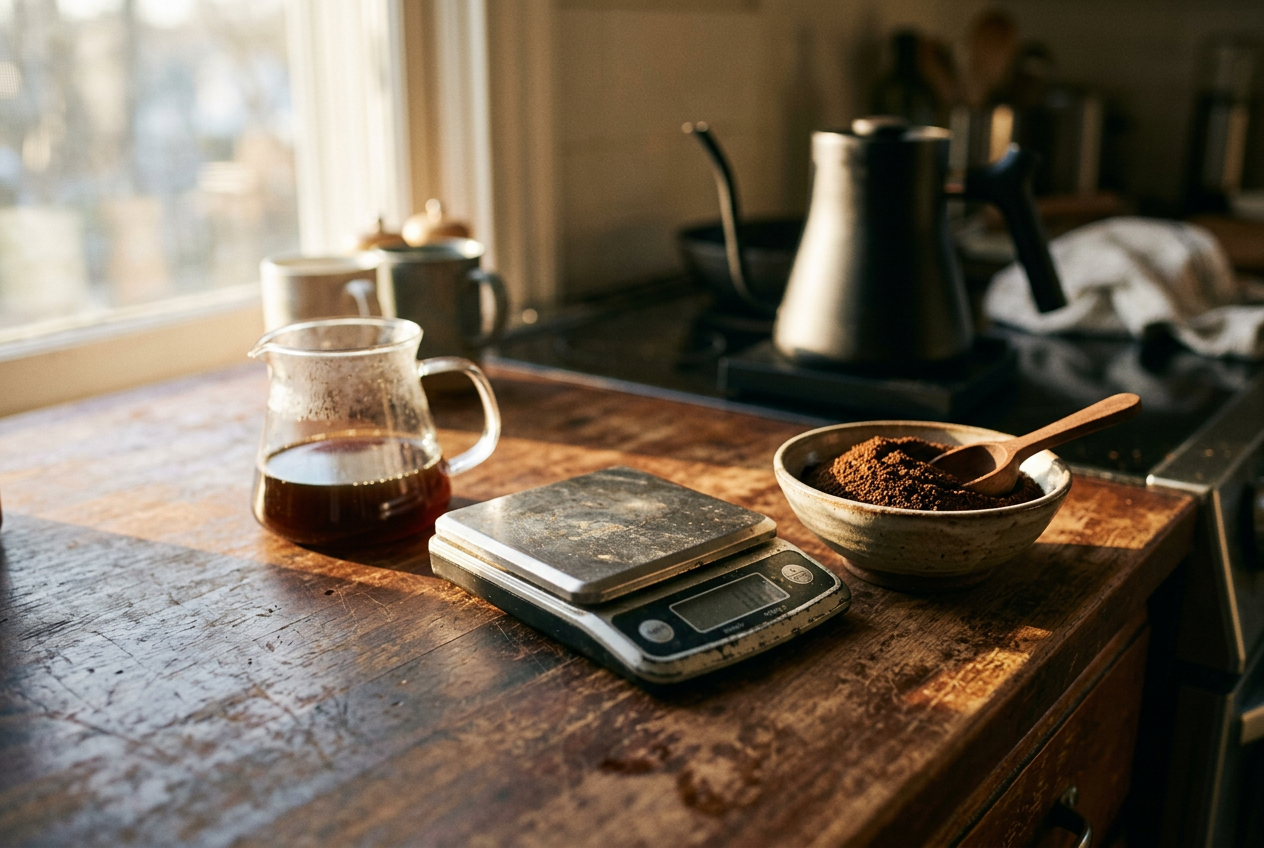
A scoop measures volume, and coffee is sold by weight. Beans lose density as they roast, so a scoop of a dark roast weighs noticeably less than the same scoop of a light one, and the roast level printed on the bag quietly moves the ratio without anyone touching it. Grind size shifts it again, because fine grounds pack tighter than coarse ones in the same spoon. A coffee scale costs less than a week of café coffee and takes the whole problem off the table.
Weigh one brew tomorrow at 1:16 and write the number on the bag. Then change nothing else for a week.
Worth measuring to the gram?

A ratio measured to the gram only pays off when what sits in the grounds rewards that kind of attention. Santo Café roasts a single-origin Mexican arabica in small batches, the kind of coffee where half a gram either way actually turns up in the cup. One origin, one profile, so the numbers have something to hold on to.

Taste our coffee from Mexico
Freshly roasted, delivered to your door.