Coffee scale explained — why weighing makes better coffee
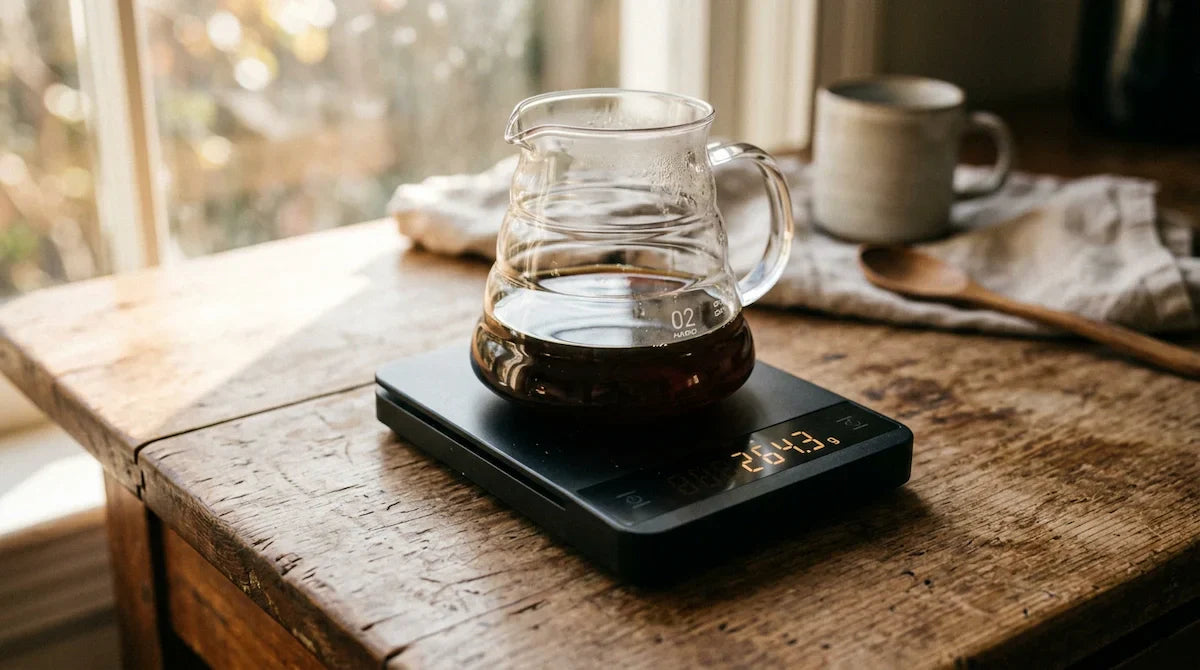
A spoon is a guess. A scale is a repeatable result.
Most people measure coffee with a spoon. That gives a different result every time. A full spoon of light-roasted beans weighs differently from a full spoon of dark-roasted beans, and differently from finely ground coffee versus coarsely ground coffee. A coffee scale is the most underrated piece of equipment for the home brewer of specialty coffee at home, and also the cheapest that makes a noticeable difference.
Why volume does not work
Coffee beans have a variable density. Light-roasted beans are more compact and heavier than dark-roasted beans of the same volume. Coarsely ground coffee has more air between the particles than finely ground coffee. A measuring spoon therefore never gives the same amount of coffee, even if you use exactly the same spoon as yesterday.
Weight is stable. Fifteen grams of coffee is always fifteen grams of coffee, regardless of roast level, grind size or how full you fill the spoon. Anyone who takes accurate coffee brewing seriously always works in grams.

The standard coffee ratio
The Specialty Coffee Association uses as a starting point 60 grams of coffee per litre of water for filter coffee. That is a coffee ratio of 1:16.7: one part coffee to just over sixteen parts water. In practice this means 15 grams of coffee to 250 grams of water for an average-sized cup.
That ratio is not a law. It is a starting point. Those who like a stronger cup go to 1:15, those who prefer lighter go to 1:17 or 1:18. But without weighing coffee you do not know where you stand and cannot adjust systematically. With a coffee scale every adjustment becomes a deliberate choice.
For espresso different ratios apply: typically 1:2 or 1:2.5. With a double shot of 18 grams of coffee you aim for 36 to 45 grams in the cup. Here too, weighing coffee is the only way to work consistently.
What accurate coffee brewing delivers
Reproducibility. That is the biggest advantage of a coffee scale. If a cup tastes good, you know exactly how to make it again. If it disappoints, you know exactly which variable to adjust. Without weights you work on feel, and feel is not transferable from day to day or from person to person.
For anyone wanting to understand specialty coffee at home, the scale is also a learning tool. You start to see how small changes in the coffee ratio affect the flavour. More coffee gives more body and intensity. Less coffee gives a lighter, sometimes clearer cup. You only learn that relationship by weighing consistently.
Which coffee scale you need
Three properties matter: accuracy, response time and a built-in timer. Accuracy to 0.1 grams is the standard for pourover and filter coffee. For espresso 0.1 grams is also the minimum requirement because small deviations with an 18-gram shot are directly audible in the flavour.

Response time is the speed at which the scale reacts to weight change. A slow scale gives outdated information while you are pouring. With pourover coffee, where you work in multiple pour rounds, a fast response time makes the difference between controlling and guessing. Perfect Daily Grind describes how scale response time is one of the most underrated specs when buying a coffee scale.
A built-in timer is not a luxury. With pourover you want to know how long the total brew time takes, because that gives information about the extraction. A longer flow time points to a finer grind or a clogged filter. A shorter one points to too coarse a grind.
Good entry-level models like the Hario V60 Drip Scale or the Timemore Basic cost between 20 and 40 euros. For that budget you have a reliable coffee scale that combines all three properties. Those wanting to invest more will find models with Bluetooth connectivity and automatic timers, but for most home brewers those are unnecessary.
When a scale makes the difference
With simple methods like French press or moka pot, accurate coffee brewing to the gram is less critical. The methods are more forgiving and small deviations in the coffee ratio have less direct influence. But as soon as you brew pourover, use an AeroPress or pull espresso, a coffee scale is not optional but a requirement.
A good coffee scale costs less than a bag of specialty beans. And it is the investment that gives the most return on everything you put in after that.

Drink the coffee behind the writing
Freshly roasted, delivered to your door, with a fair deal behind every bag.