Automatic shut off: why your filter coffee machine goes dark
A filter coffee machine that goes dark 40 minutes after brewing is following European law, not failing.
Brew a pot at eight, come back at nine, and the machine is dark. No light, no warmth, and coffee in the jug that nobody would want. That is not a fault and it is not the manufacturer being stingy with the wiring. The automatic shut off on a European filter coffee machine is a legal requirement with a stopwatch attached, and how many minutes it gives you depends on one thing: whether the jug can hold its own heat.
The rule behind the shut off
The paperwork is Commission Regulation (EU) No 801/2013, which amended the older standby rules in Regulation (EC) No 1275/2008 and pulled household coffee machines in alongside televisions and printers. From 1 January 2015, a coffee machine sold in the European Union has to put itself into standby or off mode within a fixed delay after the last brewing cycle, unless an alarm is running.
The rule never says a machine has to stop being useful. It says a machine may not sit there drawing current once nobody is obviously using it. Annex II splits coffee machines into three types and hands each type a different clock.
Five minutes for an insulated jug, 40 for a glass one
A drip filter machine that stores the coffee in an insulated jug has to switch off no more than five minutes after the last brewing cycle. The same machine with a non-insulated jug gets 40 minutes. Both get 30 minutes after a descaling or self-cleaning run, which is the one case where the machine is allowed to stay awake with nothing visible happening.
The logic sits in the jug. An insulated one holds heat without electricity, so five minutes is generous. A glass one holds nothing, so the machine has to keep a warming plate hot underneath it, and that plate is what draws the current. The rule buys the plate more time and then pulls the power on it.
Which is also why a machine that brews well can pour badly at the end of the pot. Getting the water hot enough on the way in is a separate problem in most filter machines. Holding it hot afterwards is this one.

What a warming plate does at 80°C
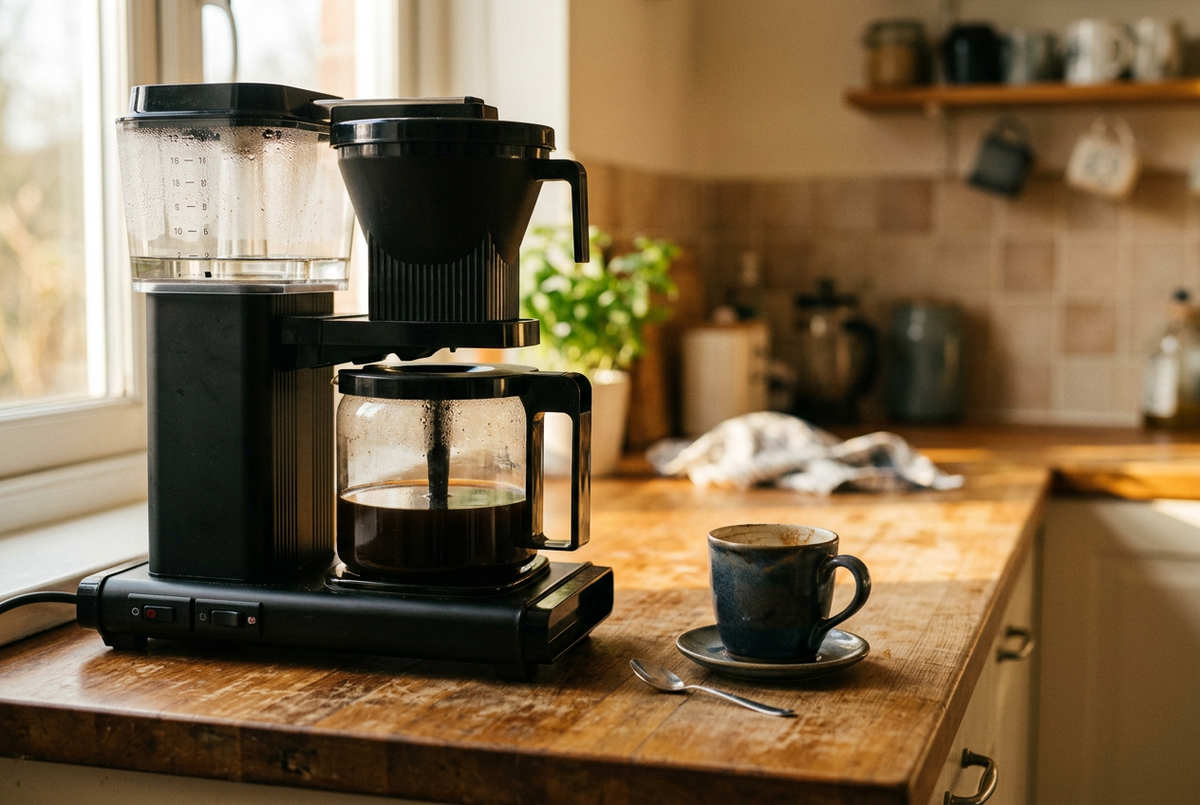
Technivorm publishes the figures for its own machines, which is more than most makers bother with. On the Moccamaster KBG Select the copper heating element switches off the moment brewing ends, but the plate under the glass jug stays between 80 and 85°C for another 40 minutes before the machine cuts out. Switch it on again with an empty water tank and it works out that only the plate needs power, then gives it another 40 minutes.
An open jug at 80°C is still evaporating. Brewed coffee left there concentrates slowly, the volatile aromatics leave before the heavier compounds do, and what sits in the glass at minute 39 is not what came through the filter at minute one. Whether that reads as flat or as harsh depends on the coffee, and what people call bitterness has more than one source.
An espresso machine runs on a different clock
Everything that is not a drip filter machine lands in the regulation’s third group, and that group carries three timers at once. A maximum of 30 minutes after the last brewing cycle. A maximum of 30 minutes after the heating element is switched on. A maximum of 60 minutes after the cup preheating function is activated.
So an espresso machine switched on to warm up and then forgotten has half an hour before it goes quiet. Turn on the cup warmer as well and the clock stretches to an hour. Anyone who has come back to a cold group head after a long phone call has met this rule without ever reading it.

Half a watt, and where the real cost sits
Once the machine is off, Regulation 1275/2008 caps what it may still take: 0.50 W in off mode, 0.50 W in a standby that offers nothing but a reactivation function, and 1.00 W where there is an information or status display. A clock on the front costs twice what a dark panel costs, and both are rounding errors on a household bill.
The energy use worth thinking about sits before the shut off, not after it. A plate holding a jug at 80°C for 40 minutes, twice a day, every day, is a different order of number from standby power measured in halves of a watt.
Find your own machine among the three groups and you know what it is allowed to do. Then decide whether 40 minutes of warming plate is something you want or something you have simply been putting up with. A thermal jug takes the coffee off the heat the moment it stops brewing, which is the cheapest fix on the counter.
What went into the jug in the first place?

A machine decides how long a pot sits on the plate. What it cannot decide is whether the first cup was worth keeping warm at all. Santo Café is Mexican coffee, 100% arabica and freshly roasted, which is the half of the equation no timer can rescue.

Taste our coffee from Mexico
Freshly roasted, delivered to your door.