Water hardness sets the descaling clock on your coffee machine
German law calls it soft, the USGS calls it hard, and the machine on the counter only counts what arrives at the heating element.
Under the settings menu of almost every coffee machine sold in Europe sits a value for water hardness, usually left exactly where the factory put it. It is not decoration. It is the number the machine uses to decide how soon it will ask to be cleaned out, and getting it wrong is the difference between a boiler that lasts and one that quietly fills with chalk. The awkward part is that nobody agrees on what the number should be called.
What hardness actually counts
Hardness is not a quality score. It is a quantity: how much calcium and magnesium the water is carrying, picked up on its way through rock and soil long before it reaches a tap. Brabant Water, which supplies the southern Netherlands, defines it in exactly those terms and adds the practical half of the story, which is that the minerals do no harm to drink and are a nuisance everywhere else.
The scale most people meet first is the American one. The USGS classification runs in milligrams per litre as calcium carbonate: soft from 0 to 60, moderately hard from 61 to 120, hard from 121 to 180, very hard above 180. Four bands, one unit, no room for interpretation. That last part does not survive a border crossing.
Soft in Germany, hard in America, same glass of water
German law draws its own bands, and it does so in a statute about detergents rather than appliances. Section 9 of the Wasch- und Reinigungsmittelgesetz sets three: weich below 1.5 millimoles of calcium carbonate per litre, mittel from 1.5 to 2.5, hart above 2.5. The same section obliges every water company to tell its customers which band they are in at least once a year, and again whenever it changes for anything other than a passing reason.
Then convert. A mole of calcium carbonate weighs about 100 grams, so 1.5 millimoles per litre works out at roughly 150 milligrams. German law files that as soft. The USGS scale calls anything from 121 upward hard and would put the same glass two bands higher. Neither is wrong. One was written to decide how much detergent to dose, the other to describe what happens to plumbing.

What water hardness does inside a machine
Manufacturers step around the argument and ask for a raw figure instead. The instructions for the JURA ENA 5 cover a range of 1 to 30 on the German scale, and give the reason in a single line: the setting exists to prevent limescale building up in the machine. Nothing about flavour, nothing about bands. A count, and that is all.
What the machine does with it is bookkeeping. It builds up deposits over time, the manual says, and prompts a clean when necessary, the degree of calcification depending on the hardness of the water it has been fed. Set the figure low on hard water and the prompt comes too late. Set it high on soft water and the descaling programme, about 20 minutes of the machine's time and some of yours, runs more often than it needs to.
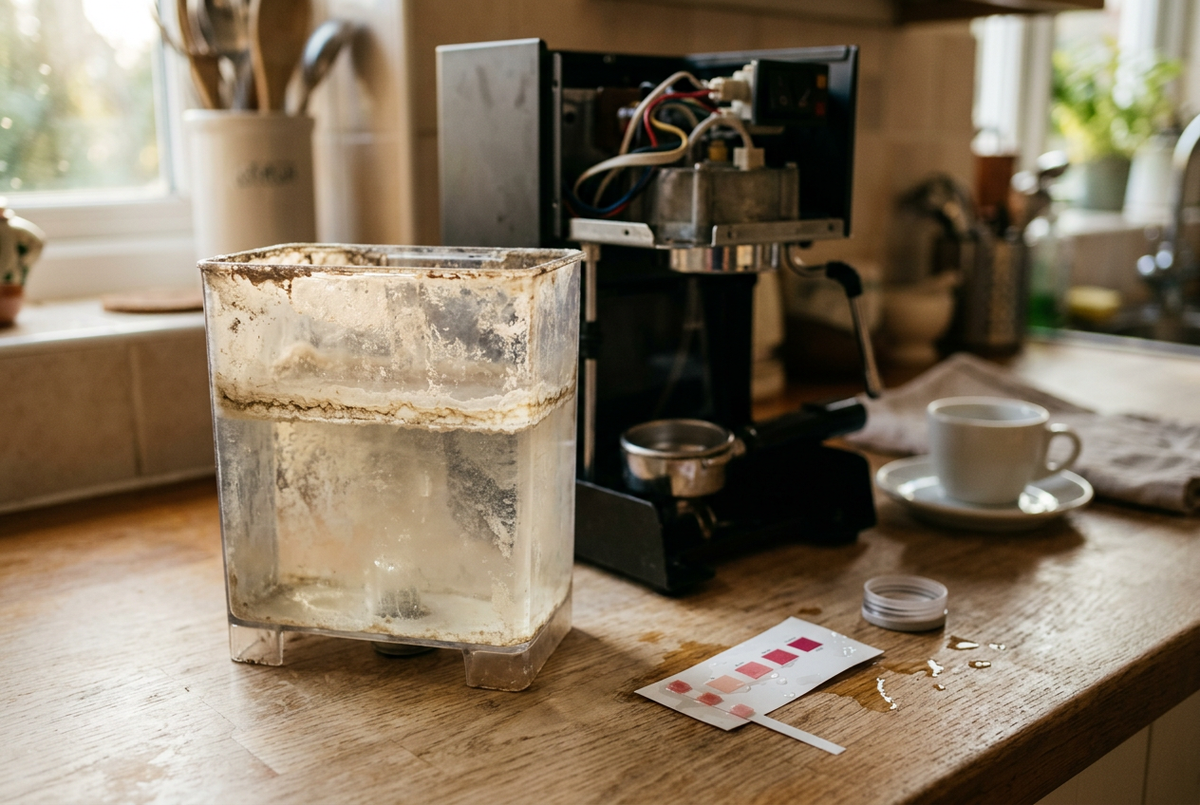
Deposits do not settle evenly. They collect where the water is hottest, which means the heating element and the pipework wrapped around it, and that is the part already working closest to its limit. A drip machine struggles to reach brewing temperature when it is spotless.
Dutch taps run to 11.2 and stop there
The Dutch numbers are unusually easy to get hold of. Brabant Water publishes them outright: the drinking water it delivers reaches 11.2 degrees on the German scale at most, while the natural hardness of the groundwater under the province averages between 4.8 and 16.7. The distance between those two figures is deliberate. The company softens the water at some of its locations before any of it leaves the plant.
That gap matters to anyone following a manual written somewhere else. Water softened at the treatment works is not the same starting point as water straight out of chalk, and the setting should follow what arrives at the house rather than what sits in the aquifer. It is worth remembering what the tank is holding, too. Water is most of the drink by weight and it is the solvent doing the work when a brew lands inside its extraction window.

Set it once, then stop guessing
The figure is public and free. Brabant Water lets anyone look up the hardness for their own town, and in Germany that publication is a legal duty rather than a courtesy. There is one alternative worth knowing about: JURA states that a machine running its CLARIS Smart+ cartridge no longer has to be descaled at all and asks for a cartridge change instead, on an interval that still depends on the hardness figure entered. A water filter does not remove the bookkeeping. It moves it.
So look up the number your own supplier publishes, type it into the machine once, and let the count run from something real instead of from a factory default. Then notice, next time the prompt appears, that it arrived later than it used to.
And what goes into the basket?

Clean water gets the equipment only as far as neutral. What goes into the basket still decides the cup, and a bag opened two months ago will taste tired in the softest water in the country. Santo Café is Mexican coffee, 100% arabica and freshly roasted, which is the one variable no hardness setting can correct.

Taste our coffee from Mexico
Freshly roasted, delivered to your door.