
San Luis Potosí coffee lost half its land and 83% of its crop
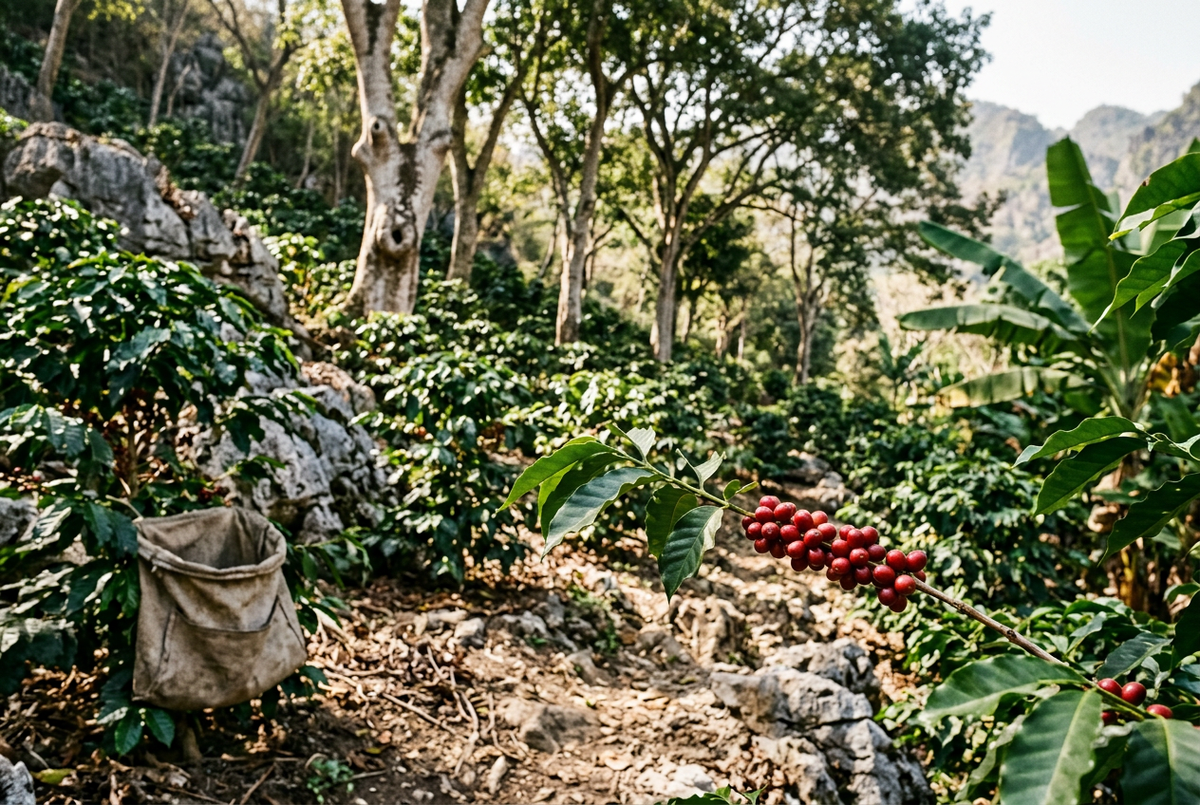
Half the planted area and 83% of the crop went in thirty years, while the national coffee map barely moved.
Thirty years of numbers from one state say something a single harvest never can. In 1989 the coffee of San Luis Potosí covered 32,872 hectares and delivered 53,605 tonnes. In 2019 the same state took 9,542 tonnes off 16,201 hectares. Half the land gone, and 83% of the crop with it, inside a country whose planted area barely moved. Mexican coffee did not shrink over those three decades. This corner of it did.
Seven municipalities out of twenty
The Huasteca Potosina is made up of twenty municipalities and the crop sits in seven of them: Aquismón, Axtla de Terrazas, Coxcatlán, Huehuetlán, Matlapa, Tamazunchale and Xilitla. Margarita Nolasco named the same seven in her 1985 book Café y sociedad en México. Forty years on, the map has not moved.
Nor has the plant. Arabica coffee dominates here, on ground that starts at 80 metres above sea level and climbs past 1,200. That is a wide band for one small growing area, and it means two farms in the same state can be working in different climates. The study that tracks it dates the first plantings in the region to 1835.
The land that went out of coffee
Planted area peaked at 34,414 hectares in 1986. By 2019 it stood at 16,201, the lowest figure in the 1986 to 2020 series, against an average of 22,973 across those years. The drop is steady rather than sudden, which is how a crop usually leaves a place.
Set that beside the national line and the contrast does the work. Mexico had 722,832 hectares planted in 1989 and 709,059 in 2019, a fall of two per cent. The state lost more than half. A growing region can empty out without the national statistic registering it at all, which is the same arithmetic that keeps a state like Hidalgo out of most conversations about where Mexico grows its beans.

What a coffee yield of 0.56 tonnes per hectare means
The land going is only half of it. Yield went too, and that is the part that rules out a simple story about farmers choosing to plant something else. In 1989 the state took 1.66 tonnes of cherry off a hectare. In 2019 it took 0.56. The high across the series is 1.92 and the low is 0.47, so 2019 sits near the floor rather than in the middle.
Volume followed the same curve: 63,910 tonnes at the 1983 peak, 383 tonnes at the 1990 bottom, an average of 17,854 tonnes, and 9,542 tonnes in the final year. The analysis behind those figures works from SIAP production databases and runs from 1989 to 2019. A coffee yield at that level turns a two hectare plot into roughly one tonne of cherry a year, before anyone has been paid.
What the rain record shows
Rain is not obviously the shortage. The low parts of the Huasteca take 1,000 to 1,200 mm a year and the high zones reach 3,000 mm, for a regional average between 1,200 and 2,000 mm. Arabica is usually put at 1,200 to 1,800 mm. On the annual figure the water is there.
A 2023 study ran a twelve month standardised precipitation index across five rain gauges for 1961 to 2018 and found the last twenty years sitting slightly under the long run average, with moderate drought showing up more often, though some years still come in on the humid side. Growers interviewed between April and July 2022 described the same pattern. Add the dry spell that falls between June and August, and the margin is narrower than an annual average suggests, on plots worked by growers whose average age is 54.

Who is left, and what they were paid
More than 17,000 tének and nahua coffee producers were counted across those seven municipalities in 2019. Plots run from 2 to 15 hectares. Nolasco put more than 85% of Mexican coffee production in the hands of indigenous and traditional campesinos in 1985, and the smallholding pattern the recent work describes looks much the same.
The price line is the odd one. A tonne of San Luis Potosí coffee fetched 1,121 pesos in 1989 and 6,442 pesos in 2019, the highest figure in the series, while the national price went from 666.11 pesos to 5,249. Fourteen states grow coffee in Mexico and the smallest of them, Querétaro, brought in 24.36 tonnes. Price up, volume down 83%: next time a coffee price headline goes past, the number worth hunting for is the one standing beside it.
Where does the coffee in your cupboard actually come from?

Most bags name a continent, a roast level and very little else. Santo Café roasts Mexican arabica, single origin, and puts the country on the front of the pack rather than in the small print. Freshly roasted, nothing added, and the origin stated plainly enough that you can decide for yourself what it is worth.

Taste our coffee from Mexico
Freshly roasted, delivered to your door.


