
Conical burrs or flat burrs: what actually changes in the cup
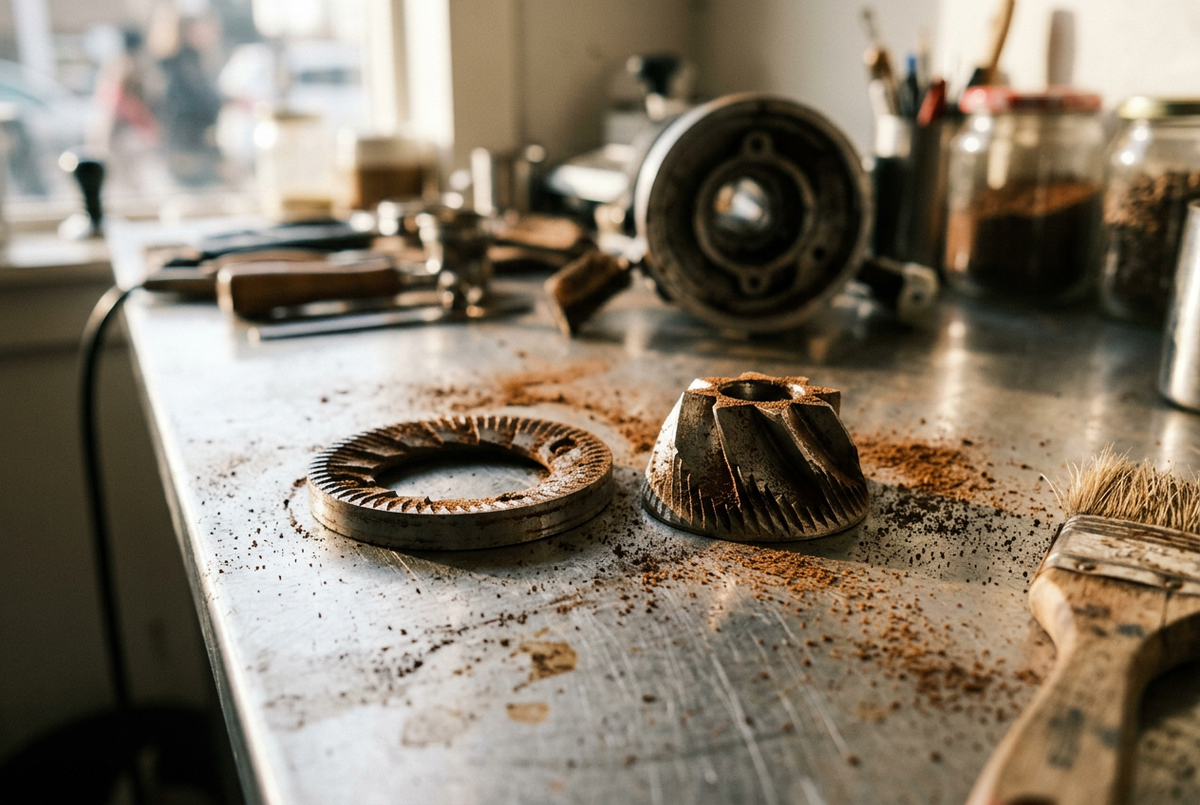
The conical versus flat burr argument is really an argument about fines, and a 2024 study in Scientific Reports measured what fines do: they choke the bed rather than sweeten the cup.
Pick up any grinder comparison and the same argument arrives within a paragraph. Conical against flat, body against clarity, Italian tradition against the specialty bench. What almost never arrives with it is a measurement. A coffee grinder is being judged on something no spec sheet lists: the spread of particle sizes it leaves behind, and what that spread does once hot water is pushed through it.
The number that matters sits below 100 microns
Researchers have a name for that spread. In a study published in Scientific Reports in March 2024, Samo Smrke, Andre Eiermann and Chahan Yeretzian defined the share of fines as the volume share of particles smaller than 100 micrometres, and treated it as a variable in its own right rather than a nuisance. Their grinding ran on a Bentwood Vertical 63, a machine whose scale is calibrated to burr spacing in micrometres instead of arbitrary click numbers.
The framing matters more than it sounds. A single median figure, which is what most particle size distribution work gets reduced to in a product description, does not describe what an extraction will do. The paper is explicit that extraction time is predicted by the share of fines together with the size of the main particles. Two numbers, not one.
Where conical burrs and flat burrs part company
The shapes themselves are not in dispute. A cone sits inside a matching ring and the coffee falls through the gap under gravity. A pair of flat rings meets face to face and throws the grounds outward. Makers publish this plainly enough: Niche gives the Zero a 63mm conical burr set, and Fellow gives the Ode Brew Grinder Gen 2 a 64 mm stainless steel flat burr set. Those two lines are the verifiable half of the argument.
Everything downstream of them is looser. A burr grinder gets sold on claims about body, clarity and sweetness that trace back to an assumption about how many fines each geometry throws. The assumption is old and widely repeated. It rests on far less published measurement than the confidence around it suggests.

What the espresso extraction data actually showed
Rather than compare grinders against each other, the team did something cleaner. Fines were sieved out of finely ground coffee with a 120 micrometre Retsch sieve, then handed back in measured amounts: 1, 2 or 4 g of fines returned to 19, 18 or 16 g of coffee. Everything else was nailed down. 20 g of grounds went into a VST 20 g basket, tamped at 20 kgF, pulled on a Victoria Arduino Black Eagle at 9 bar to a fixed 40 g in the cup.
What came back was consistent and unglamorous. More fines meant lower permeability through the coffee bed, which meant a slower flow rate, which meant a longer shot. A partial least squares regression across the full distributions confirmed the same relationship, so the effect is not an artefact of one grind setting. Anyone who has watched a shot choke after a change of beans has met it already, and it is the quiet reason a clumped grind behaves so differently from an evenly spread one.
Permeability, not surface area
The intuitive story about fines is that they add surface area, and surface area extracts faster. That story was tested and came off badly. The effect of the extra surface area on extraction efficiency was described as marginal, and the conclusion was blunt: within the range of variables tested, fines act from a practical standpoint only by modifying coffee bed permeability.
It reframes a good deal of grinder folklore. Fines are not seasoning the cup by dissolving faster than everything around them. They are filling the gaps between larger particles and throttling the flow, which changes how long water sits against every other particle in the basket. When a shot runs long and the ratio going in is already right, the bed is the place to look.

What to read off a coffee grinder spec sheet
Two things on a spec sheet are stated honestly, and both are geometry: burr diameter in millimetres, and burr type. Everything past that, the language about clarity and body and sweetness, is a claim about particle size that the seller has not measured and the literature has not settled.
The authors are candid about why. They write that there is presently no laboratory scale grinder available, to their knowledge, that could systematically vary the width of the main peak in the distribution. Without a machine that can move one variable at a time, the burr shape question stays open, and confident verdicts about geometry are opinions in a lab coat.
Which leaves something smaller and more useful to do. If shots have been creeping longer, suspect coffee fines before suspecting the burrs, and open the grind size up a notch before spending anything. A coffee grinder throwing more fines this month than last usually has a maintenance answer rather than a replacement one.
So what goes into the burrs?

None of this changes what the burrs are handed in the first place. A grinder decides how evenly water meets the coffee, and it cannot add anything the bean did not already carry in. Santo Cafe keeps that side plain: Mexican arabica, freshly roasted, which is what the front of the pack says and about all it says. Fresh beans behave differently in a burr set than tired ones, and that difference reaches the basket before any geometry gets a say.

Taste our coffee from Mexico
Freshly roasted, delivered to your door.


