An espresso puck screen lifted the puck edge from 17% to 22%
Sampled ring by ring, the edge of an espresso puck ran 8.7 percentage points behind its centre, and the gear above and below the bed moved that gap.
Cut a spent espresso puck into three rings, measure each ring on its own, and the single extraction yield number off a refractometer stops looking like a measurement of the shot. On one test bench the centre of the puck came in around 25%. The outer band sat at 17%. That band is not a trim detail: it is roughly 30% of the dose weight, and it had been brewing at its own strength the whole time.
Cutting the puck into rings
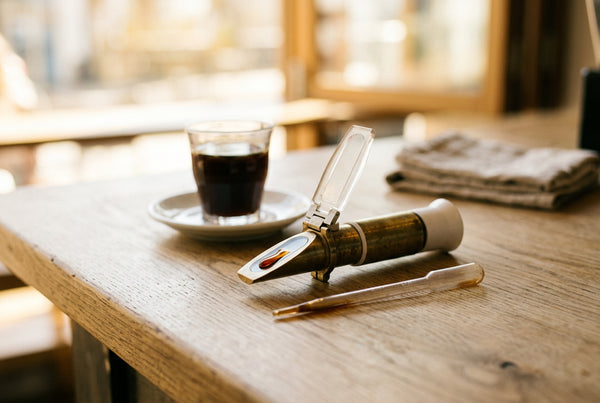
The method is blunt, which is most of its appeal. Stephane Ribes, working on a Decent Espresso DE1PRO, pulled shots at a fixed 19.0 g dose and a 1:2 brew ratio, held the water at 90 °C, capped the pressure at 7.5 bar, and then took the spent pucks apart ring by ring. Centre ran from 0 mm to 18 mm, middle from 18 mm to 25 mm, outside from 25 mm to 29 mm, where the basket wall is. Every zone went to an Atago PAL refractometer, three to five readings averaged per sample.
Puck preparation was held constant: a needle distribution tool through the dry grounds, then a flat tamper at 26 lbs. Nothing in the routine favoured the middle of the basket. The rings disagreed anyway, and they disagreed in the same direction every time, with the coffee nearest the wall giving up the least.
Where an espresso puck screen changes the numbers
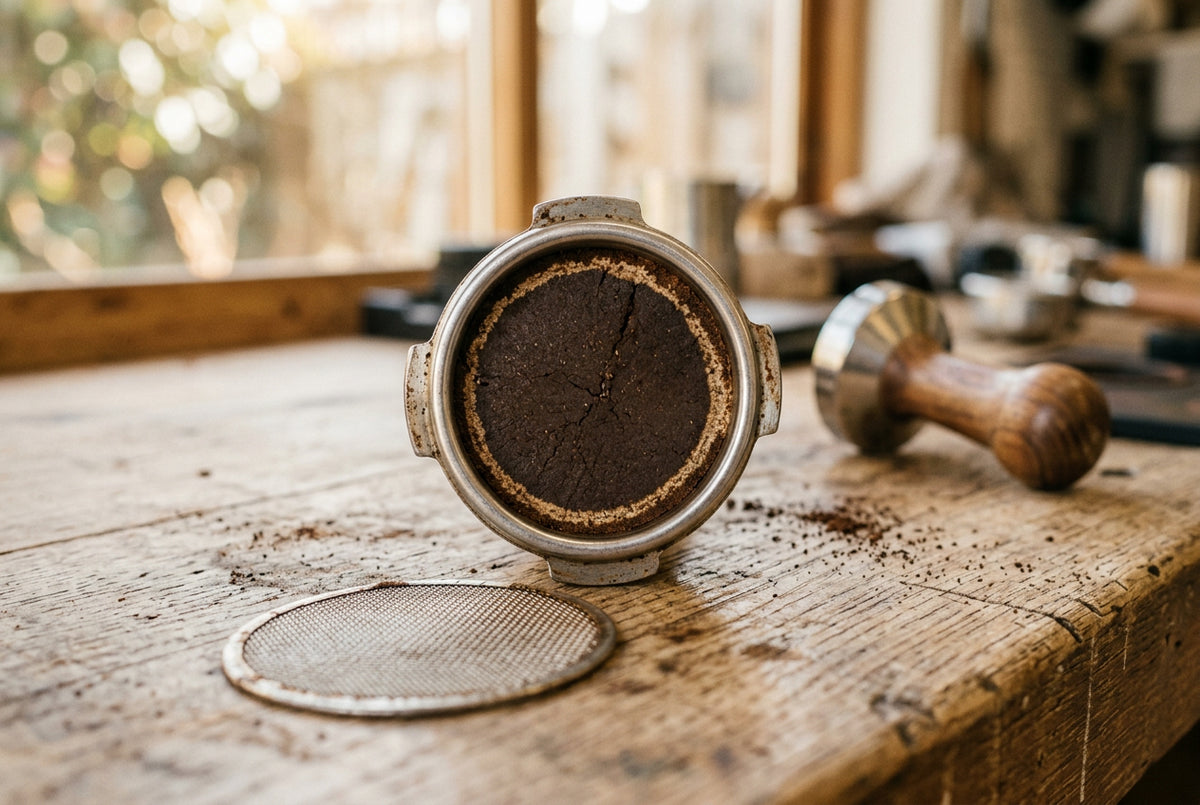
An espresso puck screen is a thin woven or perforated metal disc laid flat on the bed before the portafilter locks in. The pitch is that water spreads sideways across the disc instead of landing in a few places and tunnelling down from there. In the April 2021 run the disc was a BPLUS contact screen, and the zone that moved was the one that had been lagging.
In the VST basket the outer ring went from 17% to 22%. In the Pullman it went from 16% to 23%. Centre and middle hardly shifted, which fits the plain reading that the rim is simply where water arrives last, the same rim visible in how little of a puck is wet one second into the shot. Because that ring carries so much of the dose, the whole cup followed: overall extraction yield climbed from 22% to 24% with the VST, and from 21% to 24% with the Pullman.

The shower screen moves the same edge
The disc under the water is not the only part with a say. A year earlier the same bench swapped the shower screen above the bed, running an IMS CI 200 IM against an IMS SI 200 IM on the same machine, with a Mahlkönig EK43 S grinder, the portafilter preheated to 80 °C and a 1:3 target. With the CI 200 the rings read 24.7% in the centre, 24% in the middle and 16% at the rim: a spread of 8.7 percentage points across 29 mm of radius.
With the SI 200, pressure matched so the two shots could be compared, centre and middle stayed where they were and the rim came up to 18%. The spread closed to 6.6 points. Units matter here: that is 2.1 percentage points of radial uniformity recovered, not a 2.1% gain in anything. The spent pucks also came out drier and stuck to the screen, and the verdict on the swap was that extraction remained significantly non-uniform.
One bench, and no shot count
Both write-ups come from one machine, one author and one publisher, and that publisher sells espresso machines. Neither has been through peer review. The puck screen page never says how many shots were pulled, which is exactly the number that would turn two points of difference into a result instead of an observation. The three to five readings it does report are refractometer readings per sample, not repeats of the shot.
None of that is a reason to bin the measurements. It is a reason to hold them the way home espresso has learned to hold its own tests, including the one that found tamping force from 5 to 20 kg changed nothing. Ring sampling has its own softness: cutting a wet puck into circles smears the boundaries, and a reading taken from a ring is an average of whatever landed in that ring, channelling included.

What to look at before buying a disc
The cheap version of this experiment needs no new gear at all. Pull a shot through a bottomless portafilter, knock nothing out, and look at the surface of the spent bed under a light. A pale, loose, barely wetted rim against a darker, compacted centre is the same picture the ring sampling produced, in a form that needs no cutting and no meter.
If the rim is pale, dose and fit come first. A bed that does not reach the basket wall hands water a free lane around the outside, and no disc on top repairs that. Grind and distribution come next. The screen is the last variable to add, not the first, which is also the order the two studies happen to support: they changed one thing each, on a rig where everything else was already pinned down.
Next shot, look at the rim before the puck goes in the bin.
And the coffee in the basket?

Every measurement above holds the coffee constant, which is a quiet admission of how much the coffee decides. Santo Café roasts a single-origin Mexican arabica and sells it whole or ground, and the ground option is a filter grind, so an espresso basket wants the beans and a grinder of your own. That puts the grind back where the two studies kept pointing: in the kitchen, before any disc goes on top.

Taste our coffee from Mexico
Freshly roasted, delivered to your door.