Eight brewers, one coffee: extraction yield from 16% to 28%
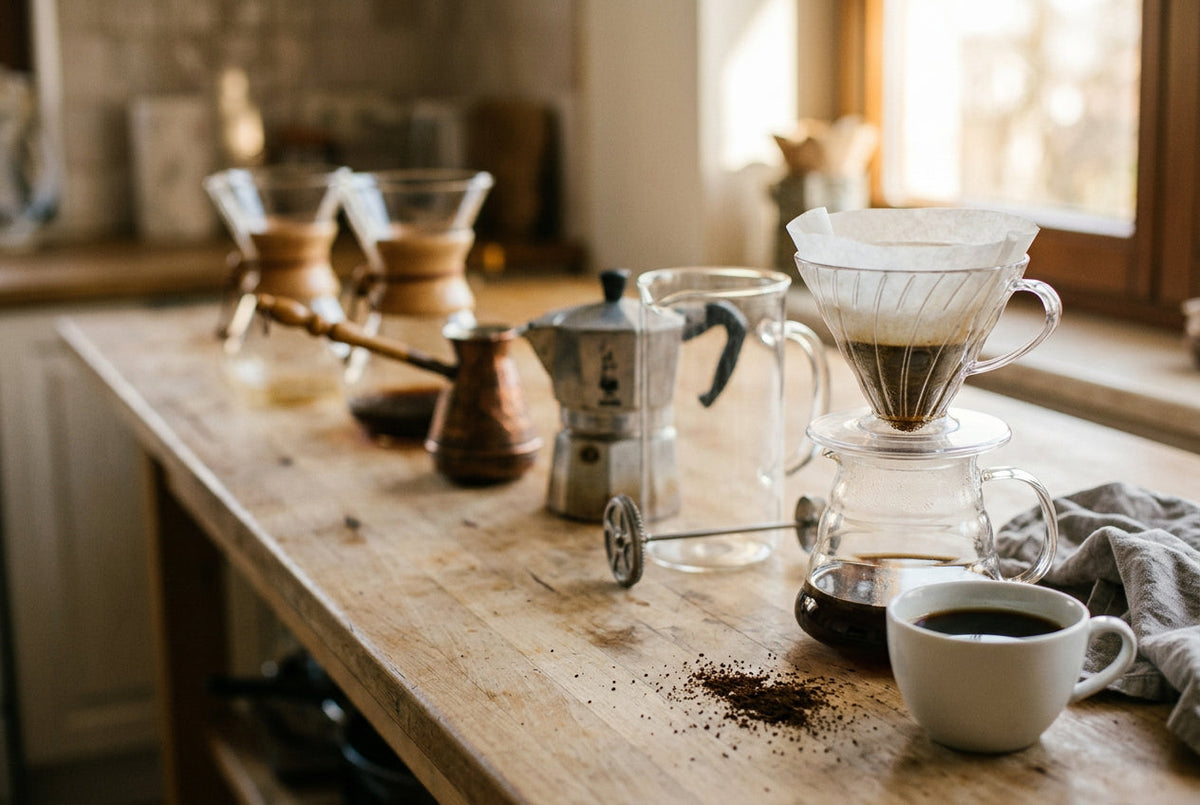
One coffee, one grinder and eight devices: the brewer decided where the cup landed, from 16.55% to 28%.
Eight brewers, one grinder, one coffee. From the lowest reading to the highest the gap ran 16.55% against 28%, and the beans never changed between them. What changed was the coffee brewing method: the dose each device asks for, the grind it needs, the water it holds and how long it holds it. A 2023 bench study in the journal Antioxidants put three roasts through eight preparations and printed a figure for every one.
Eight brewers, one grinder, three coffees
The line-up was an AeroPress, a Chemex, a Clever, a French press, a Moka, a Pure Brew, a Turkish pot and a V60. All of them were fed from the same mill, a Eureka Atom Brew Pro, so the usual excuse about a different grinder does not apply here. Six of the eight brewed at 93 °C. The Moka ran on boiling water, and the Turkish brew started at 70 °C and was brought to a boil twice.
Three coffees went through the whole set: a light Ethiopian natural, a washed Kenyan and a dark commercial arabica. Every roast was brewed on every device, which is why the figures below come in threes.
Where the extraction yield actually landed
Six of the eight finished between 16% and 19.76%. The Turkish pot finished at 26.1%, 26.8% and 28% on the light, medium and dark roast. The Moka came in at 21.13%, 18.88% and 22.49%. The team printed a table for every preparation, roast by roast, so the spread is not a matter of taste.
Read the two columns together and the picture is blunt. Six devices share one narrow band and two sit a long way above it, on the same beans, ground by the same burrs, in the same week.

The paper cones barely moved
Line up the six that pour through a paper filter or a mesh basket and the readings almost overlap. The V60 gave 17.52%, 18.05% and 17.57%. The Chemex gave 16.75%, 18.1% and 17.76%. The French press held at 17.47%, 17.75% and 17.44%, and the Clever barely twitched at 16.93%, 16.94% and 16.84%. The Pure Brew ranged from 16.55% to 18.92%, and the AeroPress sat highest of the six with 18.02%, 18.47% and 19.76%.
That clustering is the useful part. Trading one of these for another shifts the figure by about a point, well inside what the 18 to 22 percent window treats as ordinary, while a turn of the grinder on any single one of them moves it further than the swap did.
The ibrik and the Moka were making something else
Strength explains a good part of the gap. Total dissolved solids in the Turkish cup measured 2.61%, 2.68% and 2.8%. The Moka landed at 2.61%, 2.34% and 2.72%. The other six sat between 1.22% and 1.46%, which means the two outliers were serving a drink about twice as concentrated as the rest of the table.
Caffeine ran along the same line. The Moka reached 2903.14 mg/L on the light roast, the highest concentration in the study, and the lowest was 727.26 mg/L from the Chemex on the medium. The Moka is also the pot that starts extracting well below boiling point, which is worth holding on to before the stove gets the blame.

The brew ratio travels with the device
This is where the comparison gets honest. The Turkish brew used 8 g of coffee in 80 g of water. The Moka took 25 g in 250 g. The Chemex, Clever, French press and V60 all ran 20 g in 300 g, the AeroPress 15 g in 225 g and the Pure Brew 20 g in 260 g. A brew ratio of 1:10 and one of 1:15 are not the same experiment, whatever the label on the box says.
The authors put it plainly: the Moka and Turkish coffees had higher brew ratios and extraction yields "than all the other studied preparation methods". Grind ran the same way, coarse for the French press and the Pure Brew, medium fine for the AeroPress, Chemex, Clever and V60, and a fine grind for the Moka and the Turkish pot, where "small and irregular particles released their soluble substances faster".
What to check on your own counter
Brew time is the number most people never write down, and it moves more than it looks. The V60 ran 135 seconds on the light roast and 200 on the medium. The Turkish brew was finished in 130 to 150 seconds. The French press held at 240 throughout, and the Clever took up to 270.
So when a coffee tastes thin out of one device and heavy out of the next, the coffee to water ratio is the first thing to check, not the bag. Write the dose, the water weight and the brew time down once for the brewer you use most. That single line says more about what your coffee brewing method is doing than a month of tasting notes.
Which coffee goes in the next test?

A brewer only shows its hand when the coffee underneath it stays the same for a few weeks. That is the quiet argument for keeping one bag you know well instead of a new one every time. Santo Café roasts a single Mexican arabica, which makes it an easy constant to run through every device in the cupboard until one of them clearly wins.

Taste our coffee from Mexico
Freshly roasted, delivered to your door.