A coffee refractometer reads brew strength, not the roast behind it
Electrodes dipped straight into black coffee read both how strong the brew was and how dark the roast had been, which the meter on the counter cannot do.
Two cups of filter coffee can give the same reading on the same coffee TDS meter and taste nothing alike. One is pale and sharp, the other dark and heavy, and the brew strength on the display is identical for both. That is not a fault in the instrument. It is the instrument doing the job it was built for.
A paper published in Nature Communications on 28 April 2026 went at the same cup from another side. A team at the University of Oregon put two platinum electrodes straight into black coffee, swept a voltage across them and read the current that came back. The current told them how strong the brew was. The way it faded over repeated scans told them how dark the roast had been.
What a coffee refractometer actually reads
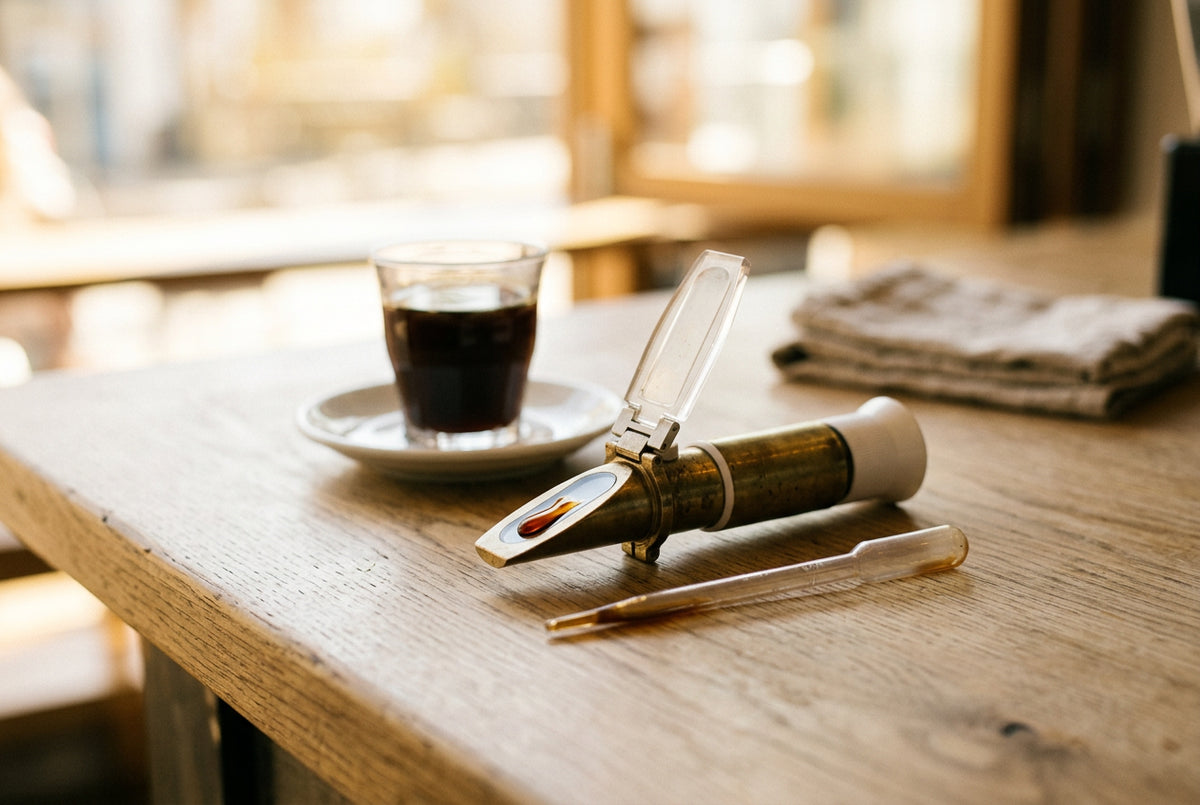
The meter shines light through a drop of brewed coffee and measures how far that light bends. The bend scales with the concentration of total dissolved solids, which the device reports as a percentage of the beverage by weight. Put that percentage together with the dose and the beverage weight and you have extraction yield, the figure behind the 18 to 22 percent window most brewing charts are drawn around.
It is a fast measurement and an accurate one. It is also blind to everything that is not concentration. Brew a pale roast and a dark roast to the same percentage and the meter returns the same figure twice. The paper states flatly that refractive index cannot separate them.
Current instead of light
The method is cyclic voltammetry, and what makes it interesting is how little it asks for. Coffee is conductive enough to measure straight from the brewer, at 2 to 3 mS per cm, and it buffers itself to a pH of roughly 4.8 to 5.9, so nothing has to be added to the cup first. The working electrode is a platinum disk of 0.0314 cm2, with a platinum wire counter electrode and a silver chloride reference, swept at 200 mV per second.
Just below the potential where water begins splitting into hydrogen, the coffee passes a current of its own. The team reports that the total charge pushed through in that region rises in a straight line with how strong the brew is. Strength, put another way, is legible as electricity.

Why the pale roast passed more charge
Reading strength alone would be a parlour trick. The second finding is the one that matters. The researchers roasted a single Colombian coffee from El Tambo in Cauca to six levels, from an Agtron of 75.8 at the lightest to 55.7 at the darkest, brewed every one of them to the Specialty Coffee Association cupping protocol at a 1:13.5 ratio with water at 93 degrees Celsius, and then diluted each brew to exactly 1.00 percent dissolved solids.
At that identical strength the cups were not identical to the electrode. The lightest roast passed around 50 percent more charge than the darker ones, and charge mapped against the roast number in a straight line. The measurement carries something concentration cannot: what the roast did to the coffee, the chemistry that also builds the melanoidins of a dark roast.
The electrode gets dirty, and the dirt carries the signal
Run the sweep again and the signal shrinks. Coffee material settles on the platinum surface and blocks part of it, and the size of that suppression tracks roast colour by itself. Caffeine is the only compound the team pinned down on the electrode, at 7.8 mg per kg, and the mechanism behind the fouling is written up as likely rather than proven.
Which is a strange thing for an instrument to do. Fouling is normally the problem that spoils a measurement. Here the rate of spoiling is half of the answer.

Four batches from one roastery
The test that counts came from outside the lab. Colonna Coffee in Bath sent four single blind batches, labelled 1 to 4, with roast numbers of 98.9, 93.9, 92.8 and 93.6. Each was measured five times. The dissolved solids figures did not pull them apart.
The charge on the first scan did. Sample 1, the batch the roastery had already rejected for coming out too light, sat 2.19 microamp volts away from sample 2, give or take 0.40, at p = 0.0002, and further still from the other two. The rate of fouling did not differ between any of the four, at p greater than 0.832, so the first scan did the whole job.
What it does not do yet
A potentiostat is laboratory equipment, and the paper makes no claim that one belongs beside a grinder. The redox couple shows about 200 mV of peak separation, which the authors read as sluggish kinetics. The blind test ran on one coffee from one roastery. The authors also disclose a financial interest in a company built on electrochemically modified food, a line worth reading before the method becomes quality control anywhere.
There is a version of this experiment that needs no electrodes. Brew a pale roast and a dark roast to the same number on the meter and drink them next to each other. The readings will agree and the cups will not, and that gap is what the instrument on the counter was never built to see.
So what goes into the cup before it is measured?

All of this assumes the coffee in the brewer is worth putting a number on. Santo Café roasts a single origin Mexican arabica and sells it as whole beans, which leaves the grind, the ratio and the water with whoever is standing at the kettle. A meter can tell you how much of it ended up in the water. The rest of it is still a question of what went in.

Taste our coffee from Mexico
Freshly roasted, delivered to your door.