Moka pot extraction starts at 68.7 °C, not at boiling point
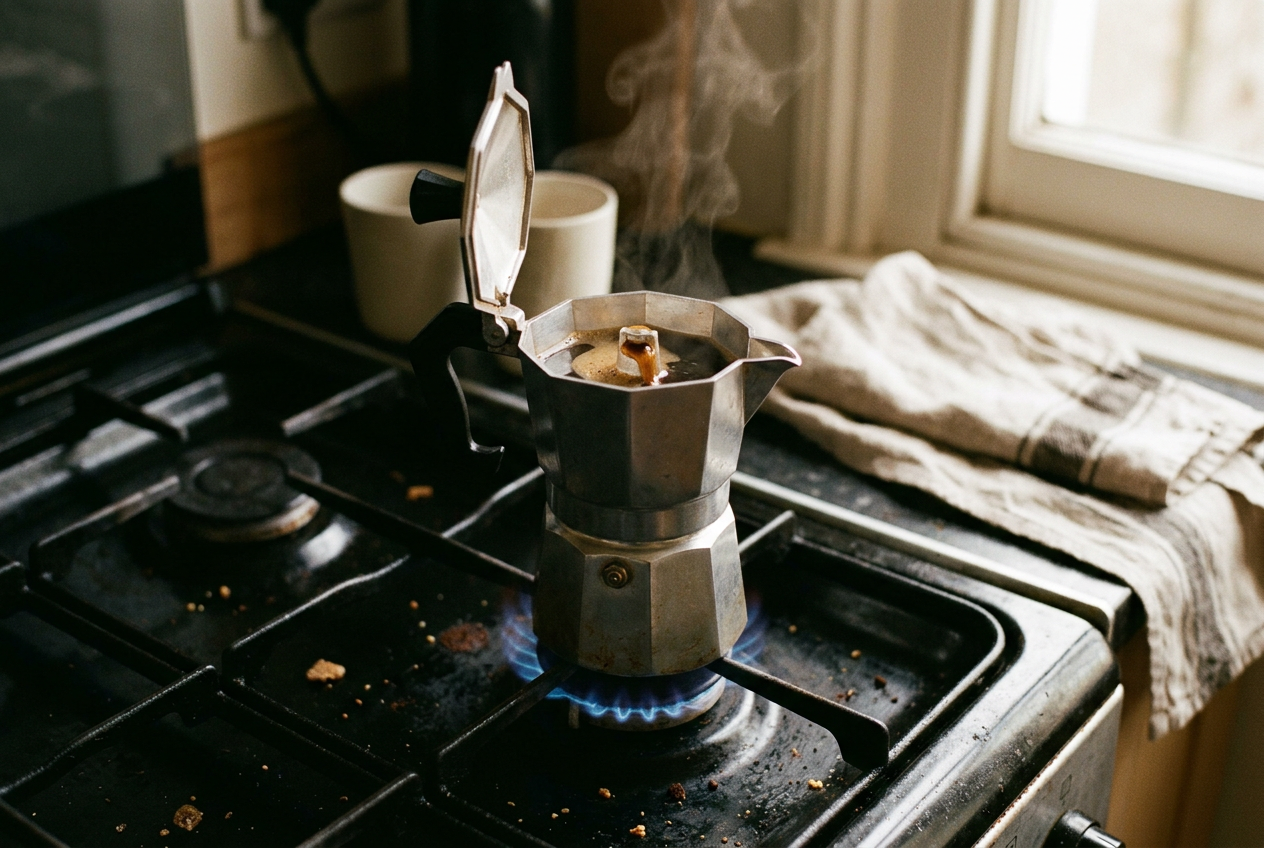
Ten thermocouples on a Bialetti show the first coffee leaving the tank at 68.7 °C, and the rattle at the end is the worst part of the brew.
The rule in most kitchens is simple: put the moka pot on the heat, wait for the boil, wait for the gurgle, pour. Almost none of that describes what the device is doing. Researchers from illycaffe and the University of Trieste wired a standard three cup Bialetti Moka Express with ten thermocouples and a pressure sensor and ran twenty brews on it. The first coffee left the tank at 68.7 °C. Nothing boiled, and by the time the familiar rattle arrives, the better half of the brew is already finished.
Where the boiling point belief comes from
The paper is blunt about it. The authors call it an article of faith among stove-top coffee maker users that standard atmosphere boiling point is needed to drive the water out of the tank. The measurements disprove it. Pressure does climb, and the climb becomes obvious somewhere around 90 °C of tank water, which is probably why the belief survives.
A second assumption sits underneath, and it fails too. The probe in the air above the waterline reads considerably colder than the water below it, right through the brew, so the two are never in equilibrium. The tank begins with 20 cm³ of ordinary air trapped above the water, and that dry air carries a large share of the pressure that pushes the brew upward. Steam is not doing the job alone.
What ten thermocouples found inside a moka pot
The rig was ordinary where it counts. A three cup Moka Express from Bialetti Industrie, its 220 cm³ tank filled with 150 g of water, 15 g of a medium roast 100% arabica blend in the funnel, ground coarse for stove-top pots. An electric ring supplied the heat, in two series of ten runs, one at 400 W and one at 600 W.
Table 1 of the study in Applied Thermal Engineering holds the number that ends the argument. When the first water leaves the tank its temperature is 68.7 °C on the lower setting and 70.2 °C on the higher one. Across the whole run the mean water temperature comes to 94.3 °C and 97.6 °C. Only at the end, with 120 g gone, does the tank reach 117.2 °C, past boiling because it is under pressure by then.

The coffee bed stops behaving like a filter
Water meets the coffee well before any of it reaches the cup. The first drop appears in the upper chamber only after roughly 40 g has left the tank, the point at which the 21 mm layer of coffee grounds is finally soaked through. Nothing is arriving in the cup before that, though a great deal is happening inside the bed.
Once flow starts, the bed changes under it. Insoluble polysaccharides swell, particles shift, porosity falls, and the resistance the water meets climbs while the brew is still running. Measured permeability of the coffee bed sits between 70 and 400 millidarcy during the steady phase, more than ten times below the single figure of 2300 millidarcy that Gianino derived from a simpler model in 2007. Something that changes by a factor of six inside one brew is not a filter. It is a material being rebuilt while it works.
What actually reaches the cup, and how warm
Heat leaves the water on the way through. The bed takes some, the metal takes some, and the liquid landing in the upper chamber is measurably cooler than the liquid that left the tank. It starts at 63.0 °C on the lower setting, averages 78.8 °C over the run, and only touches 95.8 °C right at the end.
That average is worth sitting with. A brewing temperature below 80 °C is cooler than what a filter machine is meant to deliver, and it is part of why moka coffee tastes as it does rather than like a small espresso. Strength comes from somewhere else: 15 g of coffee against 150 g of water is a far tighter ratio of coffee to water than any drip brew.

The rattle is the part worth cutting
Up to about 120 g of water flowed the tank is a closed system and extraction is orderly. Past that the water level drops below the end of the funnel, air short-circuits through, and what is left flashes into vapour. The authors named this the strombolian phase, after the volcano, and it is announced by exactly the rattling sound most people treat as the signal that the coffee is ready.
What comes out during it is a different drink. Vapour, liquid and solids extract together at the highest temperature and pressure of the cycle, and the compounds released under those conditions are the ones the authors call noxious for the quality of the extract. The totals show it. An extraction yield of 18% to 22% is the range generally proposed as acceptable, with anything under 16% counted as under-extracted and anything above 24% as over-extracted. Published figures for the moka run from 27.59% to 31.9%.
The fix is small and free. Run the pot on the lower flame, since every temperature in the study came out cooler at 400 W than at 600 W, and lift it off the heat at the first rattle instead of waiting for the noise to finish. Then taste it, and notice how much cooler that cup is than the story attached to it.
And what goes into the funnel?

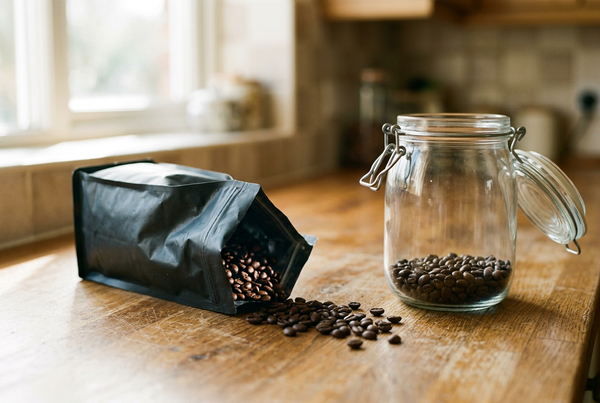
None of this rescues a bag that has been open since spring. A bed can only give up what is in it, and a stale roast on a low flame is still a stale roast. Santo Café is Mexican coffee, 100% arabica and freshly roasted, which is the one variable no thermocouple in that study was measuring.

Taste our coffee from Mexico
Freshly roasted, delivered to your door.