
From goat herder to global drink — the history of coffee
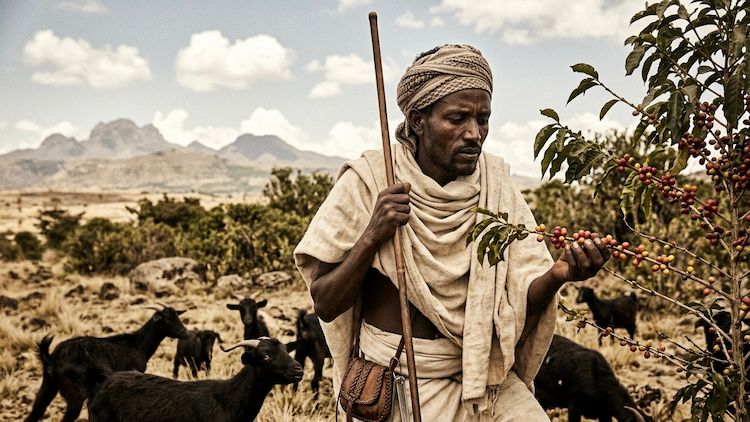
What started as an accidental discovery on an Ethiopian plateau grew into the most consumed beverage in the world after water.
Coffee is part of everyday life for billions of people. But where does coffee actually come from, and how did it all begin. The history of coffee is one of coincidence, adventure, and a journey across continents.
How coffee originated on the Ethiopian plateau
The story begins somewhere in the 9th century, on a highland in Ethiopia. A goat herder named Kaldi noticed that his goats became unusually energetic after eating the berries of a particular tree — so full of energy they could barely sleep. He reported his finding to a monk at a nearby monastery.
The monk made a drink from the berries and discovered that it kept him alert during long evening prayers. He shared the discovery with the other monks, and knowledge of the energising berry began to spread.

The Arab world as the birthplace of coffee culture
By the 15th century, coffee was being cultivated and traded for the first time on the Arabian Peninsula, in what is now Yemen. From there, its popularity spread to Iran, Egypt, Syria and Turkey.
Throughout cities across the Middle East, so-called qahveh khaneh — public coffeehouses — began to appear. These places were more than just somewhere to drink. You could play chess, listen to music, exchange news and debate ideas. They were even called "Schools of the Wise."
Coffee conquered Europe
In the 17th century, coffee reached Europe — and not without resistance. Venetian clergy called it the "bitter invention of Satan." Pope Clement VIII eventually tasted it himself and gave it his blessing, after which its rise was unstoppable.
In England, coffeehouses sprang up across the country. By the mid-17th century, London had more than 300. For a penny, you could buy a cup of coffee and a stimulating conversation. Lloyd's of London, the global insurance market, famously grew out of one of those coffeehouses.
Where coffee spread next
The Dutch played a crucial role in the history of coffee. After failed attempts in India, they became the first to successfully cultivate coffee outside Arabia — on the island of Java in present-day Indonesia. They later expanded to Sumatra and Sulawesi, and created the world's first coffee blend there: the now-classic Mocha Java.

Coffee's journey to the Americas is equally remarkable. In 1723, French naval officer Gabriel de Clieu transported a single coffee seedling from Paris to Martinique. Despite a stormy voyage, pirates and even a saboteur, the plant survived. That one seedling became the ancestor of millions of coffee trees across Central and South America.
From luxury product to everyday ritual
By the 19th century, coffee had become one of the most profitable export crops in the world, second only to crude oil. Entire nations built their economies on coffee alone.
In the 20th and 21st centuries, several "waves" of coffee culture followed. The first wave brought mass production and convenience. The second brought coffee chains and a richer experience. The third wave — still ongoing — is defined by quality, transparency, origin and sustainability.
The history of coffee lives on
From a wild shrub in Ethiopia to a global daily ritual. The history of coffee is one of curiosity, discovery, and connection. Whether you're drinking an espresso in Amsterdam or brewing a pour-over in Mexico, you're part of a story that has been written for more than a thousand years.

Taste our coffee from Mexico
Freshly roasted, delivered to your door.


