
Nayarit coffee left 2,164 hectares planted and unpicked in 2025
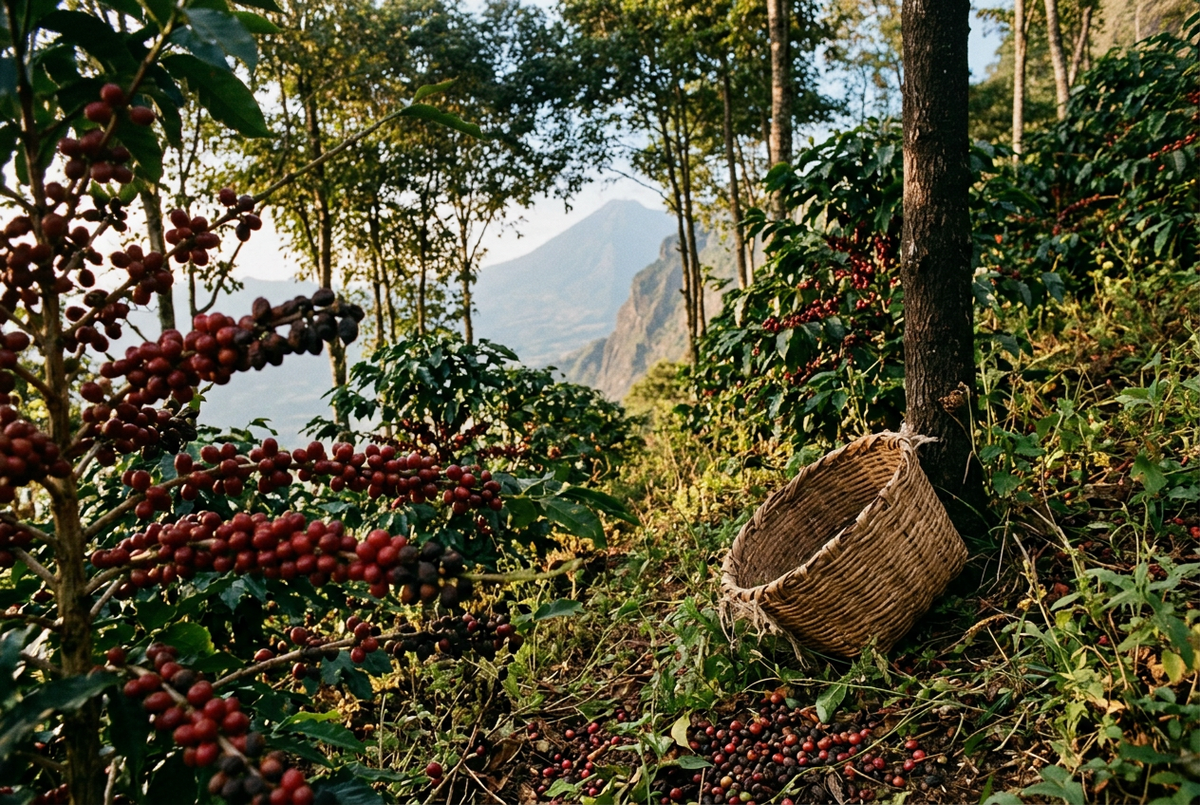
Nayarit still has the coffee trees in the ground; what it no longer has is a harvest to match them.
Nayarit's growers had 14,969 hectares of coffee in the ground in 2025 and harvested 12,805 of them. The difference, 2,164 hectares, is land carrying coffee trees that produced nothing at all. Ten years earlier the same state left 96 hectares unpicked. The map did not change in between. What changed is how much Mexican coffee actually comes off the trees that are already standing there, and in Nayarit those two numbers have been drifting apart for a decade. The state is still on the map of Mexican coffee. A growing share of its own planted land has quietly dropped off the harvest.
Seventh place on a list of fifteen
Fifteen Mexican states reported a coffee crop in 2025. Nayarit came seventh with 11,058 tonnes of coffee cherry, behind Chiapas, Veracruz, Puebla, Oaxaca, Guerrero and Hidalgo. That is more than Jalisco and Colima managed together, and still small enough that the state barely appears in anything written about where Mexico's coffee comes from.
By planted area it ranks eighth, at 14,969 hectares. Ten municipalities carry the entire crop and three of them do most of the work: Compostela, San Blas and Xalisco brought in 8,057 tonnes between them, 73% of the state total. The remaining seven, from Ruíz down to Santa María del Oro, split what is left.
What a decade did to the coffee harvest
Nayarit produced 17,679 tonnes in 2015. It produced 11,058 in 2025. That is a drop of 37% in ten years, over a stretch when the national crop moved the other way and rose 4.2%, from 1,026,252 tonnes to 1,069,464. Those figures sit in the closing agricultural accounts that SIAP, Mexico's agri-food statistics service, publishes municipality by municipality.
Coffee yields went with it. A harvested hectare in Nayarit gave 1.04 tonnes of cherry in 2015 and 0.86 in 2025, against a national average that year of 1.61. Roughly half the country's rate, on the hectares that were picked at all.
That figure is worth holding still for a moment. A yield is production divided by the area actually harvested, so the abandoned land has already been taken out of it. Two separate things are happening at once in Nayarit: the trees that do get picked are giving less than they used to, and fewer of them are getting picked.

The hectares that stay planted
The gap between planted and harvested is where this actually lives. In 2015 it was 96 hectares out of 17,068, a rounding error. In the 2020 crop year it was 5,783, more than a third of everything Nayarit had in the ground. In 2025 it was 2,164.
Compostela shows it at municipal scale: 4,701 hectares planted, 3,739 harvested, 962 standing there untouched. Trees do not get pulled up when a harvest is skipped. They stay, they keep showing up in the planted column, and they stop showing up in the other one. San Luis Potosí has been losing the land and the crop together, which at least reads as an orderly retreat. Nayarit is keeping the land and letting the picking go.
The direction since 2020 is not simply recovery either. The figure came down from 5,783 hectares to 2,164, which is better, and it is still more than twenty times what it was in 2015. A hurricane or a bad flowering explains a spike. Neither explains a floor that settles well above where the old floor used to be.
What the price says, and what it cannot
Money is not the obvious culprit. The farmgate price in Nayarit in 2025 worked out at 12,137 pesos a tonne of cherry, against a national average of 8,161 and 5,482 in Chiapas, which grows more coffee than any other Mexican state. Growers there are paid well above the national rate for what they do bring in. That is the part that resists the easy story. A crop being walked away from because it pays badly ought to show a weak price, not a strong one.
All ten municipalities are recorded as rain-fed coffee, with not one irrigated hectare; neighbouring Jalisco records both. Beyond that the columns go quiet. Mexican coffee farmers average 54 years old, and labour is the obvious suspect, but the coffee harvest data carries no line for who was there to pick.
So the honest reading is a narrow one. On a rising share of Nayarit's planted land it has stopped being worth picking, or stopped being possible, and that has held for at least ten years. If you want to watch an origin properly, the production total is the wrong number. Put the planted and harvested columns side by side and read the space between them.

Want to taste what did get picked?

Every bag that ends up in a kitchen is coffee somebody walked into a plot and took off the tree, which is precisely the part these columns keep losing. Santo Café sells Mexican arabica, roasted fresh rather than left sitting, with the origin named on the pack instead of buried in a blend. If the space between planted and picked is what bothers you, buying coffee whose origin you can actually name is the smallest useful thing to do about it.

Taste our coffee from Mexico
Freshly roasted, delivered to your door.


