
Oaxaca coffee: the third largest area, the fourth largest crop
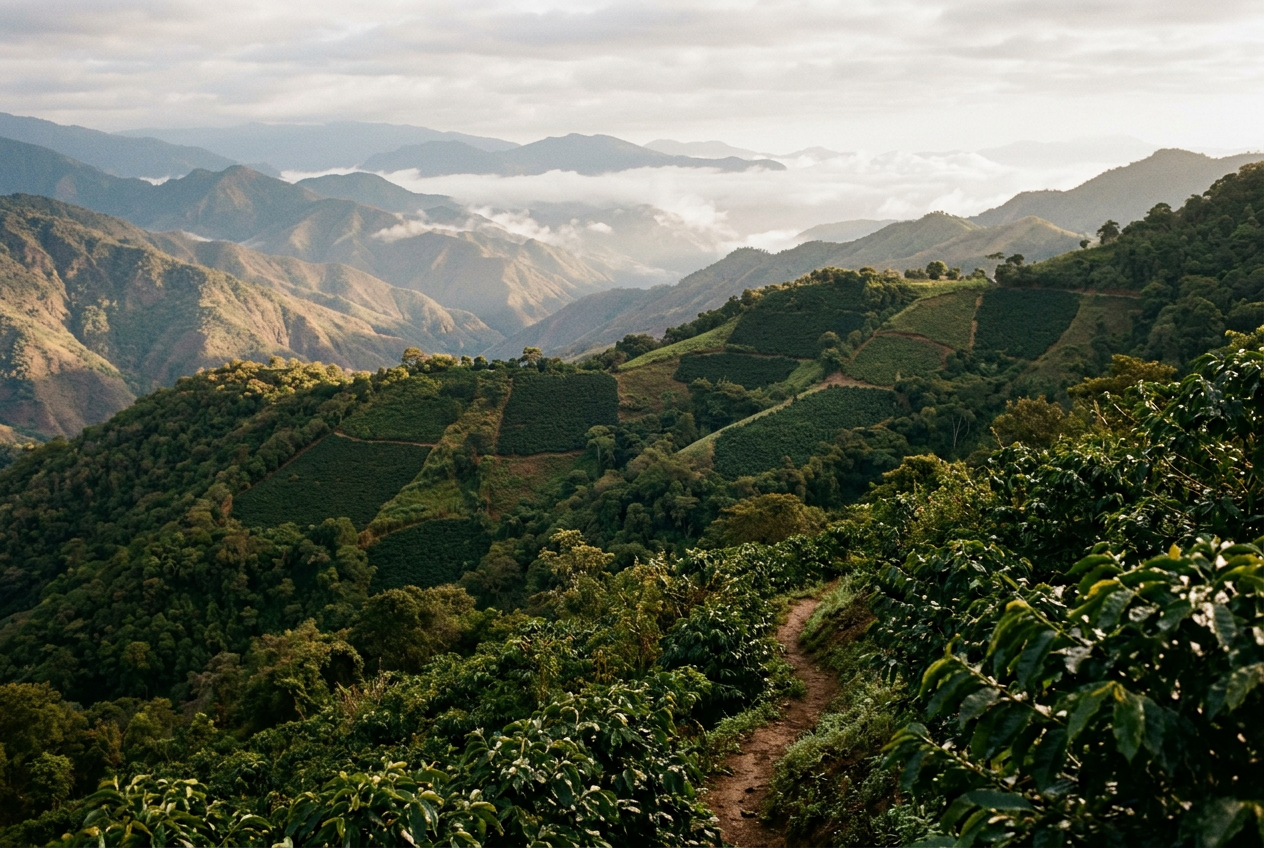
Oaxaca grows coffee in more municipalities than any other Mexican state and still finishes fourth on tonnage.
Look at a map of where Mexican coffee is grown and Oaxaca keeps turning up. The state has coffee in 151 separate municipalities, more than any other state in the country. Then look at the tonnage and Oaxaca sits fourth, behind three states that grow more coffee in fewer places. Oaxaca coffee is the clearest case in Mexico of a growing region that is wide rather than deep, and the 2024 coffee harvest figures make the gap hard to miss.
The widest coffee map in the country
Mexico closed 2024 with coffee recorded in 485 municipalities across 14 states. Oaxaca accounts for 151 of them. Veracruz, which has the second-longest list, reaches 100. Chiapas, growing more than four times as much, manages with 87. Puebla needs 54.
Roughly a third of every municipality that grows Mexican coffee therefore sits inside one state. That is geography before it is farming. The 2024 file lists coffee in seven of the state's agricultural districts, from Tuxtepec and the Cañada in the north down to the Costa and the Istmo, which is a lot of country for one crop to be scattered over.
Third by land, fourth by tonnage
Oaxaca had 132,268 hectares of coffee planted in 2024. That is 18.9 percent of the national total of 701,335 hectares and the third largest coffee growing area in the country, behind Chiapas and Veracruz. Production tells a different story. The state brought in 90,257 tonnes, 8.5 percent of a national crop of 1,056,317 tonnes, and fourth place, behind Puebla.
Every one of those weights is cherry coffee, the fruit as it comes off the tree rather than the green bean that eventually leaves the country, which is how the agricultural production close published by SIAP records it. Three places between area and output is a wide gap for any crop to carry.

Where the coffee yields separate
Divide tonnes by harvested hectares and the picture sharpens. Oaxaca returned 0.77 tonnes per hectare in 2024. Chiapas managed 1.63 and Veracruz 1.87. Puebla, the state that gets the most out of the least land, reached 3.40, which is 4.4 times what Oaxaca took off the same amount of ground.
Coffee yields at that level are neither a scandal nor a mystery, but the 2024 file does not explain them. It records what came off the land, not why. Tree age, altitude, the long shadow of leaf rust, how little goes onto these plots in the way of inputs: all plausible, none of them settled by a production table.
The land that is planted but never picked
A second number is worth reading next to the yield. Of the 132,268 hectares planted in Oaxaca, 117,472 were harvested. The other 14,796 hectares, 11.2 percent of the state's planted area, produced nothing the file records.
That share stands out. Chiapas left 1.4 percent of its planted coffee unharvested in 2024, Veracruz 5.6 percent, Puebla 7.2 percent. Nationally 659,699 of 701,335 planted hectares were picked. Coffee standing unpicked is still coffee land on paper, and it is part of why the area figure and the tonnage figure point in different directions.

No centre of gravity
Most coffee states have a capital. In Guerrero one municipality, Atoyac de Álvarez, accounts for 54.1 percent of the state crop. Oaxaca has nothing of the kind. Its largest producer, San Juan Bautista Valle Nacional, brought in 5,184 tonnes, 5.7 percent of the state total. San Juan Cotzocón follows on 4,229 tonnes. After that the list flattens fast.
Pluma Hidalgo, the municipality behind the state's denomination of origin, produced 2,749 tonnes at 0.68 tonnes per hectare, below the Oaxaca average rather than above it. A crop divided that finely is a crop in the hands of smallholder growers rather than estates, which the numbers imply even where they cannot prove it.
The use of all this is small and worth keeping. When an origin gets called big, ask whether that means land or tonnage. For Oaxaca the two answers sit three places apart.
What does a number like that change in the cup?

Yield per hectare is an accounting fact about land, not a verdict on flavour. A cup is settled by variety, altitude, processing and how recently the beans were roasted, which is where Santo Café starts: Mexican arabica coffee, roasted in small batches and sent out soon after. A production table tells you how a region farms. It says nothing about how the coffee tastes.

Taste our coffee from Mexico
Freshly roasted, delivered to your door.


