
Puebla coffee: small plots and the highest yields in Mexico
Puebla is Mexico's third coffee state by volume, holds no top-three share of the planted area, and is forecast to out-yield every other state per hectare.
Chiapas has the volume and Veracruz has the name. The third state on the Mexican coffee table is the one almost nobody names, and it grows its crop on hillsides so steep that a plot is measured in a walk rather than a drive. Puebla does not have the land to explain that ranking. What it has is density: more trees to the hectare, more hands on each tree, and six years of investment that landed in the yield column instead of the acreage one.
Where Puebla coffee actually starts
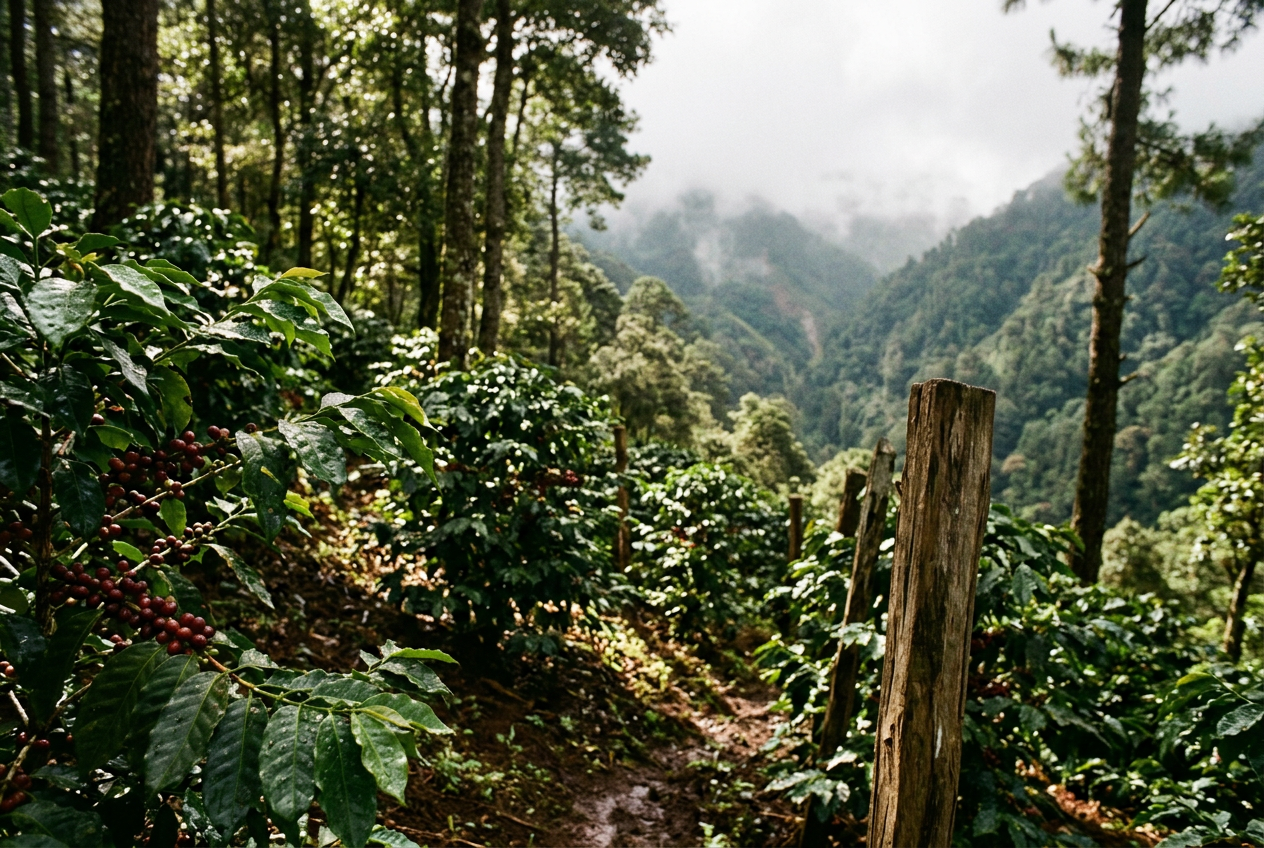
The crop comes off three mountain zones in the north and east of the state: the Sierra Norte de Puebla, the Sierra Nororiental and the Sierra Negra. The state agriculture ministry places the growing band between 700 and 1,800 metres above sea level and counts more than 43,000 production units inside it. Production unit is a dry phrase for what is usually one family and one slope.
Those mountains are wet and the roads are poor. Plenty of the harvest still comes down the hill on somebody's back before it ever meets a truck.
Third by weight, and not by a little
SIAP, the statistics arm of Mexico's agriculture ministry, ranks every coffee producing state by the weight of fruit it picks. For the 2024 cycle through June it put Puebla at 228,006 tonnes of cherry coffee, 21.6 percent of the national crop, behind Chiapas and Veracruz and ahead of everyone else. The three of them together accounted for 83.1 percent of everything the country picked that season.
Third place in Mexican coffee is a quiet position. It comes with no denomination of origin, no export brand, and almost no shelf language. It comes with tonnage.

The land does not match the ranking
SIAP recorded 703,943 hectares planted to coffee nationally in the same report. The three largest shares of that area belong to Chiapas at 34.7 percent, Veracruz at 20.6 percent and Oaxaca at 18.7 percent, 74.0 percent between them. Puebla is not on that list. Oaxaca holds more coffee land than Puebla does and picks less fruit off it.
That gap is the whole argument. Veracruz, the second state, works at a scale Puebla has no chance of matching on area, so Puebla answers by planting closer, pruning harder and pulling out tired trees sooner.
A yield forecast that doubles the average
The United States Department of Agriculture publishes an annual read on the Mexican crop, and its May 2026 report forecasts Puebla to have the highest yield of any state in marketing year 2026/27, at 13 bags green bean equivalent per hectare. The report calls that more than double the national average and credits soil, replanting with rust resistant stock, and road access to large cities.
A forecast is not a harvest. The same report puts national output at 4.1 million bags, 85 percent of it arabica coffee, and forecasts are revised as often as they are met. What is worth holding on to is the direction: no other state is projected to pull that much out of a hectare.

Plots of a hectare and a half
A 2015 study of 101 growers in Cuetzalan, in the Sierra Norte de Puebla, found an average planted area of 1.57 hectares per grower and an average yield of 2.06 tonnes per hectare. Of that sample, 59.4 percent sold through a coffee cooperative and 40.6 percent to intermediaries. The split decides more than it sounds like it should, because the first price offered at the bottom of the hill is usually the price that settles whether the year paid for itself.
The state's own catalogue reports productivity climbing from 9.2 to 17 quintales per hectare across the 2019 to 2025 cycles. Whatever else sits behind that figure, it was won by smallholder farmers on plots the size of a few football pitches, not by clearing new ground. Yield per hectare, not tonnage, is what tells you whether an origin is dense or simply large. When the next bag calls its region big, it is worth asking which of the two is meant.
Want to taste what a slope like that puts in the cup?

Density, altitude and slow ripening are not label words; they arrive in the cup as acidity and body once the beans have been roasted and ground. Santo Café roasts a single-origin Mexican arabica in small batches so it reaches a kitchen while it still has something to say. Grind it a shade coarser than feels right, pour a little slower, and let the hillside do the talking.

Taste our coffee from Mexico
Freshly roasted, delivered to your door.


