
Veracruz coffee: Mexico's second state and its highest yields
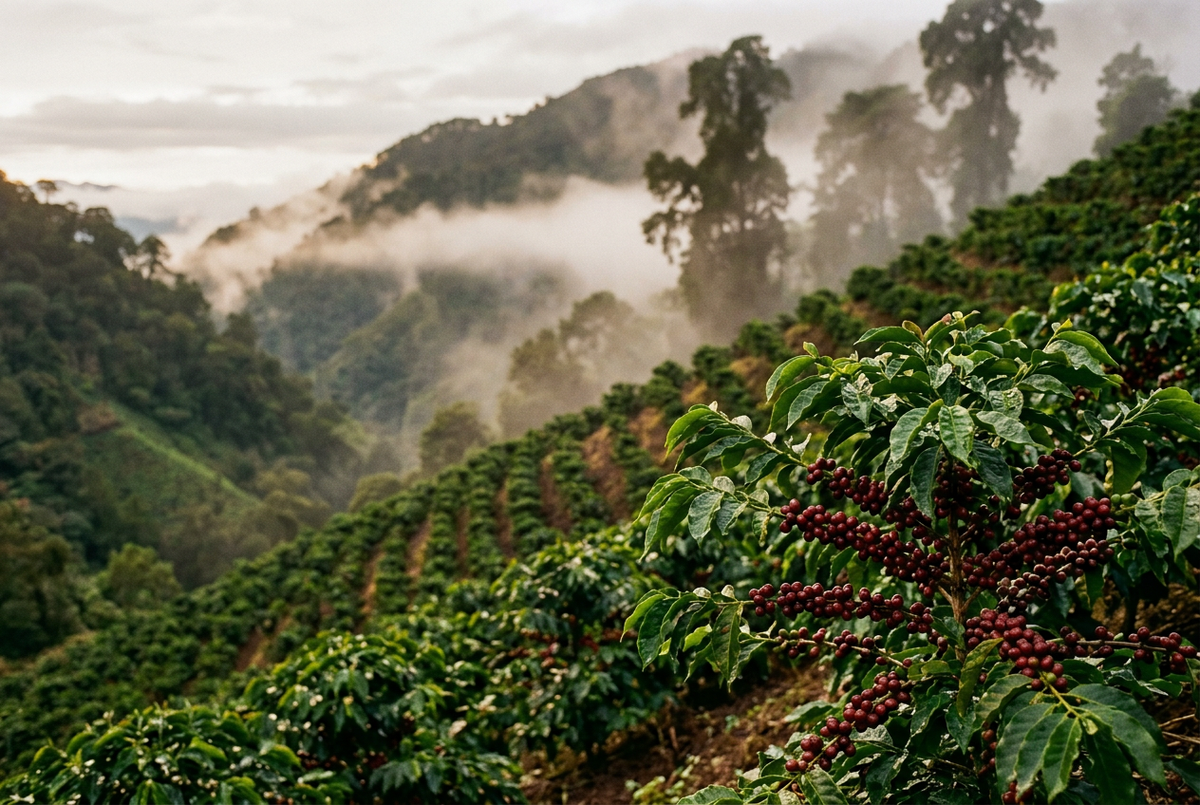
Veracruz grows about a quarter of Mexico's coffee, out-yields Chiapas per hectare and has had its name protected by law since 2000.
Ask anyone to name a Mexican coffee state and the answer comes back Chiapas, almost every time. Veracruz rarely gets a mention, which is strange arithmetic: the state along the Gulf coast grows close to a quarter of the national crop, pulls more out of every hectare than Chiapas does, and has carried a denomination of origin since 2000. Veracruz coffee is the half of the story that never made the poster.
Where Mexican coffee actually grows
Coffee grows in 14 Mexican states, but the weight sits in a handful of them. The USDA state table for the 2025/26 forecast put Chiapas, Veracruz, Puebla and Oaxaca together at 91.4 percent of national output, with Chiapas on 37 percent and Veracruz on 24 percent. The most recent annual report tightens that top tier further: Chiapas, Veracruz and Puebla alone now account for more than 80 percent of what the country produces, out of a 2026/27 forecast of 4.1 million 60-kilogram bags.
Scale is only half of it. Veracruz harvested 138,000 hectares in that same forecast, well short of the ground Chiapas works, and still returned 7.04 bags per hectare against a national average of 5.89. Only Puebla runs hotter. The state does not matter because it is large. It matters because the land does more with what it has.
The line at 750 metres
The name is not a loose regional label. The declaration protecting Café Veracruz was published in Mexico's official gazette on 15 November 2000, and the standard built on top of it restricts the name to Coffea arabica grown above 750 metres inside the protected zone. Oaxaca's Pluma region took the same legal route, and the effect is identical: the name stops being a marketing word and turns into a boundary a farm is either inside or outside.
Altitude is doing real work in that sentence. About 35 percent of the Mexican crop grows above 900 metres, and another 44 percent sits between 600 and 900 metres, which means the protected line runs straight through the middle of the country's coffee. Veracruz spans both sides of it. The upper slopes send high altitude coffee to buyers who read the elevation on a label, while the low ground does something else entirely.

Coatepec coffee and the drizzle that never stops
Coatepec is the town most tied to the state's reputation, and what makes Coatepec coffee work is weather that would annoy almost anybody else. Warm wet air comes in off the Gulf, meets cold air sliding down the Sierra Madre Oriental, and settles into a fine grey drizzle the locals call chipi-chipi. Nobody there calls it rain. It is closer to a permanent damp that never quite commits.
That drizzle, and the cloud that sits with it, slows the cherry down. Slow ripening is the whole argument for growing high, and the fog hands Coatepec coffee some of that for free, without the elevation. The route through those hills is now one of the agrotourism circuits the agriculture and tourism ministries promote under the Ask for a Mexican Coffee campaign, alongside the ones in Chiapas and Puebla.
What the coffee harvest looks like now
The picture is not uniformly good. Veracruz is forecast to win back harvested area in 2026/27 after heavy rains knocked its robusta about in 2025, a reminder that the coffee harvest on the state's low ground is a different business from the one up on its ridges. Nationally the crop splits 85 percent arabica and 15 percent robusta, and robusta is the half that is growing, pulled along by the soluble processors. The rust-resistant varieties that replaced the dead trees are still working their way toward a first real crop.

Money made the difference. The USDA quotes International Coffee Organization figures putting arabica coffee at $3.31 a pound in March 2026, roughly 40 percent above the ten-year average, and two profitable years have gone into plant density, inputs and quality control rather than new land. For coffee growing regions that stopped expanding their footprint years ago, that is close to the only lever left. Next time a bag says Veracruz or altura, look for the elevation printed beside it. That number is the claim, and here it is a legal one.
Curious how a Mexican arabica actually tastes at home?

Reading about fog belts and altitude lines is one thing; tasting what they do to a cup is another. Santo Café roasts Mexican arabica in small batches and sends it out whole bean, so the grind stays your decision rather than a factory's. Pick a brew ratio you already trust, hold it steady for a week, and change one variable at a time.

Taste our coffee from Mexico
Freshly roasted, delivered to your door.


