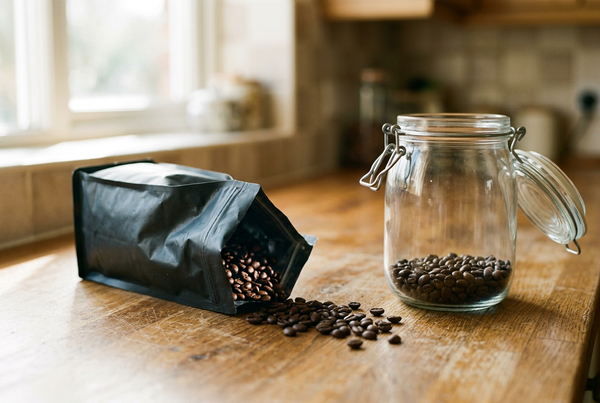
Freezing coffee beans gives a narrower grind, not a finer one
A 2016 grinding study found that the freezer changes the spread of a coffee grind far more than it changes its size.
A bag of beans in the freezer looks like a storage decision. It is also a grinder setting, and that is the part almost nobody accounts for. In 2016 a group of researchers put four coffees through one grinder at four temperatures and measured what came out, and the result explains why freezing coffee beans keeps starting arguments behind the bar. Cold beans do not simply grind finer. They grind more evenly, and those are not the same claim.
Four temperatures, one grinder, four coffees
The experiment is unusually easy to follow. Every sample went through a Mahlkönig EK 43 spinning at 1480 rpm on Turkish burrs, so the machine never changed. What changed was the bean. Batches were left to equilibrate for 2 hours at four temperatures before grinding: liquid nitrogen at roughly minus 196 °C, dry ice at minus 79 °C, a domestic freezer at minus 19 °C, and a kitchen counter at 20 °C.
The coffees were a Guatemala Caturra and Bourbon, an El Salvador Pacamara, a Tanzania Red Bourbon and an Ethiopia Mixed Heirloom, all light to medium roasted, and the measurements were published in full rather than summarised. Laser diffraction counted the particles. Nothing in the method depends on trusting a palate.
Cold beans shatter, warm beans smear
The mechanism the authors point to is the glass transition. Temperature changes in amorphous materials can lead to well defined glass transitions, where the material shifts from rubbery and flexible to hard and brittle. A roasted bean at 20 °C still has some give in it. The same bean at minus 19 °C has almost none.
That difference shows up in the half second of contact. A bean with give deforms before it breaks, and it tears into pieces of wildly different sizes. A brittle bean fractures along the path of least resistance and leaves fragments closer to each other in size. Any burr grinder is doing the same mechanical job either way. The bean decides how cleanly the job goes.

The particle size distribution narrows before it shrinks
Here the folklore and the data part company. The fine particulate cutoff, the boundary the authors drew between the fines and everything larger, came out at 70 ± 3 µm for beans ground at 20 °C and 73 ± 3 µm for beans taken straight from a minus 19 °C freezer. Within the stated error those are the same number. The freezer did not make the grind finer.
What it did was tighten the spread. The paper reports that the distribution generally becomes narrower as the beans are cooled, with the biggest change occurring between room temperature and the minus 19 °C beans. The dramatic drop in size only arrives when the temperature does: 63 ± 3 µm at minus 79 °C, 61 ± 3 µm under liquid nitrogen, and the mode reduced by 31% between room temperature and minus 200 °C. No kitchen appliance goes there, and no home grinder needs to, whatever shape its burrs are cut in. What a freezer buys is grind consistency, which is a different currency from grind size.
What a burr grinder does with a narrower spread
Coffee grinds are stubbornly bimodal. There is a crowd of fines and a separate crowd of much larger particles, and the fine particulates contribute the majority of the accessible surface area. Water meets that surface first. Shift the balance between the two crowds and the cup changes while the dial has not moved.
The practical consequence is a warning about settings, not a promise about flavour. The paper notes that with warm burrs a finer grind setting may be required to obtain the same effective surface area. Read backwards, that says the number on the collar means one thing for a room temperature bean and something else for a frozen one. Grinder temperature drifts through a busy hour anyway, which is why a single drop of water on the beans can change what stays inside the machine without touching particle size distribution at all.

What the paper does not say
It does not say frozen beans taste better. The authors state that the impact on taste and preference is not the focus of the study, and no extraction yield or dissolved solids figure appears anywhere in it. A narrower spread is a physical result, not a verdict in the cup.
It does remove one excuse. The spread came out independent of bean origin and processing method across a Guatemala, an El Salvador, a Tanzania and an Ethiopia, which puts the grind curve on the grinder and the temperature rather than on the coffee. Most advice about coffee bean storage stops at oxygen and light. This is the part that reaches the basket.
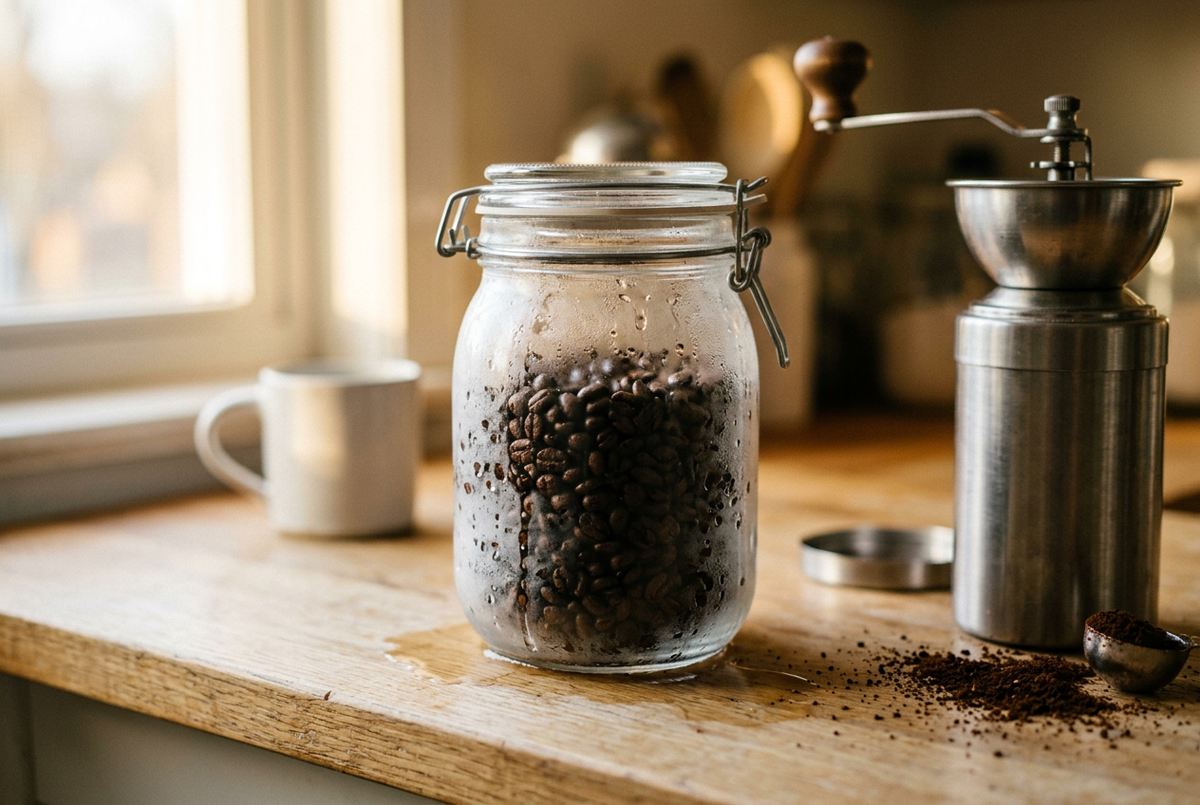
Worth an hour on a quiet morning: grind one dose at the usual setting from a jar of frozen coffee beans, grind a second at that same setting from beans that have sat on the counter, and taste them next to each other before changing anything. Same number on the collar, different surface area going into the water.
Which beans are worth the freezer space?

None of this rescues stale coffee, and a tighter spread from a tired bean is still a tired bean. Buying smaller and more often does more for the cup than any freezer trick, which is the idea behind the Santo Café pouch of Mexican arabica: freshly roasted, sized to be drunk rather than stockpiled. Whatever temperature those beans go into the grinder at, they get a fair test.

Taste our coffee from Mexico
Freshly roasted, delivered to your door.