Q-grader coffee explained — how professionals are certified to taste
Fewer than half of candidates pass the Q-grader certification on the first attempt. Here is what it takes.
Behind every bag of specialty coffee with a score of 80 or higher sits a person who made that assessment. That is a Q-grader coffee professional: someone trained and certified to evaluate coffee objectively on an internationally standardised scale. Without Q-graders, the specialty coffee industry would have no common language.
What a Q-grader actually does
A Q-grader evaluates green coffee beans and roasted coffee for quality, defects and flavour profile. They use the protocols of the Specialty Coffee Association (SCA) and the Coffee Quality Institute (CQI), the same organisation that manages the certification. A Q-grader can give a coffee lot an official quality score that is recognised by buyers, exporters and roasters worldwide.
That makes the Q-grader coffee professional a crucial link in the coffee chain. A farmer in Mexico and a buyer in Amsterdam speak the same language about coffee quality through a Q-report, without ever needing to meet. Perfect Daily Grind describes how the Q-system has made the global trading of specialty coffee more transparent and reliable.
How the certification works
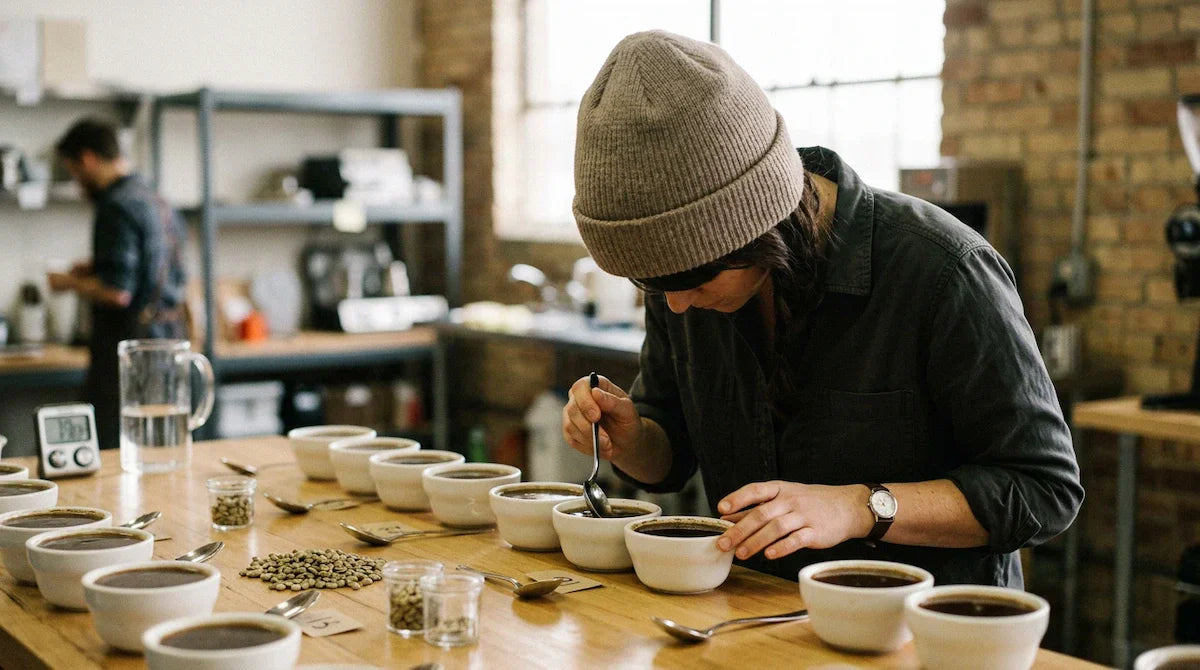
The Q-grader coffee certification consists of 22 individual tests spread across six intensive days. The tests cover a broad spectrum of skills: blind cuppings where coffees are assessed on flavour alone, aroma identification from a set of 36 standard aromas, organoleptic tests where acidity, body and sweetness are identified blind, and theoretical knowledge about processing methods, botany and trade quality grades.

The pass rate is low. Fewer than half of candidates pass all 22 tests on the first attempt. Those who fail one or more tests may retake them, but the programme is designed so that average taste knowledge is not sufficient. A Q-grader must be able to taste consistently and reproducibly, even under time pressure and after multiple consecutive sessions.
The coffee certification is not permanent. Q-graders must recertify every three years to maintain their title. Taste perception and calibration can shift over time and recertification ensures the standard remains uniform worldwide.
Why the system matters
Without a standardised evaluation system, specialty coffee evaluation would depend on subjective judgements that cannot be compared. A score of 85 at a cupping in Ethiopia must mean the same as a score of 85 at a cupping in Colombia or the Netherlands. The Q-grader coffee standard makes that possible.
For producers the Q-certification is also economically relevant. A lot with an official Q-report of 84 or higher can typically achieve a higher market price than a comparable lot without certification. The coffee quality is objectively demonstrated, the risk for the buyer is lower and the price reflects that.

Who can become a Q-grader
The certification is open to everyone: farmers, exporters, roasters, buyers and coffee enthusiasts. In practice most Q-graders work at importers, larger roasters or quality control organisations. The number of certified Q-graders worldwide is growing steadily but remains limited relative to the size of the coffee industry.
A Q-grader in a small country like the Netherlands represents a scarce expertise. Anyone working with SCA coffee standards and seriously wanting to buy on quality will sooner or later work with someone who has completed this coffee certification.
The best coffee in the world is not found by chance. It is found by people trained to taste the difference.

Drink the coffee behind the writing
Freshly roasted, delivered to your door, with a fair deal behind every bag.